Tuesday, April 23, 2013

The Lurk of Mr. Wrong: DARK OF THE NIGHT (1985)


You may have noticed that there's no title in the above poster.  That's because the title I gave above, Dark of the Night, is the American re-titleling for the VHS release; it was originally released in its native New Zealand under the title Mr. Wrong.  While this is a bit more plot-specific, it isn't helpful at all as the title to a horror movie, hence the generic retrofit.  Then again, pitching this movie as a horror flick isn't helpful, either.  Allow me to elaborate.

One of the most interesting details in Shaun of the Dead which nobody talks about is its deftness at telling a quarter-life crisis story.  Its protagonists are all in their late 20's and early 30's, still reeling from college B.S. and stuck in unimpressive jobs, unsure of why they got there or where they're going.  This point in a person's life is actually quite ripe for a horror tale, with a heap of uncertainty and anxiety surrounding one's life and doings.  There's a lot of moving around and uncomfortable decision making, and it's entirely possible for one of those moves to wind the protagonist up in a haunted house.  Dark of the Night is just like that, except it's a fabulous Jaguar sedan.


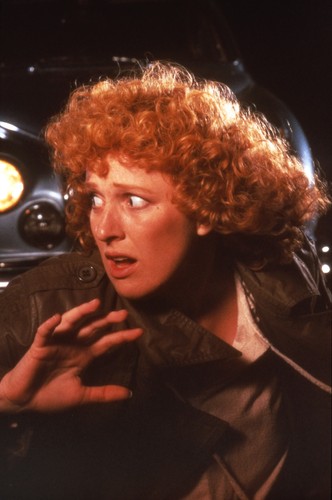
Meg (Heather Bolton) has just moved out of her parent's house, and snaps up the grand old car for a suspiciously nice sum.  There's a nice montage of her admiring all nearby bells and whistles (apparently she'd never seen a dashboard cigarette lighter before), and other drivers give props from the other lanes of the road.  Hunky-Dory-ness is quashed soon enough, however, as she hears mysterious wheezing from the back seat, and has dreams of being chased by the car and a woman walking through the rain.  Her mother is fond of the car and wonders if Meg has found a boyfriend yet, just in time for Meg to meet Wayne, an old High School classmate of hers.  The sprightly woodwinds on the soundtrack as she races down a hill after their meeting should tip the viewer off the movie is still far from blood-curdling terror.

 However, while stopped at a light in the rain, she sees the woman from her dreams coming towards her car, getting in the back just as a man gets in the passenger seat without asking.  While Meg is concerned about the silent woman the man makes thuddingly obvious passes at her - until the woman vanishes, followed by the man.  He eventually emerges from far off (though we don't know why he left), and Meg is rattled enough by this to look into the car's history, eventually uncovering its previous owner: Mary Carmichael, a woman about Meg's age who vanished years ago.

I'm going to lay it straight for you: this movie isn't particularly scary, but I don't think it was supposed to be a terrifying thrill ride to begin with.  Dark of the Night uses the set-up of a haunted car to paint a picture of twenty-something uncertainty, with Meg wrestling with life on her own and trying to deal with the poor purchase of the car.  Actress Heather Bolton is excellent as Meg, somewhat modest and awkward but with a real drive to enjoy her newfound freedom.  Her character is expertly written and realized, and the other performances and other aspects of the film are very well done.  It's the first (and apparently only decent) film by New Zealand writer/director Gaylene Preston, and it's a unique and absorbing personal project that was funded by the New Zealand Film Commission.  I've gotten the impression that film boards in Australia and New Zealand work like Canadian film funding agencies, whereby project get support if they're deemed as a valuable contribution to their country's art establishment.  Canada is usually not too interested in funding flat commercialism, and I'd bet that New Zealand has a similar policy.  The good news is that Dark of the Night is much more than that, observant, charming and beautifully filmed.  If you weren't warned beforehand you may have ended up turning the movie off after 10 minutes, which is what I did the first time I tried watching it, but I'm glad I gave it another chance, and it has a cozy spot on my VHS shelf to this day.  That's the only way to see the movie in an America-friendly format (with a chintzy-looking replacement title card), and I wasn't able to find it on YouTube.  I did find a promo for its revival in a film festival, so enjoy and let this appealing little movie into your life, if you're so inclined.


~PNK

Monday, April 15, 2013

Weaving Family Across the Land: TRAMP AT THE DOOR (1985)


When I was taking Music History in undergrad, we were visited by a Canadian composer for a special lecture on the classical tradition of the Tundra Not Unda.  Her general thesis was that being a composer in Canada (or any other artist seeking state funding) meant that government financiers were mainly interested in two subjects that theoretically made up the “Canadian Experience”: space and identity.  Space may have come from the wide open spaces of the Canadian wilderness, and how the pioneering spirit still lingered through the generations and built a foundation for country life.  Identity seems to come with living in North America, as the histories of Canada, the U.S., and Mexico were rich with the trials and tribulations of colonialism and immigration.  I can’t speak for all Canadian arts as to whether anybody producing art explores these concepts by choice or by necessity, but I can attest to the late writer Gabrielle Roy and director Allan Kroeker, whose combined arts made this wonderful TV movie from the mid-80’s that occupies that interesting slot of videos that have been out of print for decades but are very cheap to acquire online.


Tramp at the Door is set in the Manitoban Prarieside in the mid-30’s, following Gabrielle Roy herself (newcomer Joanna Schellenberg), her Justice-of-the-Peace father (August Schellenberg, Joanna’s real-life father) and her mother (Monique Mercure, who has been in things I’ve seen but I’ve never recognized her).  Her father was born of an immigrant family in Quebec, and forged a new existence for himself in early adulthood, away from his family.  His only connection left with his roots are his stories and memories, as was common with people living far away from each other in those days.  That is, until the Roy’s (called the Fornier’s in the film) are approached by a strange visitor (Ed McNamara, who died within a year of this film’s release), who we had recently seen conning a train conductor into thinking he had bought a ticket by wearing a stranger’s coat while he was in the  bathroom and getting the ticket punched before the coat’s owner returned.


The stranger approaches one rainy evening and introduces himself as Gustav, a cousin from Quebec.  Gabrielle is the one to answer the door, and she doesn’t believe him at first, because he gets her name wrong (calling her Agnes) and saying Fortnier instead of Fornier.  He is only invited inside and to the table because of the father’s curiosity in meeting a cousin from the old home.  The news of family developments spill forth, but Gustav seems to only speak of cousins as their names and details are offered to him by the family (my favorite is when he insists that a cousin who had lost his legs in the war ended up running the family farm).  Gabrielle and her mother immediately suspect that Gustav is a liar, but the father is in the mood of fool-suffering because he likes the illusion of family connection across the horizon.  Despite grumblings from his wife, he attempts sending Gustav off in the morning.  This is unsuccessful, with the father claiming that the roads are unsuitable for horseback riding.


The mother, also in the mood of fool-suffering (for her husband, anyways), gives Gustav an old work-outfit and sets him to help out around the house.  He throws himself into the help, tending to farm duties and even fetching mail from town on foot despite the great distance.  By night, he becomes a fountain of stories from the family, speaking of many cousins from the past: one who lived to be ninety after failed suicide attempts, a bootlegger who became a priest and another who killed her husband by putting glass in his soup.  Each story has a captivation to it, and Gustav often stops his stories right at a climactic point, ensuring that the family will keep him at the house for another day.  The mother is the most interesting in her reaction to all this, admitting that even though she doesn’t trust Gustav or believe the stories for a second, all information she did get of her husband’s past was in the form of stories, anecdotes, comparisons, and fragments.  Her husband’s stories were in their own way no more or less real to her than Gustav’s.


This continues for some time, with the web of history that Gustav spins becoming more and more thick and emotionally grabbing for the family.  One of the most incredible was the story of Cousin Cleofas, who apparently died aboard the Titanic with his wife, and his family didn’t find out about it until a decade later.  It’s in these moments that a thick air fills the living room, an air of rapt fascination, one that is represented beautifully by the music and lighting.  Even more fascinating is a story that he tells to Gabrielle one day, about a cousin who pulled himself up by his bootstraps by giving bottles of a cure-all cough syrup to his townspeople, and became a well-regarded and wealthy man despite having no real credentials or medical skill.  Of course, the story of how he lost all his money is for another time, stringing her along with yet another cliffhanger.


Throughout all of this a strange balance is maintained, with Gustav’s illusion keeping the family looking the other way, even though they always question him implicitly, and internally.  In a curious moment, the father finds a notice of an older, possibly deranged older man being in town on the board next to his office.  He takes the notice down, and when a coworker questions him he claims the notice was for a team of horses he wants to buy (even though he already has one), and gets defensive when probed.  Gustav has become a member of the family through pure charm, a feat that may never happen again in this day and age, where people have to undo sixteen locks on the door just to pay for pizza delivery.  He is blessed with the enormous gift of observation, and knowing how to play on people’s needs.  At one point, he breaks through to the mother’s religious bent by spinning a story of a miracle-working Brother Andre at St. John’s Oratory (a Quebec basilica).  She sees the gift of compassion in his heart, a gift that seemed obvious to them all along, by his ability to weave tales for no other purpose than to fill his hosts’ hearts with joy.


And then, he's gone.


But, not really.  Merely, he has moved onward, further West, towards another town and another family.  Nothing was taken from the Fornier’s home, and no ill feelings were kept; he just knew that it was time to keep moving.  And then the letters start coming, as Gustav tells of more family members he supposedly visits in his journeys, each one having a kind word for Mr. Fornier.  The Fornier’s spend their evenings pawing through old photographs and correspondences.  One night they think they recognize Gustav’s voice in a radio serial, and realize that his Scheherazade-like technique of cliffhangerismo may have been lifted from them.  The letters start to create a trail across the Prairie, a line of experience and warm feelings that can’t be proven by the Fornier’s but are a joy to relish.  Relatives that the father had never heard of were seemingly happy to send their regards through Gustav.  And then, he is silent.  In a pivotal scene, Gabrielle forecasts her own future as a writer by re-telling the story of the cough-syrup cousin to her classroom.   And, in her own burgeoning talent, she weaves Gustav into the character, while wearing her teacher’s coat and hat.


Much more of the plot, I shouldn’t tell, but it might not be what you expect.  It is this film’s gift to create a warm, sprawling texture that engulfs the viewer during its tidy 80-minute running time.  I can imagine that the original TV broadcast was an inferior way to view the film, as the depth of the cinematography, design, and acting is far too much for the small screen.  The cinematographer Ron Orieux and art director Bonnie von Helmot have a love affair with natural light, and the way it plays across skin, wallpaper, and wheatfields (I suspect Days of Heaven was influential in the look of the piece).  The direction by Kroeker is superb at capturing the experience of hearing Gustav’s stories, often following his inflections and movements with a handheld camera, imitating the spectator.  I got the feeling throughout most of the film that I could simply walk through the screen and live the life of a Manitoban farmer in the 1930’s, as the rhythms and moods of this kind of life are made luminous and endearing by the director’s touch.  As for the acting, it’s just right, and especially excellent from the young actress playing Gabrielle.  Ed McNamara as Gustav is astounding, giving the huckster an enormous charisma despite his obvious façading.


Few films I’ve seen have been better at exploring the relationship between family ties and storytelling, perceived connection and realistic disconnection, than this one.  Gustav opened a world of life and love spanning across thousands of kilometers, allowing an extended family spread throughout the prairie to flood into a single household.  In a way, he also was hugely helpful to the family’s immigrant experience, as immigrants have to hold onto their connections in a new world; the Fornier’s were no stranger to this, even though their ancestral homeland is never truly revealed.  Another film that expounded on the importance of immigrant family ties was Barry Levinson’s Avalon, one of my favorite family epics and a movie you should see immediately.  Referring back to my earlier point on the nature of Canadian art, Tramp at the Door is a beautiful entwining of space and identity, as well as a loving ode to the power of storytelling.  Gabrielle Roy went on to become one of the foremost Francophone writers in Canadian history, and I’m of the opinion that this story is an expression of the birth of her love for the storytelling craft (she died not long before this film was made, and it is dedicated to her memory).  The best writers in the world are those who seep compassion from every pore, can see to the heart of people and make monuments to the human experience.  It is just this gift that Gabrielle’s mother sees in Gustav, noting that he was a creature of true grace.  I believe that an Amen is in order for everybody involved.

I was unable to find the movie on YouTube, but the good news is that the old VHS copies are pretty cheap used at the Amazonz: http://www.amazon.com/gp/offer-listing/B000MC1FHS/ref=dp_olp_used?ie=UTF8&condition=used

~PNK

Monday, April 8, 2013

Philip Baker Hall's SECRET HONOR (1984)


Philip Baker Hall is a face whom you may recognize on a good day, appearing in a lot of movies and TV, and probably best known these days for appearing in three of Paul Thomas Anderson's movies, Hard Eight (as the lead)Boogie Nights, and Magnolia.  He's an actor a lot of people like but not many list among the greats, mostly because he's been relegated to small roles all his life.  I could count myself among this crowd, but that would have to be before I saw Secret Honor.  In fact, a lot of how I feel, not just about Philip Baker Hall but also film acting and speculative history, can be put into the categories of "before Secret Honor" and "after Secret Honor".

We're greeted with a text crawl:

This work is a fictional meditation
concerning the character of and events
in the history of Richard M. Nixon, who
is impersonated in this film.
The dramatist's imagination has created
some fictional events in an effort
to illuminate the character of
President Nixon.
This film is not a work of history or
a historical recreation.  It is a work of
fiction, using as a fictional character
a real person, President Richard M. Nixon--
in an attempt to understand.

The meditation is here more of a primal scream, pitting a solitary Nixon (Hall), holed up in his study with Scotch, a tape recorder, CCTV screens, a camera, and a revolver, against the world.  There are no other characters, and Nixon never leaves his study.  The only other faces we see are portraits of Lincoln, Washington, Eisenhower, Wilson, Kissinger and Nixon's mother.  He speaks to his assistant Roberto (who isn't there), issuing various instructions, including sending a manuscript to his publishers.  And then the dams break, beginning with the proclamation to "your honor" that the pardon given to "my client" was fake.  He dictates wildly, supposedly into the tape recorder but moving too much for it to pick up anything.  His speech is a vast swath, veering in numerous directions from his High School debate results to the dark secrets he carried with him through the Presidency.  Occasionally he stops and asks Roberto to erase everything he just said.  Though animated he appears under control (aside from four-letter words); this changes with the Committee of 100.

The above note on fictional events is no lie; Secret Honor rewrites Nixon's life to include a secret organization, one that attracted Nixon with the promise of pushing him into Congress and ended up forcing him to invent Watergate as a way out, to escape their plan.  There are many allegations, some odd and shocking (such as Marilyn Monroe's murder by the CIA).  It would help the viewer to have a good working knowledge of Nixon's life (I was fuzzy on some events, particularly his relationship to the Cuba Missile Crisis and the Alger Hiss case).  It is only a small part of the film's strategy to push Nixon away from a vilified public menace and more as a man trapped between external pressures and internal horrors.  And the horrors are deep and tragic, stretching from his brothers' early deaths to his mother's control.  All of this, truly everything, is delivered by Hall in one of the most unbelievable performances in all of film.

You've never seen a Nixon like this, working at articulation but swooping too fast between sideshow barker and raging lunatic.  There are small moments where he assumes the role of his own lawyer, and attempts presentability.  But there is no hope, as his absolute, manic passion drives him over natural expression and into hyperaction: waving his arms, using all the octaves available to his voice, cursing for anchor points, pulling childish faces, each turn in language gripping him to his very core.  He's at the end of all available ropes, and the fact we can understand him at all is a testament to his intelligence and purpose.  Through all of this, his mother keeps breaking through, not really there but there enough.

Based off a stage play by Donald Freed and Arnold M. Stone, the movie was directed by Robert Altman (Nashville, M.A.S.H., Gosford Park) while he was a professor at University of Michigan, using a largely student crew.  Altman always had an "actors first" method to direction and nothing less than that would suffice with a performance this complicated; he makes the eternally wise decision of staying out of Hall's way.  The camera roves on its own, making lovely moments amidst the sound and fury, but they are merely accentuations, never jarring, and I couldn't imagine seeing the film without them.  The music by George Burt (who I've never heard of before) is also unintrusive and essential, taking cues from the great 50's soundtracks by people like Bernstein and Herrmann.

I suspect that this film's obscurity is due less to its low budget and independent status, but rather a polarizing effect from Hall's performance.  He took enormous risks, giving everything he had into every second, and one could make a case that nobody would really act like that.  It's a kind of litmus test for those who can only accept naturalistic acting, as Hall is neither naturalistic or surreal.  Either way, you can't take your eyes off him, not for a second.  The film's intent may have helped as well.  Made more than 10 years after Nixon's impeachment, it was released at a time when public opinion was only beginning to soften on Watergate, and I suspect that most people went in expecting something less sympathetic and complex.  I wasn't a huge fan of Oliver Stone's W.; ts conception seemed to be decided more by Stone's publicist than Stone himself, as if they wouldn't want the chance to get a cynical, left wing biopic pass in the small window where Bush was still in office but nobody would get mad.  There's no part of me that believed that film was "an attempt to understand" (and I'm saying this as a liberal).  I can certainly bet that nobody was expecting someone to make Secret Honor.

If you're not a fan of political drama, you may be left in the dust, but either way I'd say you shouldn't go another week without seeing this movie.  Hall's portrayal of Nixon should be held up as one of the greatest performances in any film, but nobody talks about it (though we are past the time when people talk about Altman movies).  Its inclusion in the Criterion Collection isn't enough.  So in order to sway you, I've included it here:


~PNK

Wednesday, April 3, 2013

LET'S SCARE JESSICA TO DEATH (1971)


I'd like you to do me a small favor.

There are times when you just need to watch a movie cold.  No blurb, no spoilers, no trailer, nothing.  And that's the problem with trying to get people to watch a movie: they need precedence in order to give up their 90 minutes.  But sometimes the experience only works without any foreknowledge.  Let's Scare Jessica to Death is one of these cases.

This movie is one of my favorite horror films ever, made in the early 70's to little recognition and slowly building in power ever since.  It's brilliant and strange, and works best if you know nothing about it beforehand.  Even seeing the poster is a bad idea (or the DVD cover).  The above image is my favorite still that entices without giving anything away.  I've seen the movie nearly 10 times and each time I watch it I find more to admire and soak up.  I can't guarantee you'll love it immediately, but let it sink in.

Look, I'll fully admit that I'm kind of ripping this post off from Bleeding Skull (with their brilliant post on the subject here, though you might want to put duct tape over the screencaps).  At the end of that post the review Dan Budnik said he intended the recommendation as a small gift, and that if he was goofier he'd buy everybody the DVD.  I'm not that goofy, but I do have something else to offer - the movie on YouTube:


~PNK (with special thanks to YouTuber Robert Buchanan)

Sunday, March 31, 2013

Short-Order: THE FALL OF THE HOUSE OF USHER (1928)


There is a certain patriarchal, condescending feel to the lack of short film in the modern movie scene.  Aside from Pixar, the short film has largely gone the way of the dodo since the 1960's, as live-action shorts, cartoons and newsreels have been abandoned in favor of fitting more showings in a day.  However, the advent of YouTube has made a new boon for shorts, seeing as their length fits in well with the attention span of the internet.  Short-Order looks at great short films from across time and I couldn't think of a better one to start with than the great The Fall of the House of Usher by Melville Webber and J. S. Watson, Jr.

You really can't go wrong with Poe, and The Fall of the House of Usher is one of his most enduring and haunting stories, creating palpable dread from mere suspicion and obsession.  There have been many film adaptations over the years, including two excellent and very different takes: Roger Corman's 1960 version starring Vincent Price in one of his most affecting and subtle performances (also check out The Tomb of Legia), and the stunning, feature-length 1928 French silent version by Jean Epstein and Luis Buñuel.  An incredible telling that is often forgotten, aside from experimental and silent film scholars, is this 13 minute silent version, from the team behind Lot in Sodom (another high water mark in experimental film making).

It's a film that lives in kaleidoscopes: the opening shot is just a pan across the first page of the story, refracted to the edge of comprehension.  A traveler approaches a kaleidoscope castle, nothing but a many of spires against rolling clouds.  The stairs multiply as well, cutting like paper to see their walkers.  The Usher siblings, Roderick and Madeleine, live alone in their ancestral home, cast in Deco splendor and served by unseen servants.  A superimposed coffin is served on a silver platter.  Doors are built from Tangrams.  Hammers.  Top hats.  I'm in love in fright.

I'm being vague because it's only 13 minutes and is vague in itself, playing with the images of the story rather than initiating the poorly-read.  Because of its seeming public domain status, there are a number of uploads available and some of them have atrocious soundtracks.  Internet Archive has one with decent music, though the quality isn't too good.  I'd suggest taking this version and turning the sound off, replacing it with this.

~PNK

Thursday, March 21, 2013

The Voice in the Pendulum in the Wall: THE NINTH GUEST (1934)


If there's one genre the 20's and 30's couldn't get enough of it was the "Old Dark House" thriller: a group of varied Mrs. Odds and Mr. Ends trapped in a spooky mansion with danger lurking in shadows and secret doorways, but not too dangerous to keep the audience from laughing.  These were often based on popular stage plays, the most notable example being The Cat and The Canary, which was remade a number of times after it's successful 1927 adaptation starring Laura La Plante.  Though I think the most interesting entry in the genre (that I've seen) is James Whale's The Old Dark House, which turns the ODH conventions on their head and maintains a quirkily dark sense of humor, The Ninth Guest isn't too shabby by comparison.  Based on a best-selling novel, The Invisible Host by Gwen Bristow, and made by studio workhorses with studio casting, The Ninth Guest...actually, let's take a look at that novel for just a seco-WHOA!


Ho-Lee-Krap, is that an awesome cover.  Actually, I think the novel does a much better job of setting the mood for the film than the it's poster, as it covers the main elements: terror among modern style and technology, rather than swooners at midnight (though the clock is a part of things).  Let's get the party started.

A flurry of telegrams are sent to eight people, all wealthy, powerful figures in business, academia, and high society.  Each is an invitation to a party in their honor, each telegram saying that the receiver is the sole celebree, as if the guests wouldn't be bothered with a party unless they were the main event.  Though the host is unknown, they all gather at a Penthouse apartment out of curiosity, and possibly out of their interlocked past.  The Penthouse is not only up to the minute in Deco decor, it's quite high tech, with an electric iron gate, a timeclock in the kitchen, and an embedded wall clock, it's pendulum a rod seen only through a curved slit a few feet below the hands.  Movies from this era often used lavish homes as settings, using a fantasy of the super wealthy as an escape from the Great Depression, though I'm not sure why anybody would aspire to be any of the guests at this particular function.  One guest appears in an encrusted dress that glitters like a disco ball, but her efforts to impress may have been wasted; everyone attending burns a loathing torch for each other, enemies made by years of competition and treachery.

No one is certain why they're there; if they can't stand one another why assemble them for drinks?  The butler, his bumbling assistant, and the chef have all been given specific instructions and monitor the progress of the evening with some fear.  As soon as a few guests attempt to leave, the first fright occurs: the radio starts talking to them, under the moniker WITS.  The eight have been gathered to play a game, "a game of death."  The phone lines have been cut, and the front gate has been electrified.  The voice claims to be someone they all know; he also knows their secrets and weaknesses.  For those who don't want to play, the voice offers a bottle of poison on the mantle.  It also claims that before 11:00, the most reprehensible of them will die.  It tells them to use a provided key to look behind a nearby door; they find a corpse and electrician's tape.  Glitter girl makes a break for the gate and is stopped before reaching it, but a vase falls against it and shoots sparks all around (quite odd for ceramic, really).  They take the staff hostage and split up, offering a montage of shadows, doorknobs, feet on stairs, and illuminating light fixtures, a fine piece of direction.

One man, a businessman whose desk was surrounded by chic lamps and stock charts, strays back into the living room and tries to speak with the radio, offering $50,000 for his life (as he thinks himself the worst of the lot, and it's already ten to 11).  We get an interesting shot from inside the radio, and his face is one of genuine worry.  The radio doesn't have to answer him, though; he pours everybody drinks, each one possibly spiked with the poison.  The radio announces that his death is part of the plan, and that they have met the ninth guest: Death.  He didn't even have to drink to die; he merely cut his finger on the poisoned bottle cap.  With one death down the hatch, our host announces that they are to play with two sides: them on one and him on the other, "with Death as the referee."


I don't want to spoil the rest for you, because the ride is pretty suspenseful, holding up remarkably well after 80 years.  Unlike a lot of thrillers of this era, The Ninth Guest is almost totally devoid of comic relief*.  Even though we know next to nothing about the victims the actors know who they are, each character offering enough contrast from one another to create a crackling, tense dynamic (much like the cast of John Carpenter's The Thing).  What drives each of them is their secret crime, and they are all interesting and shameful; the voice says of a society woman who offs herself via cocktail, "She is unworthy of her company."  The "game" is a relentless, measured act of high revenge, and the terror comes not only from the threat of death but also the threat of being exposed.  Image is so important to these upper crust leeches that living with the truth is worse than death.  And it's interesting for the viewers to find themselves siding with characters they would cross the street to avoid in real life.  Each of the deaths is taken seriously, and the various snuffs thuds in the viewer's psyche.  One of my favorites is a character who gets shot in the dark: when light returns the camera tracks in on his frozen face, only backing away when he slumps to the floor.  For a movie that thinks little of its subjects it certainly knows how to make the viewer cringe at their passing.

I said before that The Ninth Guest was the work of studio workhorses, and that's not untrue, but they've done some really terrific work in embellishing this thriller for the screen.  The Penthouse set is spectacular, with a heap of shadows playing off an engaging and sneaky floor plan.  In addition to a disembodied hand made of marble, there are a number of masks on the walls, and the sliding front door has a gargoyle-like visage across it, reminiscent of a mandala in its complexity.  At one point the ceiling lights in the living room go out and we see that the clock and its pendulum are backlit, the pendulum slit an ominous smile.  Guest has a real fascination with its hidden technology, and the movie even opens with a montage of the telegram system (featuring women wearing clip-on phone transmitters).  Much in the fashion of early sound films there is no background music aside from the opening and closing credits, which adds considerably to the film's palpable dread.  The camera work is fluid and observant, with a lot of deft tracking and some interesting tricks that hint at the host's presence without giving it away.  I know this kind of cinematography is par for the course in 30's movies, but it really works in Guest's favor.


And once all is revealed, the finale is really pretty tragic.  However, the downer ending is met by peppy end credits music, a funny quirk of these movies (like Island of Lost Souls, chasing burning rubble with a theme that could fit a Three Stooges short).  That said, The Ninth Guest is a fast-moving, suspenseful thriller that got a lot of work put into it for standard studio fare, holding up to this day.  It's only 65 minutes long and in public domain, so you should just go ahead and download the sucker: http://archive.org/details/TheNinthGuest


~PNK

*One of the most painful elements in genre movies from this period is annoying comic relief, and if you think characters like Jar Jar Binks are irritating you haven't even BEGUN to see annoyance.  One of the most exciting and creative Old Dark House movies is The Bat Whispers, shot in an experimental widescreen format and featuring some of the most breathtaking camera work I've seen in an old movie.  Unfortunately the film is saddled with the most horrible, screeching Irish maid stereotype I've ever seen, and she gets about 40 minutes of ear-raping screen time.  Even Dracula had two comic relief staff members at the loony bin, and the rediscovered Karloff movie The Ghoul had one, too.  I really wanted to love The Bat Whispers but that maid ruined it.  Jeesh.

The Most Desperate Creature on Earth: SHADOW OF THE VAMPIRE (2000)


Standing beside the camera in a white lab coat and goggles, director F. W. Murnau (John Malkovich) has a plan.  Denied the rights to Bram Stoker’s Dracula by his widow, Murnau has gone ahead with the film under changed character names and a new title: Nosferatu.  As he finishes his last studio scene, he screams to the heavens, “Thank God, an end to this artifice!”  He is about to embark upon a bold experiment in on-location filmmaking in Czechoslovakia, most boldly in employing a mysterious character actor named Max Schreck to play Count Orlok. 

According to Murnau’s limited information, Schreck will only appear to the cast and crew in character, in full makeup, and at night, and he went to Czechoslovakia weeks prior.  None of the crew, including producer Albin Grau (Udo Kier), the writer, or the lead actors (Eddie Izzard and Catherine McCormack) have heard of him, some hearing he’s a follower of Stanislawski’s school and comes from the Reinhart company.  However, none of these things are true.  Only Murnau knows who Schreck really is, and this secret, revealed early in the film, is what drives the story of this utterly fascinating speculative fictionalization of the making of one of the greatest horror films of all time.

What Murnau knows, and tries desperately to hide, is that Schreck (Willem Dafoe) is actually a vampire.  Murnau found him in Czechoslovakia, and roped him into playing Orlok on the condition that he doesn’t harm the cast and crew, and that, once filming is completed, he will have the neck of the lead actress, Greta Schröder (Catherine McCormack).  Keeping the vampire in check, and convincing his people that he actually is a character actor, is a constant battle of wills, one that the filmmakers take surprisingly seriously.

The idea that Schreck was a real vampire has its roots in real-life rumor, which spread upon the film’s release due to Schreck’s barely known personal information and incredibly chilling performance.  A combination of frightening talent, striking make-up, Murnau’s deft atmospheric touch, and the dream-like, evocative quality of silent filmmaking itself, the character of Count Orlok is one of the most memorable and haunting presences of horror cinema.  Orlok is also unique among Draculas in his demeanor.  In most Western vampire literature, the vampire is an ex-human, maintaining an outer image of life while desperately sating its animalistic hunger for human blood.  If the line between human and animal is straddled, most Western vampires are on the human end, such as most depictions of Dracula.  However, Orlok is clearly on the animal end of the spectrum, though hardly a living one.  Through incredible make-up and costume work, Orlok could be described as an enormous rat, bound upright in a black straightjacket, painfully attempting to pass as human.  His rodent-like teeth, extremely long fingernails, alarming gaze and stiff movement make him a far cry from your average Bela Lugosi.

Part of the genius of Shadow of the Vampire is the unbelievable performance by Willem Dafoe, who here shows himself as one of our greatest living character actors.  Dafoe understands the animalistic and desperate tendencies of the character and turns Schreck into a shifty, embittered, pathetic and deeply frightening figure.  His speech is slow and tortured, each word resonating a bottomless hunger for sustenance and escape.  He peers around each room, regarding the cast and crew with a predatorial gaze and a certain amount of confusion at his acting task.  His movement is stiff and awkward, each gesture dramatic and separated by pregnant pauses.  And he is no actor.  Each filming session with Orlok is an unusual ordeal, where the cast and crew are mystified by Schreck’s apparent lack of acting talent and Murnau’s uncanny habit of looking the other way, even when Schreck attacks the cinematographer on set during a brief power outage.  These scenes result in a good deal of unexpected humor (much of it drawn from Schreck’s inability to act), such as when Schreck-as-Orlok looks at the pendant of Greta Schröder worn by the Hutter character (Eddie Izzard) and loudly exclaims, “She has a beautiful bosom!”  He has little respect for his side of the bargain, and eventually members of the crew start vanishing in the night, eventually working his way towards the film’s climax.

This isn’t to say, of course, that the other performances aren’t also gold.  The film relies on its performers in order to stay afloat, and John Malkovich as the obsessed and megalomaniacal Murnau couldn’t be better.  Malkovich has always possessed a talent for making seemingly innocuous phrases seem electrifying and hilarious simply through his arch delivery, and this is perfectly suited to Murnau (e.g., when he screams “Albin, a Native has wandered into my frame!”).  He cares little for the safety of his people, except for the purpose of finishing his picture, mixes contempt with morbid fascination in dealing with Schreck.  The screenwriter, Steven Katz, exploits the director-actor relationship to real satirical depth; even though Schreck isn’t human, he still has self-absorbed quarrels with the director, such as refusing to ride the sail ship to Heligoland, forcing Murnau to build a full-sized replica at Schreck’s castle.

As for the supporting cast, we are given a dynamic grab-bag.  Udo Kier as the producer is delightfully Kier-esque, employing little facial movement but using his voice and weirdly compelling gaze to hypnotic effect. (If Dr. Mabuse is ever reincarnated, I know just the man for the job.)  Eddie Izzard as Gustav von Wangenhein, the actor playing Hutter, is inspired by prima donnas before him and creates a preening, spoiled hack-job, and in a DVD extra admits he was inspired by the real-life Gustav’s mediocre talent.  Catherine McCormack is devilish and rightly hateful as Greta, a narcissistic theater debutante whose first question upon reaching the German village of Wismar is where she can find a cabaret.  About halfway into the film a quirky and robustly uncouth Cary Elwes replaces the cinematographer, swooping in on a bi-plane with his face covered in soot.  When referred to as Dr. Fritz Wagner, he replies, “Well, I’m not a doctor, but I have dabbled in pharmaceuticals.”  His first action as photographer is to fire a gun to startle the extras.

What makes this film work so well is how it takes its subject matter very seriously.  In his review of the film, Roger Ebert remarked that what makes Nosferatu such a compelling film is that the filmmakers seem to really believe in vampires; this effect is literally reproduced here, with Murnau both repulsed by, and fascinated with, his vampire.  And, in the tradition of Dracula, the film paints the vampire as a deeply pathetic, tortured creature, unable to die a natural death and forced to contend an endless time with his fading memories.  (At one point Murnau approaches him as he recites Tennyson’s “Tithonus”, a poem about a mythical being who is immortal but continues to age.)  One of the most heartbreaking scenes of the film is when Schreck joins Albin and the writer in some late-night drinking and reveals his feelings on Dracula.  The book made him sad, because it depicted a man who had forgotten how to be human but was forced to pretend, and simple human tasks such as preparing meals had to be painfully relearned.  There is nothing glamorous or attractive in being a vampire, only desperation and regret.  (This scene also includes the funniest moment in the film, in which Schreck grabs a bat out of the sky and ravenously devours it.)

Working from Katz’s inspired screenplay, this film is E. Elias Merighe’s first foray into mainstream filmmaking.  Merighe is a daring and intriguing filmmaker, whose first feature, Begotten (1991), was an uncompromising, experimental plunge into a unique world of myth and horror.  Lacking dialogue, character definitions, straightforward plot, and music, each scene was photographed and then re-photographed to create a striking and surreal effect, sometimes making it difficult to make out what is happening.  The film moves as if submersed in a peat bog (and looks just as much), depicting a psychological tale of death and rebirth more like a vivid nightmare than a fashioned story.  Void of normal entertainment value, the film is instead fascinating in a more haunting and cerebral fashion, and will remain a staple of experimental filmmaking for a long time to come.

Although this film is far more mainstream than Begotten, Merighe isn’t devoid of inspiration in its execution.  The events of the film are often set up by title-cards, throwing the film into silent-film territory with great ease.  Before the crew departs for Czechoslovakia Murnau visits a kinky sex-club in Berlin, and this brief glimpse into surreal Weimar decadence is capped by a shot from above seemingly looking through frosted glass.  This is actually just a deliberately artificial frame, giving the action a deeply strange touch of old-world atmosphere (this is accompanied by distant and distorted sound).  I can’t tell you of the effect that he uses in the film’s climactic scene on Heligoland, but I can tell you of the opening credits.  The camera moves through an imagined castle, or rather what appears to be a screen painted to depict rooms.  These images are very flat, almost like blueprints, and the images are clashes of medieval architecture and frightening, symbolic faces, battle scenes, and Escher-like deconstructions of beings.  The camera pans very slowly, allowing the viewer to really soak in the haunting beauty and eerie power of these images.

Each aspect of the film’s production is gorgeous and compelling.  Of particular note is the genius make-up design by Ann Buchanan and Pauline Fowler; when we see the vampire, we don’t think about make-up – all we see is a vampire, miraculously captured on film.  Caroline de Vivaise’s costumes are brooding and ominous, edging towards cloaks and long coats and steeped in rich darkness.  (Schreck’s outfit actually restricted Dafoe’s movement greatly, adding to the stiff and pained effect of his acting.)  Lou Bogue’s cinematography and Assheton Gorton’s production design brilliantly capture the crudely organic landscape of Schreck’s realm, finding looming shadows in ruins and making sure any civilization present removed from the modernity of Murnau’s production, dirty and left to nature’s devices.  A large wooden cross seen in a Czech village seems to have erupted out of the ground centuries earlier, so darkly woody it appears burned.  And composer Dan Jones has opted towards an elegiac post-romantic language, and with that mindset created one of the most haunting film scores of the 2000’s.  His main motive is an icy fiddle tune, both folk-like and removed from folk tradition, that is so distant it seems to be coming from across a mountain valley.

Another compelling aspect of the film is the role of Nicolas Cage as producer.  Shadow of the Vampire was the first production of Cage’s Saturn Films, which he founded in order to explore new avenues of acting.  He was the one who originally paired Malkovich and Dafoe, who come from two very different theatrical aesthetics and, when combined, made a richly engrossing film experience.  Unfortunately, Cage hasn’t maintained his vision for the company, and has been using it primarily to fund his starring roles.  It would be nice to see him return to form and find another project as fruitful as this one.

Shadow of the Vampire was released by Universal Pictures and Lion’s Gate Pictures to a small audience and a warm critical reception.  Though it was never intended to be as widely seen as their flagship titles, I’m not sure that it will be remembered as time passes.  One reason is the inherently small target audience, as the film will most likely appeal to fans of Nosferatu and those interested in film art.  And I’m not sure the film is flawless, either.  The Wismar sequence pulls the pacing to a crawl, and the presence of drugs and Weimar culture in Nosferatu’s production and the character’s lives is an undeveloped detail that irritates me more and more each time I watch the film.  But despite these minor errors, the film is still an engrossing, perceptive, and haunting experience.  I don’t think it really counts as a horror film, but it is certainly one of the best vampire films ever made, and one of the best films about filmmaking I’ve seen.

The most compelling feat it accomplishes is the way in which it examines the same themes as Dracula with almost as much depth as the original, even though they are separated by more than 100 years.  The greatness of Dracula’s narrative came not only from its examination of the vampire, but also from its depiction of a society where an exciting and fast-approaching future is clashing with a mysterious and superstitious past.  The Victorian era looking upon ancient Transylvanian myth is a clash of progress and tradition, enlightened sensibilities and rural fears.  When Murnau was making Nosferatu, Dracula wasn’t more than 30 years old; when he went to the Bohemian countryside to film, people still lived in a timeless village existence, and for many vampires were as real then as they were a generation prior.  Murnau was working from a fascination with the supernatural past as personal to him as it was to Stoker.  It is enthralling to see Merighe and Katz work from that same fascination, and it is even more enthralling to witness the vampire taken up in those same feelings.  Some of the best moments in the film are rooted in Schreck’s first encounters with modern film technology, as well as the aforementioned scene where he discusses Dracula. 

What may be the most revealing and beautiful moment in the film is when Schreck is left alone on the set and comes across a projector loaded with Murnau’s nature photography.  As he hand-cranks the camera, the flickering image of a cloudy sky appears on the wall opposite him.  He sticks his hand into the frame, in awe of his shadow interrupting the scene.  Eventually, he ducks down to face the camera dead-on, and as he cranks the sky is projected directly onto his face, and a sight that he has been denied for hundreds of years is now intoxicating him, letting him drift into abandon.

~PNK