Showing posts with label 1990's. Show all posts

Sunday, June 2, 2024

A Dark and Empty Dream - CHICAGO JOE AND THE SHOWGIRL (1990)


"This is a true story.  No names have been changed.  No events have been altered."  This declarative opening text is set against layers of theater curtains that withdraw against a gothic soundtrack.  Already, our trust in the film's truth is put on edge.  A scene is revealed of a lavish movie premiere, where Betty Jones (Emily Lloyd) poses and flashes her smile for throngs of fans and press.  Her gaze is captured by a large news camera, and drawn in, and we dissolve into a bedroom where Jones, in real life, is merely fantasizing about silver screen glory.  It's London in 1944, and Jones piddles away her small life through poor work and frequent movie-going - her favorites are American gangster pictures, with glamorous stars committing dirty deeds to celluloid.  While she has no chance of meeting Fred McMurray in her daily drudge, the next best thing happenstances into her: Karl Holten (Kiefer Sutherland), a young American serviceman with the swagger and stories of someone accomplished of both official and surreptitious careers.  Holten says he's an officer, frequently engaged in secret missions, and a gangster while in America; Jones says she's an actress.  Both of them drink in their mutual attraction and need for someone to indulge their fantasies, and start spending late nights tooling around in a military truck looking for action.  Holten has no intention of telling Jones that the truck is stolen, and that he's a deserter, certainly no more than her desire to tell him she's worked as a stripper.  Also absent is that Jones has another lover, a nice young woman with a nice family who think he's merely on leave.  Jones delights in his willingness to engage in petty crime to please her, such as ripping the fur coat off of a stranger and smashing into buildings, and he delights in having an impressionable waif to dazzle, even if their misadventures have them dodging catastrophes of a London landscape still in the throes of the blitz.  With nobody watching them too closely, they let their crimes escalate, at least until they pick up a hitchhiking woman with a plan to rob her, then things go terribly south.  And this brush with fatal destiny will only cool them off, until one night when they take out a cabbie, and all their fantasies come to an end...

One of my favorite films is Paperhouse, a 1988 fantasy film about a girl who draws while stuck sick in bed, then dreams of visiting the literal landscape of her drawings.  Seeing it for the first time in college was an important event, as it was one of the first and most important pieces of evidence I had that there were fantastic movies out there that very few people knew about.  Its ingenious concept, visual invention and directorial intensity are still remarkable today, and I made a point of seeking out more films by its director, Bernard Rose.  Rose had come to Paperhouse from the world of music videos, such as the provocative video for Frankie Goes to Hollywood's "Relax", and the stretch of films he made shortly after Paperhouse were rich with visual presence.  Rose's two best-known films were released in the early-to-mid '90s: the classic horror film Candyman, and Immortal Beloved, the only good Beethoven movie.  After his 1996 adaptation of Anna Karenina bombed with critics and audiences, he left Hollywood behind to make small indie films on digital video, and has never returned to film and big budgets.  That wasn't his first major flop, however, as he had another crater in his rear-view: Chicago Joe and the Showgirl, an ambitious period piece with hot young stars, teeing itself up to be British cinema's answer to Bonnie & Clyde and slicing into a water trap.

There were certainly many reasons the people behind this film thought it would be a success, not the least the talent and draw of its lead actors, Kiefer Sutherland and Emily Lloyd.  Sutherland had been riding high from acclaimed performances in Stand By Me, The Lost Boys and Young Guns, and brings the ideal energy to this sort of character.  Karl Holten is a hard shell around a quivering core, and Sutherland has the range and looks to swing between amoral flash and boyish fragility - Holten is a case study in how much mileage certain men can get with themselves, and certain women, playing the confident villain.  Equally well cast is Emily Lloyd, who had wowed critics a couple of years earlier in the sad, absorbing period drama Wish You Were Here.  Lloyd was only 16 when filming it, and is both exasperating and sympathetic as a bored, wild teenager who screws up with an older man and is forced to grow up faster than anyone should.  That performance trained her especially well for this one, a similarly bored and unruly young woman who throws herself into criminality because it's viscerally elevating from the bleakness of her London life.  And to their credit, both actors are as excellent as they are able to be - but then there is the nagging problem of the script, and the direction's failure to improve on its weaknesses and marry the various elements into a compelling whole.

As I alluded to in my opening, and what is apparent from the first frames of the film, is that Rose and company have elected for a grandly artificial approach to scenery, music and storytelling.  Rose brings his great strength of swinging between fantasy and reality to this picture, and Chicago Joe is plush with bold visual concepts that both depict the dark fantasies of the characters, and scene-set their real lives in a London of modern myth.  Everything is shot on soundstages, and the sets are deliberately stagey - cityscapes are shown through matte paintings and miniatures, rich in dark blues and blacks and featuring numerous barrage balloons.  Production designer Gemma Jackson had created the stunning, surreal sets and props for Paperhouse, and this is another showcase of her great vision.  This is a picture-book blitz-era London, resembling Tim Burton's Gotham City more than anything in England; that colossal smash was released while this film was in production, and one can't help but think they were influenced by its gothic neo-noir approach to the urban.  It's also an apt comparison because Shirley Walker, who wrote the film's score, would go on to score more than 30 episodes of Batman: The Animated Series.  Walker had to share billing with Hans Zimmer for legal reasons, but the score was all hers, and it deserves wider recognition than it has gotten.  Sure, there is a lot of big-band stuff, appropriate for the likes of Warren Beatty's Dick Tracy film of the same year, but one recurring piece breaks my heart: the elegiac love theme, reminiscent both of the climax of Strauss's Death and Transfiguration and Dominic Muldowney's orchestral score for Michael Radford's film of Nineteen Eighty-Four.  But they just don't quite adhere into an emotional whole.

I've seen lots of movies that swing between hard reality and the delusions of their characters, and the successful ones all work to make the real world feel real enough for us to move from it assuredly into the unreal.  However, Chicago Joe's version of wartime London is performatively fake, and subject to nearly as many directorial flourishes and dream-like corners as the material we infer as the characters' imaginings, and as such we lack the grounding required for us to empathize with the people that inhabit either world.  Rose's desire for visual sweep tends to get in the way of proper cinematic storytelling, and moments of flair tend to fall flat if they aren't concerned with Holten's criminal acts.  One scene shows Jones looking out her bedroom window, watching for Holten to arrive for another nighttime trek; Holten never comes, as he's spending the evening with his other girl.  This could have been a great scene showing Jones being betrayed by her own expectations of a man who cares less about her than he lets on, but the film uses the scene to zoom away from her face, as she blithely sings to herself, until we see her whole apartment building and the horizon behind it, all cluttered rooftops, balloons and spotlights.  What the darkened cityscape has to say for her emotional state, or even the story's themes, I can't say, and it's just one of many moments where the film's style distracts rather than enhances.

And ultimately, what the style would be enhancing is a story of people staving off boredom and existential fears by lying to each other and committing pointless crimes - this concept requires an extremely observant eye on human character and the thickets of morality and historical contexts, and neither Rose nor the script had such an eye.  The audience certainly sees what is happening, and the liabilities of lovedrunk abandon and sociopathy, but they're never brought to care about what happens to either of the leads.  These are a Bonnie & Clyde who fail to bewitch us with charisma, and never draw us to feel their tragedy with convincing vulnerabilities - the stakes are too low, and when they are finally caught they spend most of their time afterwards merely disappointed rather than distraught.  Other films with peculiarly heartless protagonists in true crime stories rely on supporting characters for insight and emotional anchoring, but the other people in Holten and Jones's London are slim sketches, having no personalities beyond their thumbnail descriptors.  With few anchors in the story or visuals, we are left apathetic, muttering about how much material grandeur was squandered on such a tepid movie.

This article is a bit of a departure, as I normally write articles for movies I consider wholly worthwhile; however, the positive aspects of Chicago Joe and the Showgirl make it worth a wide reappraisal.  Plenty of big-budgeted films that initially failed have found respectable latter-day audiences, some earnest fans and others rubberneckers, and Chicago Joe may yet gather both crowds.  A good companion film to this may be Neil Jordan's 1989 remake of We're No Angels, a similarly ambitious period piece with lush visuals and music that fell like a lead barrage balloon.  That film left viewers perplexed with its mix of light and dark humor, affectionate parody of classic film acting, and religious themes, and was not the way Jordan wanted to enter into Hollywood.  It certainly has its share of faults, but is an interesting attempt nonetheless, and I enjoy it for its ambition and curious elements.  There is a lot to admire in Chicago Joe's production, and Sutherland and Lloyd are swinging for the fences, though I wouldn't go into this with high expectations of emotional engagement.  Indeed, I appear to be in a serious minority in liking the film at all, and it wouldn't be hard to convince me that I only care about it because I want another Bernard Rose movie to be great.  I'm also likely in a minority of people by wishing it would get a video rerelease, as the last time it was available in the USA was for a no-frills, fullscreen DVD from Artisan Entertainment, now long OOP.  This is a film that would do splendidly on Blu-Ray, where 1080p would let us see the depths of all those beautiful sets and we might get to see Rose, Sutherland and Lloyd talk about a collective dream of theirs that didn't find its audience.  It would also be nice for Lloyd to get renewed interest for the brief time she was in the spotlight; a number of unfortunate factors, including mental health problems, dragged her away from what could have been a promising career, and I cherish the few times I've seen her at her peak.

Another favorite film of mine is The Fall, the 2006 masterpiece of Indian-American director Tarsem Singh.  The Fall was a huge undertaking, costing millions of the director's own dollars and shot in a couple dozen countries, and has a similar gimmick of two lonely characters spinning fantasy together in order to bear the dreariness of their daily existences.  However, we care deeply for them, and the movie is a triumph of imagination and humanity.  Singh, like Rose, started out directing music videos, including the striking video for R.E.M.'s "Losing My Religion", and was aware of how the format worked and how different narrative fiction is.  In the behind-the-scenes footage for The Fall, we see Singh talking about how important the core characters, and their relationship to each other, were, saying (paraphrased) "If that doesn't work, this is just a 25-million-dollar music video."  Music videos are meant to adorn musical substance with concentrated style, and rarely have the time to function as stories unto themselves.  Perhaps Rose wasn't equipped at the time to do the hard work of choosing the right directorial moves for what the story needed, a process that frequently involves sacrificing exciting ideas to let the one right tool do its job.  Maybe it is just a 5-million-pound music video, one that made less than $200,000 back.  But it still has a place in my heart, even if I can't defend the reasons why beyond its style and stars, pedigree and potential.  In my book, it's always better to fail reaching beyond one's grasp than from a lack of effort, and even if Chicago Joe's dream didn't result in great returns and reviews, at least it wasn't as ruinous a disaster as the dreams of its protagonists.


~PNK

Tuesday, March 24, 2015

The Early Prime of Nancy Savoca, part 2 - DOGFIGHT (1991)


After True Love was a big winner at Sundance Nancy Savoca was given a shot at making a move for Warner Bros., a pretty big deal for a novice director.  That doesn't mean that the studio really gave her a shot, though - her second movie, Dogfight, was only released in two theaters (!) in the US and went direct to video in the UK, part of a long tradition of studios bungling a slightly off-centered movie's distribution and then calling the movie a failure as if they had nothing to do with it.  It's pretty unfortunate, as Dogfight is one of the best movie romances of the 90's and among the best performances for Lily Taylor and River Phoenix, the latter more precious due to his untimely death.

Set in San Francisco in the early 60's, Dogfight stars Phoenix as Eddie Birdlace, a listless young Marine about to be sent to Vietnam whose friends like to partake in "dogfights", group dates where each boy finds the ugliest girl they can ask out and take them to a dance club so they can vote on who's the biggest "dog".  The "winner" gets a pot of money and usually the girl gets a cut, so there are a few regulars to the "fight".  Eddie isn't one to back down from a challenge, so after running around for a while he comes across Rose (Taylor), a lonely, pacifistic coffee shop clerk, and sweet-talks her into going with her, though she has no idea about the fight.  She finds out about it from another "contestant" in the bathroom and is understandably angry.  However, during the course of the night Eddie has actually taken a liking to her.  After some awkward flirting they go on a long, winding date through San Francisco that same night, and as they grow closer their bond becomes deeper and stranger, revealing aspects of their personalities and stations in life that are both impossible to ignore and heavy with symbolic weight.

Whereas True Love was brash and bawdy, Dogfight is enormously tender.  Written by the unprolific Bob Comfort, the film uses the backdrop of Haight Ashbury at the cusp of Vietnam to explode a microcosmic romantic encounter to a hugely enveloping experience.  The conceit of Eddie having to leave the next day allows for events to play out almost in real time, and each new locale they visit is more wonderful than the last but another inch closer to a devastating departure.  The period reconstruction is unbelievable, as SF landmarks like City Lights Books rub shoulders with magical nooks and crannies, such as a basement filled with antique mechanical toys.  The performances by Phoenix and Taylor are stunning, arguably the best of their careers (but with Phoenix that's a hard claim to make, as there's about four or five "best" performances to choose from), each actor totally inhabiting their roles and creating fascinating opposites.  Savoca's direction lovingly draws out every detail from the sets, lighting and action without being overbearing, allowing the setting and story to take on a magic realist quality where anything can happen, and the magnified timeframe only helps that cause.  The mood has shifted from True Love to be both funny and quite sad, as the story is driven not only by circumstance but by its characters' deep-set insecurities and star-crossed worldviews, and it isn't afraid to follow the pair towards a quietly surprising, poignant conclusion, and leave it open-ended, to boot.  It's a brave and creative sophomore effort from an artist growing more and more into what could have been a modest icon in American cinema on par with what Alexander Payne would become later in the decade.

And the worst part of it is that nobody saw the thing.  Two theaters?  That's not enough to recoup expenses for a modern TV pilot, especially with an off-centered, small-scale movie like this.  But at least Dogfight got multiple DVD rereleases, which can't be said for Savoca's most daring and thought provoking film, Household Saints.  Stay tuned, Women's History Month.


~PNK

Wednesday, October 29, 2014

Listen to the Cessnas of the Night - THE NIGHT FLIER (1997)


The universe of Stephen King adaptations is widely varied, from the terrifying (The Shining) to the dramatically excellent (The Shawshank RedemptionDolores ClaiborneThe Dead Zone) to the entertainingly mediocre (Needful ThingsMaximum Overdrive) to the bottom of the barrel (Bag of BonesThe Langoliers).  While I'm loathe to stick too many feathers in the author's cap I'll admit that Kingland ain't a bad place to be and I find myself continuing to inch my way through the 'verse when the mood strikes.  With so many to choose from it's easy to overlook a sizable percentage of them, but the more I watch them the more I can stand to let the poorest in appearance slip by.  Today, though, I'd like to talk about one of the better ones that still remains without a proper fanbase, and it has a particular significance to me as the origin of one of my favorite Halloween memories.

Ever have one of those times when you tune in to a show or movie most of the way through without really knowing what it is, only to have your haunting memory filled in years later?  I've got two of those moments, both horror flicks that turned out to be worth waiting for the full experience.  The first was when I caught the last 10 minutes of Night of the Creeps at a friend's house when I was probably 11 or 12; it was immediately memorable and pretty crazy, and as I didn't catch the name I almost leaped out of my seat when I watched it some 10-12 years later and the recognition slapped me in the face.  The second time I caught the name but still only saw the last act, The Night Flier, and this time it was after I had gotten back from one of my last times trick-'r-treating.  I had moved to a neighborhood with houses too far apart and not enough children, so my candy bucket wasn't particularly full and I felt the spirit of the night was passing me by.  Lo and behold, the film hooked me with a blood-soaked climax involving airplanes and vampires, and I knew I had to track down the flick.  I certainly wasn't disappointed, and after a couple more viewings I can safely say it's in the upper drawers of SK horror cinema and undeserving of its obscurity.

Late one night at a small-town airfield, the night attendant walks out to a Cessna he can't communicate with, only to get brutally killed by the pilot, one with massive claws.  The incident gets the attention of the editor (Dan Monahan) of Inside View, a sleazy WWN-style tabloid, and he tries handing it to his fallen-star reporter Richard Dees (Miguel Ferrer) who scoffs at the assignment.  He suggests handing it to a new recruit, Katherine Blair (Julie Entwistle), who joined the paper partially due to the reputation of Dees.  The advice is taken, but when another airfield controller gets slaughtered Dees steals it back from Blair, aided by the fact that he has his own Cessna and can easily fly to the crime scenes.  As he investigates the killings more and more evidence piles up that suggests the killer is more vampire than man, not only because of his nighttime murders and black plane but also the animalistic wounds, anachronistic dress and plane decorations and seeming ability to hypnotize people.  As he goes by the name of Dwight Renfield, the Dracula connections become to hard to ignore and he's soon labeled "the Night Flier".  Blair is soon offered to step in on the story by the editor after he sees her writing about it during her off hours, and when she meets Dees he admits that his trail has run cold despite Renfield nearly revealing himself in an effort to scare Dees off.  They work together for a bit before Dees locks her in a hotel closet so he can go after the only remaining lead by himself, and Dees finds himself hurtling closer to Renfield in more ways than one.

For those who read my review of Philip Cook's Invader you'll know that there aren't nearly enough movies starring exploitative tabloid reporters, and for the life of me I can't think of any other movie centered around local airstrips, a probably fascinating subculture that I'd love to see more of (I'll freely admit that I've always wanted to have a little prop plane or at least an ultralight...make that especially an ultralight).  King uses these cultures to frame one of his cleverest ideas, a recursive logline that is fleshed out well beyond mere pastichery.  You can't swing  a dead cat in the score recording studio without hitting several Casios, composer Brian Keane does manage to squeeze some fine musical ideas out of his limited means.  The gore effects are excellent and unflinching, the most remarkable of which is a man whose whole neck was ripped out, leaving the head lying back on the thin hinge of the small amount of neck skin remaining.  While the movie looks and sounds much like the many TV King adaptations that littered the networks in the 90's, one-time writer/director Mark Pavia keeps the pace sure and steady and has a good eye for camera placement.  The screenplay features a lot of flavorful rural dialogue and knows to include small fright moments without letting the proceedings go over the top, a risk that King adaptations often find themselves way too far on either side of, such as this scene in Sleepwalkers where a woman stabs a guy in the back with a corncob:

*

Miguell Ferrer as Richard Dees is a phenomenally cynical reporter, and in a better world it would be known as his signature role.  There's never a moment when he isn't bitter and scowling, showing absolutely no regard for other people in his search of the story.  His introduction is when he storms into his editor's office after a photo he took of a dead infant was kept out of the paper.  He goes out of his way to photograph dead bodies, such as a car accident he stumbles across, and laughs at his own quips while dictating into a tape recorder in between analyses of horrifying crime scenes.  A particularly weird moment comes when Dees goes to the grave of the second controller and decides to "jazz up" his photo of the gravestone; he swaps the fresh flowers out for some old ones on another grave, kicks the stone to dislodge it, and even cuts open his hand to smear blood on the stone's face.  The comparison between reporting and predation is an old one but the writing and Ferrer's performance are good enough to keep it from growing stale (even if it is a bit too on-the-nose near the end).  Ferrer was previously in the miniseries of The Stand, playing a washed up hard rocker who gets roped into Randall Flagg's demonic plans; it was King's favorite character from the book and ended up being one of the only saving graces in an extremely overlong, boring and frustrating series.  Julie Entwistle is fine as the chipper, yet increasingly jaded, Blair (who quickly gets labeled "Jimmy Olsen" by Dees), and Dan Monahan channels newspaper editors of classic comics to great effect, especially considering the shocking incongruity between his enthusiasm and the grisly subject matter of his stories ("God, I hope he kills more people!").  His character is left the most weirdly ambiguous, such as the unnerving presence of paintings of a muscle-bound, nude minotaur on the wall of his office**.  Renfield himself takes most of the movie to be fully revealed (as it should be), and the performance by Michael H. Moss and the exemplary makeup and design are well worth the wait, as is the ghastly final act at a large airport filled with corpses of Renfield's biggest attack.

While The Night Flier did get a theatrical release it was delayed heavily and actually premiered on HBO a few months before, giving people the impression that it was a TV movie and most likely inferior product, and even though some elements smack of made-for-TV-isms The Night Flier has bite where it counts and is a juicy Halloween flick to boot, just silly enough to fit in with the spirit of of the season.  While the HBO DVD is out-of-print and expensive three separate people have uploaded it to YouTube, making it a heck of a lot easier to see Miguel Ferrer's finest hour than before.  Drink it all in and you just might regain a bit of faith in Stephen King movies***.


~PNK

*I know that has nothing to with The Night Flier, but how in God's name do you not include that?!

**I'd say it's a Rose Madder reference, but that'd put too little faith in the belief that some people just like hanging anthropomorphic porn on their walls.


***But not too much, lest you try watching Bag of Bones.  Seriously, that's one of the most boring and pointless miniseries I've ever tried watching.

Saturday, February 15, 2014

Evil Embryos and Funny Masks - THE JOHNSONS (1992)


I'm a huge sucker for fictional religions and cults.  I was raised with ancient Greek mythology and tend to go nuts whenever a Greek pantheon movie comes out (like the recent, underrated Immortals).  I also get a huge kick out of movies that depict Christian cosmology and the dense mythology of Catholocism, however successfully.  For my money, the coolest stuff is movies that either tinker with the Catholic mythos (John Carpenter's Prince of Darkness, the staggering Giulio Paradisi-Ovidio Assonitis mindscrew The Visitor) or create new mythologies - it should come as no surprise that Ghostbusters is one of my favorite movies.  Keeping the latter in mind, The Johnsons was right up my alley and turned out to be a wickedly creative and very fun cult-prophecy horror flick, and probably the only horror movie from the Netherlands you're likely to see.

The movie begins with a narrator telling us of an anthropologist's 1930's expedition to study the Mahxitu tribe in the Amazon.  The tribe worshiped Xangadix, a god of pure evil who would beget seven sons who would bring eternal darkness to the world through an incestuous ritual.  The professor disappeared, and decades later a trunk of his studies would wind up in Amsterdam, to be unearthed by Surinamese anthropology Professor Keller.  21 years before he does, a Dr. Johnson performs the c-section birth of male septuplets (uh...), complete with a shot inside the womb, and that night goes out to the Biesbosch National Park to smear mud on his face and summon the Embryo of Xangadix (...oh), which rises out of the swamp with fire surrounding it.  In the present, the professor examines the expedition materials with no help from his witch doctory father, who tries to destroy any records of Xangadix he can find.  He is also rudely tasked by a secret government agency to help deal with seven male siblings (hmm...) who committed a horrible massacre at age 7 and were committed, now at the whim of the state as the sanitarium is being closed.  The men never speak and once tore one of the guards apart, drawing symbols on the wall in his blood.  Meanwhile, a newspaper photographer is assigned to try to photograph the rare night heron in the Biesbosch, and her nearly 14-year-old daughter tags along.  The daughter has been having unsettling dreams involving bald young boys drawing blood symbols on walls, as well as being ritualistically gang-bred by naked men wearing hilarious masks, and not-so-coincidentally she's been worried about how late her first period is becoming.  With everything that's been going on she should be a heck of a lot more worried.

While I don't think The Johnsons is truly scary it is really damn fun, and with a movie this nifty fun is a very welcome adjective.  This is crowd pleasing stuff - inventive, bloody and action packed - and it's much smarter than your average junk-horror rental.  The movie could have sustained itself on its ideas alone, but fortunately for us the acting is top notch and it's very well made, the look rising above its obvious shot-on-video-then-processed-by-Film-Look appearance.  While the horror and action is taken seriously it's pretty funny; the narrator at the beginning ends his tale of the doomed expedition by saying "Holy Shit!", and a character kills a villain via TV set, then blows the end of the remote control as if it was a gun barrel.  It's the kind of movie Midnight screenings were made for, a dang good time with Guts 'n' Laffs (and the Embryo!) that doesn't overstay its welcome.  Anchor Bay released a special edition DVD some years ago, so the next time you've got too much popcorn to eat by yourself round up some friends and give The Johnsons a spin.  Just don't ask why there's a garbage strike in Amsterdam that has nothing to do with anything.


~PNK

Monday, February 10, 2014

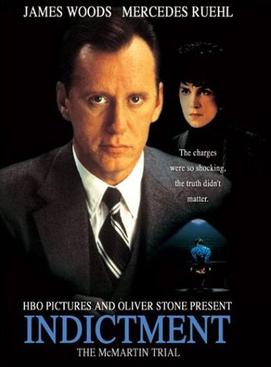
The Depths of Wild Imagination - INDICTMENT: THE MCMARTIN TRIAL (1995)


HBO is spoiled these days, what with all the good shows and TV movies confined to pay walled-in channels and the premium channels winning ALL the Emmys.  Back in the Dark Ages (the 90's) only a handfull of shows ever broke into the mainstream, the big winner being Mr. Show, until The Sopranos came along and changed the channel's fortunes forever.  I covered another 90's movie of their's in my review of The Second Civil War, and today we're looking at another hidden gem - Indictment: The McMartin Trial.  Executive Produced by Oliver Stone and starring James Woods and Mercedes Ruehl, Indictment has never seen the exposure you think its names would warrant, and it's doubly odd considering the ridiculous true story it faithfully documented, the longest and most expensive criminal trial in US history, one that sparked a nationwide panic but resulted in zero guilty verdicts and went down as a textbook example of mass hysteria.

In the mid-'80's, a horrifyed mother calls to report that her local preschool, run by the trusted and longstanding McMartin/Buckey family, has been physically and sexually abusing her son as part of Satanic rituals.  The family is arrested and the 200 or so children in the class are taken to an innovative child abuse therapy center, Children's Institute International, to be questioned by a counselor.  As the media frenzy grows, attorney Danny Davis (James Woods), a man used to defending drug dealers and society's rejects, sees through the media blitz and takes on their defense, partially to uphold the American virtue of "innocent until proven guilty" but more because it's a "hell of a case."  That hellfulness also attracts prosecuting attorney Lael Rubin (Mercedes Ruehl), and their first meeting is one of adversarial ribbing and snickering at the prospect of their careers skyrocketing as a result of the trial.  Their adversarying can't equal the wide smiling of CII's head Kee MacFarlane (Lolita Davidovich), obviously quite proud of her work wringing accusations out of the children.  Everybody, with the notable exception of Davis, is quick to accept the increasingly outrageous accusations, and Davis points immediately to the huge-framed 80's glasses sported by Virginia McMartin (Sada Thompson), teacher Peggy Buckey (Shirley Knight) and her son Ray (Henry Thomas), the latter of which Davis says "looks like a child molester."


As the hearings and investigations from both sides get underway it becomes increasingly apparent that not only does all the prosecution's evidence consist the testimony of small children, the children's statements are bizarre to the point of farce.  One claims that the Buckeys killed a horse with a baseball bat; another claims they flew the kids on an airplane, then says they went to a car wash instead, then says the car had no windows.  A boy claims that a man put his penis inside the boy's penis.  When shown a row of possible molesters, another boy identifies a City Council member and Chuck Norris as participating Satanists.  The one that sends the media into the most uproar is one overenthusiastic boy's claim that everybody dressed in black robes and sacrificed a rabbit, drinking its blood.  And to think that some townspeople had set fire to the preschool before the trial even started - thank God the family was protected from the outside.


All of CII's sessions were videotaped, and as Davis looks over the sessions he notices something very striking - the techniques used by the therapists are less encouraging the truth and more coercing the right answers out.  His hypothesis is that the therapists were fed a general claim of abuse from the parents or some officials and used any means necessary to get the kids to admit to the claims, oftentimes saying that all their friends were smart for telling them they were abused, and "you don't want to be stupid, do you?"  The kids were also shown dolls with anatomically detailed (ahem) dolls meant to represent the Buckeys, accompanied by remarks as to how Peggy's breasts had lines on them, and in one instance a kid is encouraged to slam the doll on the table.  It's very clear to not only Davis but one of the prosecution's investigators that the children are being led on, most likely afraid that if they don't say what the adults want that it will get them in trouble, and the hearings show just how easy it is to lead these young witnesses.  That doesn't stop the judge from blatantly favoring the prosecution, allowing their questioning while letting objections stick on the defense's countering.  All of this actually convinces the prosecuting investigator to resign, leaving Rubin in a state of righteous frustration that only grows as the trial progresses.  Davis's case only grows in the process, skillfully piercing holes in not only CII's techniques and MacFarlane's credibility as a social worker but also demolishing a witness who claimed that Ray admitted to sodomizing children and successfully turning the preferential tables not only for the judge but the jury and the audience.  The most entertaining part of all of this is when Rubin begins her personality attack on Ray, citing his interest in "pyramid power."  I won't dare spoil it for you, except to say it's incredibly funny and produces some of the best lines in the movie.


It's important to note that the mother who made the first accusations, the claims upon which the whole case is based, was a severe alcoholic and was diagnosed with paranoid schizophrenia, a fact that the prosecution deliberately hid from the defense.  It's also important to note that she died from alcohol poisoning before the trial even started, and the entire ordeal, from the arrests through the final, merciful ending, lasted seven years and resulted in zero guilty verdicts.  It ended up being the longest and most expensive criminal trial in American history, a doubly ridiculous fact considering that nobody went to jail for it, though the Buckeys most of that time in prison anyways.  To the delight of docudrama fans Indictment is just about the most accurate representation of the real trial as you're likely to see on film, and even the most ludicrous elements are completely true to life.  I've read reviews of the movie that accuse it of being one-sided, but how can it be anything else when the accusations are patently false?  What, did these reviewers really think that there was a Satanist conspiracy bent on molesting children and ritual sacrifice?  There are real Satanist organizations in America that the police could have talked to at any time, such as The Church of Satan, and none of them have any kind of abusive or sacrificial agenda and are in fact pretty harmless in the grand scheme of things.


The case marked the turning point in the public's willingness to believe in Satanist conspiracy horsehockey, and Indictment was the final nail in the moral panic's coffin.  The movie is incredibly well done for a TV movie, its filming style reminiscent of Oliver Stone's over-the-top style familiar to viewers of JFK and Natural Born Killers but knowingly restrained.  The performances are excellent, with Woods and Ruehl in top form and the supporting cast fully committed and at times heart-wrenching.  James Woods is one of my favorite actors and he was born to play this kind of role, a third-banana lawyer who uses his smarts and rhetoric to not only win over the jury but redeem his unillustrious career defending drug dealers and scumbags.  Henry Thomas, who plays Ray, gets the most well-developed arc in the movie and his performance is the most compelling of the film, quite remarkable for an actor I've never paid much attention to (the only role I'd seen him in before was as Amsterdam's best friend in Gangs of New York).  The movie is shot much more like a theatrical film than a TV show, and the camera is free to sweep and accentuate the story beyond our TV-movie expectations.


The true story of the McMartin trial is a fascinating portrait of the peak and decline of one of the most idiotic moral panics this side of rainbow parties, and the movie does the facts great justice while making its own identity as an entertaining and tense courtroom drama.  If you've got a spare slightly-more-than-two-hours and can secure a copy you're in for a true-story ride on the same level as docudrama masterpieces like Zodiac and All the President's Men.  You've got my guarantee that at no point will Chuck Norris show up to put his penis inside your child's penis.


~PNK

Wednesday, November 20, 2013

Short-Order - HPYNEROTOMACHIA (1992)


The challenge of capturing dreaming through art is more than unique, and creating new dream art that draws inspiration from another is also challenging, requiring an intimate understanding of the structural and imagistic tricks employed by the original author to capture the stuff dreams are made of*.  This is easy enough to witness whenever a new Alice's Adventures in Wonderland/Alice's Adventures Through the Looking Glass retread is unleashed and hardcore fans are sent gnashing into the shadows in argument over its Pros'n'Cons.  After witnessing Andrey Svislotskiy's 8-minute animated short Hypnerotomachia (literally "sleep-love-fight", or "The Strife of Love in Dream" in the usual English translation) I sat back in my chair wondering if something that unsettling should be unleashed to a general audience, and realized that something of its skill, passion and imagination should get as wide an audience as possible.  I also wondered what in the hell the short had to do with this:


This is part of a page from Hypnerotomachia Poliphili, an anonymously** authored allegorical tale published in 1499.  Widely considered one of the most beautiful books ever published, the tale follows the dream journey of Poliphilo ("Friend of Many Things") as he pursues his love Polia ("Many Things") through a series of densely described landscapes and kingdoms.  


The original publication features 168 exquisite woodcuts, simultaneously flat and crammed with detail, that became a major influence upon late-19th century Aestheticism.  The font is unusually clear and attractive for the time, and as can be seen on the above page the publisher found many creative new layouts for text.  Here's a page that looks like a vase:


All of this is written in a sui generis hybrid of Italian, Latin and Greek with a lot of Arabic and Hebrew text mixed in, along with some imaginary words for good measure.  The book is a masterpiece of aesthetic elegance and no translation can replicate its power of enchantment.  With all that in mind, be aware that I've been scared to attempt to read it in one of its English translations, primarily because it was written long before Modern conceptions of fiction writing were set and what I've read so far is anything but conventionally entertaining.  Its descriptions of monuments and buildings are so exhaustive multiple reconstructions, by hand and using computer modeling software, have been successful at making its dreams catalogable.  From what plot summaries I've seen the allegory does have a comprehensible and beautiful philosophical message, but I know it would take a Herculean effort to make it through the meat of the thing.  If you're interested, here's the whole book in digital photographs at the superb rarebookroom.org.  If you can't get the 1999 Joscelyn Godwin translation you can get the 1592 partial English translation here.

So once again, I have to ask - what does that have to do with this?


Made for Pilot Animation Studios in 1992, Hypnerotomachia may have been influenced by DalĂ­ and de Chirico (or Krazy Kat considering the stark, off-balance landscape), but I highly doubt it sprang from the mind of Poliphilo.  My best guess is that Svistlotsky deconstructed the title to its three components - "sleep-love-fight" - and ran with the "fight" part as fast as he could through the hallways of the squirrel factory.  Shucking off the noble pursuit of lost love across a continent of classical wonder, the short enters the dream of a man who looks like a corpse made out of old raincoats.


The pupil of his eye is the sun.  It turns out there is a hole in his head, revealing the sun behind.  Then the tandem men appear (like those two pics above), and the perspective swerves so radically the hills appear gelatinous.  They screech and bicker, and small rooms float past like perverse votive scenes (like that Blood'n'Knife scene).  The scene climaxes inside the face of a woman, the other sleeper, and then focuses on a dog with shining eyes.  It produces tandem dogs - 


- that pass through the face of the male sleeper -


- and then more things happen, and I'm fine not describing them in detail, suffice to say I've never seen more animated ladders break before with such unsettling detail.


I read that this director also did animation for children.  I'll just have to take their word for it.

Joking aside, while this short may have a message, I was a little too shell shocked to want to think deep thoughts about what I'd seen.  The connection between the two dreamers is razor-thin, and an easily-noticeable arc isn't anywhere to be found.  I've seen a lot of animated shorts take place in dream landscapes, but this one is the most terrifying I've seen yet, and its homaging to Hypnerotomachia Poliphili is tenuous at best.  The animation is great, though, and its cumulative power can't be understated, so if you're interested in the art of animation you may want to give it a whirl.  I'd tell you to proceed with caution, but you could probably could have guessed that from the screencaps.


~PNK

*Apologies, apologies.

**Each chapter's first letter is of the enlarged, decorated style of ancient books -


- and putting them together makes an acrostic that reveals the author's name: Brother Francesco Colonna, an Italian Dominican priest.

Thursday, October 3, 2013

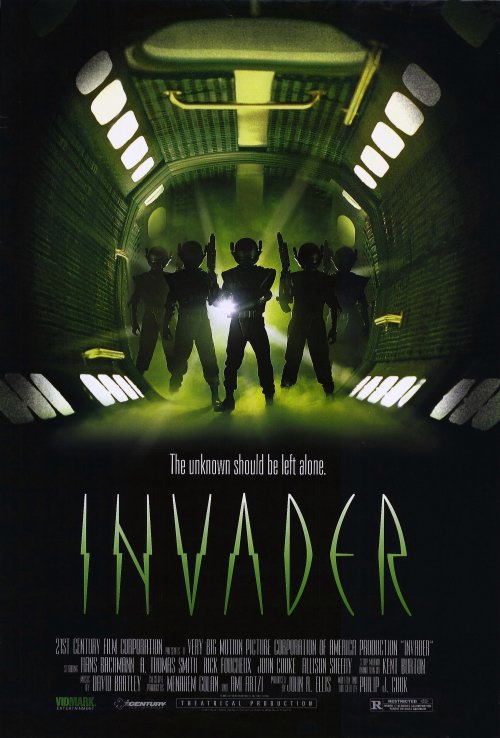
The American Dream Is Alien - INVADER (1992)


There's two kinds of direct-to-video product: theatrical movies that sat on a shelf before being pooped out onto video to avoid massive losses, and movies made to be direct-to-video.  It's uncommon for the latter to appear on recommendation lists, and often there's good reason, but some transcend their supposed limitations and become classics in the field.  For my money, Philip Cook's Invader is not only my favorite DTV sci-fi flick, it might be my favorite move ever made to premiere on video.  It's fast-paced, wickedly funny and very smart, featuring impressive special effects and good performances all around.  After I tell you all of this in more detail it may be time for you to dust off your VCR and give this one a go-round.  (Don't expect the guys on the poster to show up, though; they're not in the movie).

Frank McCall (Hans Bachmann) is an ace reporter at the National Scandal, an Enquirer-styled rag that specializes in flying saucer and mutant baby fare.  He stumbles across a bizarre multiple homicide scene where soldiers were fried to a crisp while on a routine bus ride.  He is met by Capt. Harry Anders (A. Thomas Smith) of the Department of Defense, and Col. Faraday (Rick Foucheux) who operates the Air Force base the murdered men were stationed.  The incident couldn't come at a worse time, as Faraday is unveiling a new fighter jet at a show that night, which McCall sneaks in to.  During the test flight, the autopilot switches from normal flight mode to attack mode, and eventually crashes, killing the pilot.  As people scramble, McCall gets whisked to a back room by robotic men in sunglasses, who strap him into a chair with the intention of injecting a green glowing liquid into him.  They're stopped by Anders, and the three men convene to hear the truth: the ship's onboard computer, A.S.M.O.D.S (Asmodeus), was recovered from a crashed alien vessel, and now has grown a mind of its own, taking over the base's men and working tirelessly on a sinister plot to take over America's defense systems for a hilariously unwise ambition.

While this may seem a bit boil-in-the-bag in its setup, Invader is far more intelligent, funny and accomplished than the majority of its peers.  The dialogue is hilarious, containing some of the best one-liners I've heard in a DTV flick ("Why is it that every time somebody tries to photograph something spectacular it's with a shitty camera?!").  The odd couple of the snarky, disobedient McCall and the no-nonsense, bureaucratic Anders is a joy to behold, with both actors nailing the parts and making the film's glue.  While the concept of an alien ship gone rogue isn't new, the payoff is, and the film transforms from routine sci-fi popcorn-muncher to freewheeling satire on military excess and unchecked nationalism.  It's one of the few movies I know of that exposes the bureaucratic red-tape of the military, making it a surprisingly comedic environment.  The special effects are excellent for a low-budget movie like this, featuring some impressive stop-motion and some of the most vast and detailed models I've seen since Total Recall.  WARNING: the DVD special edition decided that the accomplished practical effects of the original release weren't good enough for the 21st century and revamped the film Lucas-style with hideous CGI monstrosities that would cause Douglas Trumbull to dig himself a grave and roll in it.  Let's pray for a re-release of the original, at the very least for the legacy of practical effects.


Either way you see it, Invader is a wild ride, full of laughs, action and satire, a shining beacon for B-moviedom.  If you're going to make something entertaining this is how you do it, and the flick far outshines its DTV limitations (or assets, depending on how you're counting it).  This is the kind of movie that Saturday nights were invented for, so get out the VCR, snag a copy and get to watching.  If you're disappointed you may as well be shuttled off to Asmodeus for "retraining".


(Ignore the CGI!)

~PNK

Tuesday, March 19, 2013

A Crisis of Perception: MINDWALK (1990)


“What, is there a Red Alert on or something?”

It’s this question that greets Jack (Sam Waterston), senator and failed Presidential hopeful, as he calls his poet friend Tom (John Heard) in France.  Jack is in the midst of attempting senatorial re-election, and therefore in the midst of a mid-life crisis.  Tom knew Jack from a former speechwriting gig and has retreated to France for various mid-life reasons.  An invitation is given for Jack to come out to visit Mont. St. Michel, a medieval castle on an island surrounded by salt flats in the French countryside, and thus begins my favorite movie on scientific philosophy next to Donald in Mathamagic Land.


“I shouldn’t have invited him,” Tom internally monologues as they drive towards the mount.  “I’m residing quite contentedly in my own mid-life crises, thank you very much.”  Tom’s sedan trundles down the dirt road, and each time Jack spots the castle through the spring fog he quips enthusiastically, such as “This is amazing!”  Their dynamic is one of loving, subdued judgment for each other, and their chosen professions separate their worldviews; one side is pragmatic and hopeful, the other reflective and moody.  The reflective side insists on walking across the flats to reach the shrouded hill, and the movie insists on starting the Philip Glass score and credits there, too.  It’s here where we meet Sonia (Liv Ullmann), a Norwegian scientist who has rented a room in the castle and is cooped up there with her books and her daughter Kit (Ione Skye).  Kit complains of boredom (oddly appearing more childlike here than in Say Anything, which came out the year before) and her mother’s reclusion, saying “You aren’t even aware of the world around you!”  I’d call this statement foolish considering Sonia’s personal philosophy, but I may end up eating those words later.
 
Before we go any further I should probably warn you that this movie is essentially a 110-minute conversation, much in the vein of My Dinner with Andre (1981), which needs no introduction.  And although the conversation is steered towards a main topic eventually it begins with Jack and Tom reflecting on their ups and downs, why Tom left New York, and semi-snarky observations on the monks who once walked among the castle’s walls (“Judgment Day for them was kind of the ultimate day off, not the ultimate off-day.”).  And in spite of Kit’s earlier complaint this movie is certainly aware of its surroundings, and the setting is very well used throughout, from the architecture itself to views of the salt flats, and even views of its large parking lot.  The movie isn’t afraid to show the ancient structure being invaded by tourists, and its anticipation of the wandering wonder-filled causes me to wonder why Jack, Tom and Kit are there themselves, as it is no mere sightseeing jaunt. 

The three of them first get within spitting distance in the cathedral (where Tom quips that the whole point of having huge cathedrals was to make the individual in the human body feel insignificant to the glory of God).  They finally broach the boundary in the back room with the clock, a remarkable medieval creation that is still running after centuries.  Sonia reluctantly agrees with Tom that the clock was mankind’s first break from the naturalistic view of the world, but then posits that the view of the universe as a giant clock is antiquated. 
The men are intrigued, and we enter the real topic of conversation: how we think about problem solving, and the search for a more holistic worldview.  Her views are largely influenced by systems theory, a method of scientific thought that focuses not on solving individual problems with straightforward means but rather focusing on its relationship to the larger system of which it is a part.  It’s a simple principle, and Sonia is all too well-equipped to offer examples to back up her position.  And though there is opposition from the men they generally agree with the bigger picture on bigger pictures.  Her ultimate plan is to collect her thoughts on systems theory in a book to be titled Ecological Thinking, but it is unclear as to whether this will come to fruition.  Jack’s opposition is a defense of pragmatic thinking, of understanding one’s limitations and persisting on the few solutions that can be won.  Tom’s opposition is more veiled at the beginning, even though he takes offense at Sonia’s insistence that the old view is too patriarchal (and it on that detail she most reveals her personal biases).


One would wonder what spurred Sonia to take this viewpoint, and her explanation is a clue to this movie’s overarching concerns.  Before her voluntary retreat from the world she was part of an American team of scientists working on improving laser technology.  One day she discovered an unconventional approach to the tech and she ended up causing a breakthrough, gaining accolades and offers in the process.  Sonia knew the possibilities were endless (including improving cancer research), but she eventually got wind that a more advanced version of her contributions to lasers was being used in the Star Wars program, a futuristic Cold War plan introduced under Reagan, and it caused her to completely reevaluate the scientist’s place in the world and the nature of responsibility and accountability.  And though the conversation veers around this concept, from quantum mechanics to the threat of nuclear warfare, it’s her internal struggle, her guilt, that drives her search for truth and is part of the film’s larger metaphor.


The movie is directed by Bernt Amadeus Capra, the brother of physicist Fritjof Capra, author of The Tao of Physics and The Turning Point.  The latter is essentially the book that Sonia is writing in the movie, and Fritjof is one of the world’s leading advocates for systems theory.  Bernt wrote a short story about the three characters in the film, and it was turned into a movie.  Personally, I think these layers of disconnection from idea to narrative play an essential role in the viewer’s enjoyment of the movie.  Mindwalk could have been a diatribe, or merely a stylized civics lesson, but in giving the viewer characters to filter the ideas at play adds another layer, the layer that I really lock on to after now watching the movie a few times.


Each of the main characters came to Mont. St. Michel as a form of escape from mid-life crises, and it’s fair to say that most mid-life crises boil down to a crisis in perception: perception of one’s self and one’s priorities in life, their morals, legacy, etc.  That quote I have at the top has a tiny metaphor in it, the joke about big obvious problems implying that the real problems in our lives are ones that we don’t see until they’re out of control.  The crisis is one that creeps up on the subject, one that arose because they didn’t know it existed until it was already omnipresent.  Sonia’s major concerns in science and the world are problems such as this, such as global warming, pollution, hunger, overpopulation and so forth.  And while her concerns are certainly noble and applicable, their root is in her own guilt, a selfish desire for personal change, taking away from the credibility of her goals.  That isn’t to say that this isn’t old news for why people perform good deeds (and I personally detest it when people try to undercut small virtuous acts by calling out people on selfish motives), but I’m of the opinion that Mindwalk has Sonia expressing answers because she lacks the answers.  Though some hot-button issues are brought up they never sit down and attempt to tackle anything specific, and the movie never forces systems theory down the viewers’ throats. 


I watched this movie a while ago with my mother, who didn’t agree with me that it wasn’t a diatribe, and I understand that unlike My Dinner with Andre, Mindwalk does have a lofty, semi-specific message in its proceedings.  And I’ll admit that if you’re not in the mood for a nearly two-hour philosophical conversation the movie may be a tough sit.  The thing that brings the viewer through the conversation is the strength of its characters, three very interesting, realistic, relatable people with opinions and backgrounds and failings.  And it isn’t just the scientist who is an expert in her field; Jack is a career politician who is very aware of the pitfalls of his world, and Tom is extremely well-versed in poetry and art, offering a fresh perspective on many of Sonia’s quips.  It also requires all three of these people to make a full conversation, and one could even posit that their opposing viewpoints are essential to thought: scientific idealism, artistic idealism, and pragmatic action.  As systems theory is the science of relationships, the heart of the movie lies in the relationships between these three viewpoints, and how each of the speakers has a part of the method but not the whole.  Not one of them is smarter or more right than the other two, and the respect the authors have for their characters prevents the movie from becoming one-sided.


In fact, the real congealing moment in this film, and its most profound moment, comes not from Sonia or Jack but from Tom, who has spoken the least during the film and before the moment spends the better part of 10 minutes moody in the distance.  The three have made it to the flats (the empty expanse a fine place to approach the bigger picture).  Jack suggests to Sonia that she come back to America and try to lobby for her views in Washington, and Jack is ready to rethink his political method to accommodate her theories.  Tom cuts into this suggestion, insisting that perhaps jumping wholly into this new philosophy might not be the best move for Sonia at this point in her life.  At first he doesn't back up this concern, but his answer is eventually brought out by reciting a poem (Pablo Neruda’s “Enigmas”).  It’s a move so well timed, with only a few minutes, and it turns the tables so eloquently and completely as to not invalidate Sonia’s beliefs, but to place the question mark on an even higher plane of understanding.  I won’t dare spoil it for you, suffice to say that it’s my favorite poetry recitation in a film and is a good show of John Heard’s acting skills, which aren’t spoken of enough in my opinion (Ullmann and Waterston are also excellent, BTW).  It’s just a great way to leave the conversation, a reminder that even when you think you have the answers you can’t even know what the truth is.

Because Mindwalk was released by a major studio (Paramount) and was guaranteed to not make much money, this film has only been released on VHS and original copies are a bit pricey.  But fortunately somebody put the whole thing up on YouTube: http://www.youtube.com/watch?v=qzAbjbH-1oA


~PNK