Showing posts with label 1970's. Show all posts

Friday, September 23, 2016

Celebrate Bisexuality Day Special - THE RUBBER GUN (1977)


I normally don't participate in unofficial holidays, such as National Kite Day or National Hot Dog Day or National Prank The General Populace To Celebrate Your Bizarre Fetish As An Unofficial Holiday Day.  It's not that I hate fun or holidays, it's just that I never know about these things until the day is half over and there are so many of them that even if I wanted to keep up with them it'd be just a tinge less than impossible.  That being said, earlier today I opened up Facebook and in my Trending feed was a notice for Celebrate Bisexuality Day, an unofficial holiday that I'd not only missed until half the day was over but had also never heard of before.  And you know what?  It's high time for a bit of biwareness.  And it's also high time for me to get that one last foot out of the closet.

My good friends and close family already know that I'm bisexual but I almost never bring it up in conversation and haven't bothered to come out to colleagues and other acquaintances.  My usual tack is that my sexual orientation is almost never relevant to the kinds of discussions and situations I find myself in during the day, and it's the kind of information that I don't like having to talk about without a good reason; I simply have no reason to talk about it.  It's part of my general social and political attitude towards how I feel sexual orientation should be treated, which is as a harmless cosmetic attribute of daily life that has little effect on others and doesn't affect how people go about their business.  I'm not a particularly political person to begin with, considering myself someone that focuses on ethics rather than machinations and posturing, and when I came out I realized that I was suddenly forced to have an opinion on a political issue at a time where I would much rather be left alone.  The thing about "coming out" is that you don't just come out once, you make a decision whether or not to come out to every new person you meet for the rest of your life.  Anybody in the Queer* populace who's had the unfortunate experience of being asked point blank if they're gay, as I have been, knows what I'm talking about, and it takes a great deal of patience not to just snap back, "I dunno - are you?!" and walk out of the room.  It's just a rude question 99% of the time, kind of like asking someone if they use toilet paper or how frequently they masturbate.  It infuriates me that sexual orientation is a political issue at all, and in an ideal world people wouldn't have to take sides and make stands based on a flimsy connection with who you sleep with and who you vote for.

And then there's that "taking sides" thing, another reason I don't talk about my sexuality much.  Few things make me feel like I've been unjustly nudged out of the room like the notion of having to pick sides of either being straight or gay.  I "pass" for straight almost all the time, not because I'm trying to appear that way but because I simply grew into my personality and didn't change it very much when I came out - if anything I just became happier and more self-confident.  I'm sure quite a few people I interact with very frequently would be a bit shocked if I gave them the scoop, and a good number of them would suspect, vocally or secretly, that I'm faking it and am either straight and just want attention or gay and playing it safe.  The public perception of bisexuality, while definitely improved vastly over the decades, still clings to some creaky misconceptions.  Female bisexuality is largely treated as a novelty, something to titillate straight men more than a real aspect of the women themselves, or a phase that they'll get over once they meet Mr. Right.  At the other end of the spectrum male bisexuality is treated as the aforementioned ruse, or, in the case of media depictions, a perversity that hides sociopathy or malice.  

This latter version of male bisexuality got me to thinking back on all the Queer characters I'd seen in fiction and take a hard look at them in search of that elusive character, a bisexual who's not closeted and is a positive presence in the story.  This is much harder to find than you might think, especially with how many positive, assured gay characters we've seen in recent years.  The times are definitely a-changing, so much so that Archie comics, one of the most resiliently old-school child-oriented comics around, introduced an openly gay male character a few years ago, Kevin Keller, and not only was the response in some circles overwhelmingly adoring some of his comics sold out (I'd also argue that he has no personality outside of his orientation, but whatevs).  On the TV series Mr. Robot, the boss of Elliot, the main character, is gay, and as the series progresses he ends up being the only completely kind, decent character in the show.  Heck, ParaNorman's side characters include a gay guy who's orientation is only revealed in a throwaway line at the end of the movie, a first for a mainstream family flick.  Meanwhile, female bisexuals in movies and TV are almost never treated with more depth than with that dark-eyed waif on House who has a long-term romance with her irritating male hunk colleague but'll do a belly button shot off a stripper if she think it'll boost ratings.  There's a lot of inconsequential female bisexuality in Tim Burton's Alice in Wonderland but its inclusion is pointless and kind of distracting, only adding to the vast pit of shrieking hell that is that film's innumerable problems.  Lena Dunham's semi-autobiographical Hannah Horvath in Girls has a handful of sexual moments with other women throughout the series but it adds little to her character except to reflect her scatterbrained lust for social adventurousness and flighty immaturity that the show depicts as part of her whole generation's emotional deficiencies.  As for male bisexuality there's...well, there's Frank Underwood in House of Cards, but his attraction to men serves mainly to add yet another sword of Damacles over his head rather than add anything substantial to his character and serves more as a refection of his lust for power and control than anything else.  A case could be made for the protagonists of Brokeback Mountain, both of whom maintain marriages with women during their decades-long affair, but the environment they're in is so repressive that they're obliged to bend over backwards to maintain a facade of normalcy and Jake Gyllenhaal's character is only shown having any real interest in men.  An interesting case can be seen in The Disappearance of Alice Creed, a kidnapping three-hander wherein two men kidnap the daughter of a rich man for ransom, only for one of them to reveal himself as her former lover and tells her he'll keep her from getting hurt and plans on splitting the money with her.  However, it's later revealed that he and the other kidnapper are lovers themselves, and the layers of deception and twisted alliances grow heavier and heavier as the movie progresses.  It was a really interesting use of the format and the movie did a good job of painting the first kidnapper as truly torn between his past love and current one.  It's also a use of bisexuality as a symbolic anchor for the themes of the story, and while it was done very well in the film the men are still the villains of the piece and the situation eventually blows up in everyone's faces.  An odd example is the 1990's computer game Phantasmagoria: A Puzzle of Flesh, wherein an office drone at a secretive company tries to solve a series of gruesome murders in his workplace while at the same time sleeping with a female coworker and sheepishly growing attracted to a gay male colleague.  In the finale (SPOILERS) it's revealed that the Big Secret of the company has to do with alien experimentation and that the protagonist is actually an alien/human hybrid borne out of an accident.  His sexuality adds up to little more than a reflection of his split identity, and while he gets to have a pair of wild, fetishy sex scenes with women he gets little more than an attempted kiss with his male crush, only to see said crush get killed seconds later.  I suppose you could point to 1982's Making Love, once a very controversial film, where Michael Ontkean and Kate Jackson's marriage is threatened by Ontkean having an affair with Harry Hamlin, but this late-blooming sexuality thing is the entire plot of the film and therefore assumes the role of the "villain".

After much thought (which leaves out butt-tons of material that could have better examples than the ones I'm about to give) I could only think of one instance apiece in film where a male or female protagonist is bisexual, they are unquestionably a positive influence in the story, and their sexuality isn't the entire plot or brought up more for symbolic purposes than as a legitimate character trait.  For women the example is a bit shaky as the film is of that most dreaded early '90's genre, the erotic thiller.  The goofy DTV mystery Desire featured Kate Hodge of She-Wolf of London and Leatherface: Texas Chainsaw Massacre III investigating murders that relate to the perfume business, and (SPOILERS) the villain is revealed at the end to be a woman Hodge was sleeping with back in the day.  At no point will I try to tell you that this is a good movie (or that I've seen much more than a clipshow version of it), especially considering that one of the film's red herrings is a man who hits on Hodge (successfully, I might add) by claiming his nose is so good he can smell whether or not she's wearing underwear.  One could easily say that the bisexual angle was tossed in to rile up male viewers, but the strength of Kate Hodge's character and the substantial enough plot keep the film from being just a porn with no sex scenes, so I can give it a begrudging gold star for Bisexual Effort.  For men, however, I can finally talk about a funky little flick that has been on my talk-about-yes-sir list for a while now: The Rubber Gun.

Canadian cinema is all too often left in the conversational dust in American cinephilia, and that's a shame as the country is just as capable of producing quality directors as anywhere else.  David Cronenberg is one of my favorite directors and is one of the most respected voices in modern horror filmmaking, and Atom Egoyan got a lot of critical appraisal in the US before scoring a bonafide hit with The Sweet Hereafter, one of my favorite movies ever.  Right now one of the most exciting directors working in Hollywood is the Quebecois Denis Villeneuve, who produced a string of acclaimed French-language films before making Prisoners and Sicario, both among the best movies of their respective years, and Arrival looks like it'll be just as wonderful from the trailers.  A more flash-in-the-pan director is Allan Moyle, whose sophomore effort, Times Square, is a touching and subversive teen flick where a high school girl is spirited away by a brash runaway and goes on an adventure of punk rock, rule-breaking and self-discovery in a pre-Giuliani'ed Times Square.  He would later go on to direct the Christian Slater DJ movie Pump Up the Volume, but today we're talking about his first film, released in 1977 to exclusively Canadian praise and being nominated for two Genie awards, the Canadian equivalent of the Oscars.  It's total obscurity in the U.S. is accounted for by it never having hit video, back then or now, and so its reputation is based on what bootleggers and people who like watching movies on YouTube feel about it, which is thankfully positive.

At a Montreal bookstore Allan (Moyle) meets Steve (Stephen Lack), a young artist, and the two of them hit it off, with Steve inviting Allan to meet the other people who live at his apartment in a loose kind of commune/drug den.  Allan happens to be a university student going for a sociology degree, and decides to join Steve's circle of friends while secretly recording his experiences for a paper based on testing to see if a drug community can have a positive effect on its members in the right circumstances.  Things are mostly loose and relaxed in the "family", where Steve and the others share drugs and sleep with each other freely, including between Steve and Pierre (Pierre Robert), a prostitute and heroin addict.  Allan keeps a certain distance, staying off the hard drugs and refraining from intercourse, but things get tricky when Pierre proposes to rob drugs from a locker at a train station in a bid to gain control of the group, whatever that might entail.

Running a scant 75 minutes in the cut I saw, The Rubber Gun is a casual, poignant view into the lives of society's most harmless deviants.  It's the kind of independent film that could have only been made as a truly independent movie in the 1970's - the camerawork is loosy goosy, the dialogue is mostly improvised and the whole thing looks like it was shot in a weekend.  While that can spell doom for other films this one uses its tension-laden setup and brief runtime to its advantage, keeping the story tight while allowing the actors to lay it all out.  The mood is encapsulated by the performance of Stephen Lack as Steve, at once hip and affectionate, too cool for the room but never ignoring the needs and feelings of his friends.  Fans of exploding heads may recall Lack as the frustratingly wooden, terribly miscast protagonist of Scanners, and no amount of viewings can make Lack's awkwardness easier to look at.  The truth of the matter is that Lack was never really an actor - he's a painter and sculptor who slid into acting a handful of times, and in The Rubber Gun his presence works because he's allowed to just be himself.  It also helps that he co-wrote the script with Moyle, and because he was clearly working with friends - the music consists of quirky cabaret/bar rock songs by Lewis Furey, an underground Canadian musician who commissioned Lack to make the cover of his first album in '76.  The other actors also come across as non-actors but this kind of movie doesn't necessarily require Shakespearean emoting, just sincerity and a minimal number of flubs.

While the movie is certainly worth viewing in its own right, its take on sexuality is remarkable and remarkably ahead of its time.  Both Steve and Pierre are indisputably bisexual and are totally comfortable talking about their sexual experiences together with the rest of the "family" and Allan, and at one point Steve offers to sleep with Allan, an offer Allan would clearly like to take him up on but can't because of his need for distance in his duplicitous study.  While Allan's sexuality is left ambiguous it's never questioned or really brought up, and Allan never feels the need to pry into Steve or Pierre's orientation.  It's just part of life in their little community and has little effect on the story, and the film could have easily been rewritten to make everyone straight without changing the plot at all.  And the thing of it is, the film makes life in the commune look pretty appealing and ethically reasonable, even though the furniture is junky, nobody has any money and, well, heroin.  Steve remains a positive presence in the film even after the fit hits the shan, and there's no comeuppance or punishment for his sexuality or choice to live on the fringe, and the viewer is left with a weird admiration for what the "family" was doing.

Because of the film's miniscule impact I can't say it's had any influence on depictions of Queerness in the movies, but it does stand as a good example of having multiple main characters who aren't straight and go about the plot as if it doesn't matter, which it doesn't.  In the coming years I'm sure we'll see more solid bisexual characters on screens big and small but American culture still has a way to go wrapping its head around bisexuality and how it's OK to not "pick a side" or make a political statement with a small part of your identity.  Reviewing The Rubber Gun is a small reminder for me, at least, that not only is it totally OK for me to be bi but that I probably could use to have a bit less fear talking about my orientation, even if just to put as normal and reasonable a face on it as I can.  I'm bi and I'm fine, and it's a fine day to say it.

Here's the full movie

~PNK

*I use the term "queer" as a blanket term for the LGBTQ community, not at all derisively but because it was the academic blanket term in the 90's and no more convenient term has come about since then.  Also, just because I'm saying "queer" that doesn't mean that I'll be totally cool with you calling me queer, bub.

Saturday, April 16, 2016

Short Order - John Korty's Lumage


Late last September one of the home video world's most direly outstanding debts was finally repaid, and it came in the form of a print-on-demand DVD from Warner Bros.  Longtime readers may recall that one of my favorite movies ever, specifically my favorite animated film after Fantasia and The Incredibles, is Twice Upon A Time, an utterly delightful and hilarious fantasy with characters like Ralph the All-Purpose Animal, Synonamess Botch and Rod Rescueman.  A fleet jaunt through the garden of spoofly whimsy, the George Lucas-executive-produced joint is the only feature-length animation by Korty Films under the leadership of John Korty, animator and TV-movie director, and its singular presence in the film world is partially due to a bungled release by its distributor, The Ladd Company, outputters of Blade Runner.  Ladd chose to give it a limited theatrical run in order to give what might be the company's great winter passion to The Right Stuff and the decision ultimately wasn't enough to keep the company from sinking into bankruptcy, and further appearances of the film on TV and home video were complicated by infighting between Korty and producer Bill Couturié.  The Warner Bros. Archive Collection release is the only legit video version since the early 90's and features two different audio tracks as a compromise to both Korty and Couturié's preferred cuts, and the cult animation gods smiled down from their seat on top of Mount Animalympus.  The film's rescuing is important not only for making a kickass kartoon available once again but also because it helps preserve Lumage, an animation technique invented by Korty and used in Twice Upon a Time for its one and only shot at feature-length glory.

"It's alright, I'm wearing rubber underwear!"

How Lumage actually works might not be apparent from the clips in the trailer (a good thing, as one isn't supposed to think about how a film is animated but rather be sucked into its world) but here's the skinny: the characters are first sketched out, then translucent plastic is cut up to form them, and the pieces are moved around on a light table, the kind used for drafting.  The positions are shot frame by frame and viola.  If this sounds time consuming rest assured that it's far more time consuming than you think, as every frame of action has to be sketched and then cut out and then filmed, making the work potentially twice as life-consuming as traditional animation.  There's a reason not many stop-motion movies are made these days (and why they're so dang expensive) and understandably Lumage never really caught on outside of Korty Films.  The real shame in losing the art isn't just that it's cutout animation, a rarely-used technique these days (seen here in John Weldon's The Lump, filmed in "Recyclomation"), but that the addition of backlighting makes the technique not only especially rare but uncommonly beautiful - remember how astonishing it was to see intense, real-life glowing in moments of The Secret of Nimh, such as Mrs. Frisby's convo with the Great Owl?  The use of light here allows the liquid textures of the plastic figures radiate and come alive in a way that paper and pen could never accomplish.  Korty and co. exploit this throughout the film by using every opportunity to change the textural makeup on the characters, such as Ralph's fur, giving them a magical, almost volatile presence.  You might be wondering how a feature-length film using such a difficult and new animation technique got greenlit, and the answer is not only simple but a fine trip in the wayback machine - Korty had used it many times before, all under the great umbrella of 70's children's television.


In the 70s and 80s Korty Films produced dozens of short bits for Sesame Street and The Electric Company, both Children's Television Workshop shows and, at least for the latter, the standard for young children's programming.  One of the big draws of Sesame Street was teaching simple concepts, such as numbers and letters, in creative and fun ways, and the quality and variety of artists they got to make these bits kept both Sesame Street and The Electric Company head and shoulders above anything similar before it, and it's the reason that Sesame Street managed to stay on the air and on top for so long that some of the kids who saw the early seasons had grandchildren who watched the show.  Korty's shorts were among the best pieces of animation to appear on the two shows, not only for their educational value but also their wit and attention to detail, such as the above bit "Q is for Quiet" wherein the letters of the word "quiet" jabber and argue.


What strikes me the most about Korty's Sesame Street work is his care and respect in depicting people, such as with "Angry Annie" here.  Think about how much work it took to cut out and shape her hair and then animate all the tiny movements as she pulls it, shakes her head around and reacts to its presence on the tip of her nose.  The most difficult task in any animated film is making the characters believable and Korty makes up for the flat appearance of Lumage with tons of detail drawn from a sharp eye as to how people think and act upon those thoughts in subconscious ways.  Also apparent is how the voice actors are allowed to flesh out their performances through ad lib and inconsistency, giving their characters a fine naturalism that Korty worked off of to great effect.  The cast of Twice Upon a Time was made up of improv comedians such as Lorenzo Music and Marshall Efron, and different cuts of the film had different dialogue, the main thing keeping the film from a proper video release for so long.  For an early example of how those guys worked with Korty, here's James Cranna, the voice of Scuzzbopper, in a Sesame Street bit:


Sesame Street was a notable change from earlier children's programming in two major ways - it's setting was decidedly urban rather than the rural or fantastic worlds before it and its cast was racially integrated, a point of contention with conservative viewers, especially in the deep South.  While praising someone for conforming to Sesame Street's values might not seem necessary it is notable that Korty's previous work was actually well-suited to the show's humanistic, pro-friendship values and concern for urban living.  Consider one of his earliest works, the anti-nuke docu-short "The Language of Faces", produced by the Peace Education Program of the American Friends Service Committe, a Quaker-run peace activist organization:


That haunting would-be omen might seem a bit much now with its Criswell-esque narration and experimental percussion music but it's far from the scariest of the nuke scare flicks, with Fail-Safe and The War Game taking all cakes known and unknown.  It doesn't take a film scholar to point out how the nightmare bombs and Big Red One doomsday button from Twice Upon a Time have more than a passing resemblance to the world's most ominous stockpile, and the horrifying realities of nuclear warfare and our need to come together as a world alliance are obvious enough truths to be self-evident to preschoolers, though Korty never got that particular message on the air.  One Electric Company short about pollution is a good substitute, though:


The most extensive work Korty did for these shows was the running Sesame Street bit "Thelma Thumb", no examples of which (in English, anyways) I was able to find, which is a shame as it featured both James Cranna and Judith Kahan, the voice of the Fairy Godmother from Twice.  There are plenty more individual shorts, though, and if anything can be said for the content on Sesame Street and The Electric Company it's that it's simple enough for small children to understand, so I don't see any reason why I shouldn't just let them all hang out.


You can get lots more info on Korty at his personal website, a nice piece of design at the very least, and hopefully more exposure of his talents will help more Sesame Street and Electric Company shorts resurface.  Lumage's serious difficulties as an art form have logically kept it from spreading its wings farther than the Korty kamp but we cna help honor its vital contribution to American animation by recirculating Korty's bits, as commenting on current political issues with shorts like "Pollution Solution" is what Facebook was made for.  To close out, here's one of Korty's most charming and humanistic shorts, a kind reminder of the how human potential can be seen only one step (or foot) at a time.


~PNK

Saturday, May 30, 2015

Short-Order - THE ANTIQUE COLLECTOR (1976)


It's a shame that short films have largely gone the way of the dodo, at least outside of bundled showings at film festivals.  Edison famously remarked that he didn't think anybody would sit still for a movie longer than a half hour, and short films used to be a standard part of the theater-going experience along with newsreels and cartoons.  Most shorts shown theatrically from the 30's through the 50's were serial films shown one episode at a time, and once TV came along theatrical serials quickly became obsolete.  Theaters started shedding shorts along with newsreels and cartoons (also largely rendered obsolete by TV) in an effort to fit more screenings in per day.  Short films occasionally get shown on TV for special occasions (such as Mickey's Christmas Carol or Mr. Humphreys and His Inheritance) but almost never theatrically, the main exception being Pixar shorts shown in front of their own feature films.  Home video has helped shorts out somewhat but only in bundled form and usually under the banner of awards consideration, such as the Academy Awards shorts collections released each year.  It's because of this lack of availability that short films have a sort of fleeting preciousness, so I appreciate whenever I can find a good older one, and for that purpose I'm once again grateful to the fine uploaders at YouTube and Internet Archive.  The latter hasn't been featured too much on this blog but has been an invaluable resource for collecting interesting movies that have fallen into the public domain or whose owners don't mind putting up for free.  A while ago I snagged an interesting short from the Internet Archive, The Antique Collector, made by an industrial film maker in the mid-70's and remaining a finely crafted curio from an age when shorts were at their most threatened.

A young boy named Tom (Scott Hart) works at his grandmother's antique store, scooping up items where he can and learning the fine art of marking up prices and haggling.  His grandma (Edna Macafee) is an expert in the business but her spirit is gradually fading, and one day is charmed by a wealthy-looking man (Tom Ramirez) who buys an expensive piece of glassware from the store without asking the price.  What she doesn't know what Tom sees - the man pitched the item into the trash after leaving the store.  After he comes around a couple more times Tom realizes that he's not interested in the items he buys from the store, but rather buying Tom's grandma - and he may not realize how literal the collector's intentions are.

Unfolding like a delicate Twilight Zone episode, The Antique Collector is a warm and strangely resonant fable that has held up rather nicely for being almost forty years old.  The direction and cinematography seep atmosphere and mood, the store among a pocket of antique shops stuck in a strange, dusty strip mall.  The store is so displaced that the characters seem to inhabit a kind of dreamworld, an atmosphere supported by the boy having a secret best friend in an unsettling mannequin propped on a balcony.  The acting, while not exactly Hollywood-level professional, is at least impassioned and works well with the odd premise.  The only actor to have appeared in anything else (according to IMDB) is the grandma, Edna Macafee, who managed to appear in both Warlock Moon and Dirty Mary Crazy Larry, a resume I'd kill to have.  The music is pure 70's and extremely charming, and the ending has a cozy, still-shot quality that puts it in league with the best of 70's horror flicks (...like Warlock Moon, for that matter).  Its writer/director, Jerry Callner, apparently had an award-winning career in industrial and educational films (much like Carnival of Souls director Herk Harvey) and his son James went on to make a number of films about obsessive compulsive disorder, a condition he suffers from himself.  It's a shame this is so unknown that it doesn't even have an IMDB entry, nor does its creator or hardly any of the actors involved, but that's exactly what Internet Archive is for - helping people like me fill in the gaps of American film culture.  Here's the short in full for those with just under a half hour to spare, not even breaking Thomas Edison's famous prediction of the maximum amount of time that people would sit still for a film.


~PNK

Wednesday, January 28, 2015

Short-Order - MR. HUMPHREYS AND HIS INHERITANCE (1976)


After I did my article on Whistle and I'll Come to You I rewatched the first of the M. R. James adaptations I'd seen, A Warning to the Curious, which was excellent, and decided that if one of them can be great they can all be great.  This led me to checking out the only one of the BBC James adaptations to get an official DVD release in the states, 1979's Casting the Runes.  It blows.  That is, aside from a hilariously fake giant rubber spider and the worst floating head effect I've ever seen.  If those things float your boat, that is.  Fortunately, a special feature on the DVD put things back on track; it was a true short film adaptation of a James story I'd never heard of, Mr. Humphreys and His Inheritance.  Presented as part of a beautifully dated 70's music show called Music Scene, the short was introduced by Philip Wilby, the man who wrote the score, urging viewers to consider how the music was written to aid the horror and furthermore to discuss it in class or work or whathaveyou.  While that intro might be the best thing ever broadcast I can safely say that the film itself is pretty dang good, only taking 16 minutes but sticking in the viewer's dreams for much longer than that.

The eponymous Mr. Humphreys has just inherited, quite unexpectedly from a distant uncle, a semi-grand old country house.  His uncle was apparently a strange man, strange enough that his body isn't kept in the family vault, and the property features a large hedge maze, the gate of which features a plaque reading "SECRETUM MEUM MIHI ET FILIS DOMUS MEUM" (MY SECRET TO MYSELF, AND THE SONS OF THIS HOUSE).  Mr. Humphreys is as naturally curious as every other James protagonist, so he goes in, and at the center finds a pedestal with a metal orb on top*; the base reads "TERRITORY OF DEATH", which is enough to get Humphreys to temporarily retreat.  He investigates further in an attempt to get the maze cleaned up enough for general use (as his uncle forbade visitors from using it), but despite Humphreys's insistence that mazes are easily understood he can't begin to predict what might be preventing him from mapping the maze...or what lies beneath its center.

Working on a more modest scale than Whistle and Warning, Mr. Humphreys is just right.  As with Whistle and Warning, the key to good James adaptations appears to be Location, Location and another dose of Location for good measure (I can't wait to see what could be done with "Canon Alberic's Scrapbook"), as the country house is both properly old but also eerily unkempt.  Once again James's ideas are engaging and unique, drawing the reader/viewer in with elements that surprise in how creepy they are in his hands.  As per the much-hyped music, it's actually pretty good, created in that brief window when horror scores could be somewhat Avant Garde.  It's a lot like Gerald Busby's score for Robert Altman's 3 Women, and much like Busby Wilby little to nothing else to his name as a composer, which is a it unfortunate as I'd like to hear more from him.  It's also quite a bit like the classical music Frank Zappa wrote in the 60's with its heavy emphasis on winds and thick harmonic scoring.  If anything is wrong with the short it's its pacing - too much wandering around for this little time, and an ending rushed enough that the narrator can't even finish his sentence before the end credits start rolling.

Perhaps there's virtue in not overstaying one's welcome, and at a scant 16 minutes there's really no time, or reason, to complain.  I found an upload and included it below, but if you don't like watching a TV short being played by an outmoded video player on a new video player (with a bit of lag and missing the Music Scene intro) you might want to hunt down that Casting the Runes DVD, if only to laugh your ass off at floating heads and funk-music intros.  Either way Humphreys is a quick-'n'-satisfying way to get your James fix and a worthy interlude to its larger cousins.  And remember, if a hole mysteriously appears in a map you're making, don't look in.


~PNK

*The spiderweb budget for this short must have been through the roof, let me tell you.

Sunday, March 16, 2014

Special Report - NORTHERN LIGHTS (1978)


You're setting yourself up for irony when you call your soda company Americana.  I'd secured one of their delicious cherry colas on my way into the Grand Illusion's lone screening room to watch Northern Lights for the first time in many years.  I first encountered it when I looked up the Camera d'Or award (Best First-Time Director) list for Cannes, and it was the first film to get it.  Its two writer-directors, John Hanson and Rob Nilsson, were born'n'bred Midwesterners, and seeing as their film concerned Midwestern history, and my extended family hails from Minnesota and South Dakota, it was natural that I should see it.  My chances were limited, as the lone VHS release from the 80's was extremely out of print and very expensive, and Scarecrow's copy required a sizable deposit to rent it.  But, rent I did, and was enchanted by its crisp B&W bleakness and well-told story of a fascinating pocket of American history I had never heard of before.  I'm many years older now, and having seen the film again I can say that it's better than I remember it and worth checking out at one of the screenings this next week.  I guarantee you've never heard so much political history about North Dakota in your life.

The film begins with a very old man in 1978, a former homesteader who was living in the city in his old age.  He was going through his things when he found the diary of Ray Sorensen, a North Dakota wheat farmer of his same generation, and decides to type up Ray's story.  We then move into that story: 1915 in the empty plains of North Dakota.  Ray is vying to marry Inga Olsness, both of whom belong to wheat farming Norwegian families.  Ray's friends bug him about joining the Nonpartisan League, a new "farmers' rights" political movement attempting to gain members after several other semi-Socialist groups had failed before it - Ray is naturally skeptical, considering those failures, though not as much as his friend John.  He's got a lot of work to do to keep the farm running, and ends up delaying the wedding until the Winter harvest is finished.  Unfortunately, things start going downhill fast.  One night, Ray's father goes for a walk, sits against a scarecrow to drink, and dies of exposure.  The time for mourning is brief, as the threshing machines are due to arrive in a couple of days, and when they do arrive a terrible blizzard hits.  Their work seems almost impossible, as the grinding howl of the threshers mixes with the howl of the blizzard, but they manage to save 90% of the crops.  The price of wheat is down, and John insists on waiting to sell it until the price goes up, but their funds soon run down.  Much worse is that the bank forecloses on the Olsness's farm, forcing Inga to move to the city with her family, and the passing of Ray's wedding day is rock bottom.  In his desperation he gets more involved in the Nonpartisan League, and through gathering farmers to the cause and the ticking clock of survival Ray and his fellow farmers find a newfound hope and power, a glimmer of reward for their trials in the Heart of the Void.

In case you haven't noticed, Northern Lights ain't exactly an upper.  Shot entirely in B&W in the Dakota Nothing, Ray's world is oppressively bleak, all big skies and dry weeds.  Keen picturewatchers will recall that Days of Heaven came out the same year as Northern Lights, and while it was also a portrait of wheat farming in the 1910's the tribulations of the Lights families makes Sam Shephard's farm look like a trip to Starbucks.  At least they didn't have to deal with any blizzards, and Shephard was raking in the cash.  The conditions in Lights are so extreme and unfair it's a miracle anybody survived at all, and the film's nitty-gritty focus on farming life eclipses Malick's film in terms of survivalist terror.  Also, I should warn you that there is a rather graphic sequence where the men kill and butcher their last pig, and while I can't be sure it looks like they really did kill that pig on film.  Perhaps I'm a hypocrite for recommending a movie that might contain real animal murder while maintaining a personal boycott against Lars von Trier for killing a donkey for Manderlay, but there's a chance that it was faked and Hanson & Nilsson aren't nearly as scumbaggy as Trier.


Despite all this, Northern Lights is strikingly beautiful, both visually and aurally.  The camera placement is superb, continually finding unique angles to capture the prairie and its inhabitants.  The camera is occasionally pointed into the setting sun, and the B&W film stock makes the sun-adorned horizon a visual wonder.  Some of the most haunting moments are brought about when characters have to walk from one house to another in the dead of night, the only light an oil lamp and the only sound the eternal winds.  One particularly arresting shot is at the funeral of Ray's father - they buried him in an open field, and as they leave the camera crams the horizon to the bottom of the frame, leaving the viewer with a tiny cross against a huge overcast sky, the clouds whorling like spilled car oil.  The music is a lovely-yet-quirky mixture of bagpipe tunes, harp and 70's electric piano, sometimes primeval folk music and other times like Captain Beefheart's "A Carrot is as Close as a Rabbit Gets to a Diamond".  The actors playing Ray, Inga and John are all excellent, and the directors give them plenty of character moments to show off their naturalist chops.  The other actors are all non-professional native North Dakotans, and their natural, mumbly delivery ensures an authentic docudrama feel for the movie.  If Northern Lights achieves anything it fully immerses the viewer in the rural 1910's, and at a couple of important moments the directors capture the scene through series of still shots reminiscent of turn-of-the-century photography, their moments joyous and life-affirming.  Above all it's a well-told story, and the first time in my life in which I saw the emotional power of the ideals of Socialism.


I grew up after the fall of the USSR, and the combination of the failure of the Soviet Union and the face-slapping insanity of North Korea have painted a picture of irreversible corruption and stupidity for large-scale Socialism.  Americans will never fully embrace Socialism because of this, and while some other Western countries have implemented Socialist policies in certain institutions they are rightfully wary of the Full Marx.  Northern Lights depicts a life-or-death situation in which practical, small-scale Socialism is not only possible but essential, as farmers were put in a stranglehold by a handful of large companies in Minneapolis scooping profits off a long line of mounting costs.  The Nonpartisan League sought to give control of sales, distribution and production to farmers, and their struggle wasn't about ideals but rather practical survival.  The storytelling in the film is so assured that the viewer is swept up in the emotional journey of the farmers, so much so that their meager political victories are cathartic moments of release and rebirth.


Northern Lights is often cited as a touchstone in the American independent renaissance that gained traction in the 80's, though it virtually disappeared from circulation after it's Camera d'Or win.  It was released in the 80's by New World Video, a company mostly known for B-grade genre flicks, and while that may have contributed to its poor sales I blame the fact that downbeat period political dramas aren't exactly a hotcake market.  Very recently, the film was restored by Artists Public Domain, a company that specializes in digging up and restoring lost great films, and the print I saw was the restored 35mm print they created.  It looks really nice, with a lot of depth and sharpness (as well as some charming dirt here and there), and I'm eternally grateful for their work.  Hopefully a DVD will come out, but as the company doesn't put out DVD's we'll just have to wait and see if another company can take the opportunity *COUGH* Criterion *COUGH*.

The irony in drinking a soda called Americana laid in the realization that, in order for the delicious cherry cola to get into my hand, there were so many layers of payment in between sugar production, soda production, packaging, distribution and finally its sale at the Grand Illusion, each with their own profit boosting, that my $2.00 soda's raw parts probably cost all of 17 cents to make.  With sufficient means and time I could have made a cherry cola at my house and smuggled it in my jacket pocket, and a Socialist community might have produced a variety of sodas by the hard work of the whole family.  That doesn't mean anybody is willing to do that, and I prefer to leave sodamaking to the professionals.  I got an Orange Cream for the road, and as I walked back to my car in the pouring rain, Americana orange soda in my jacket pocket, I thanked whatever lord may have been listening that I wasn't harvesting wheat in a blizzard in the middle of North Dakota.

~PNK

Monday, January 20, 2014

In Memoriam Mike Vraney (1957-2014) - some Something Weird gems


I'm sitting here at Cinebarre, a movie theater in Mountlake Terrace, WA that also serves food and drinks to your seat.  I'm amongst about 100 people who have amassed in honor of Mike Vraney, a man who the general public has never heard of but really should have.  In the early 90's he founded Something Weird Video, a company dedicated to unearthing and supplying video distribution for hundreds of ultra-obscure exploitation and sexploitation movies, primarily 60's and 70's stuff by the likes of Herschell Gordon Lewis (The Wizard of Gore) and Doris Wishman (Indecent Desires).  These were movies relegated to the drive-in circuit and skeezy 42nd Street theaters, made for next to nothing and quickly forgotten by whatever fraction of the public saw them to begin with.  With little tradition and virtually no MPAA-esque oversight, these rag-tag filmmakers whipped up some of the loosest, most memorable hunks of genre insanity you've ever seen, and Something Weird's near-endless catalog is a Hall of Infame, constantly surprising and often jawdropping.  I've barely scratched the surface of their stock myself, largely because of the bazillion other movies I want to see but also because much of their catalog is 60's sexploitation, a gray-area genre that mixes plots with porn (or just chaste nudity), and I can't bring myself to be interested in old-school skin flicks.  They also offer pretty much everything else from gore fests to kiddie matinees and educational reels, so if one section of their site turns you off you can always find something completely different.

Because Something Weird's catalog is something of a niche market it's not surprising that not too many people outside of the obscure weirdities film geekdom would have heard of them, so in recognition of Vraney's efforts I've decided to go over a handful of my favorite films in their catalog in order to make a "gateway" list.  Despite what some people may think, I don't like every bad old movie I see, and I've tried to gear this blog to many different genres in the expectation that my readers have a taste for "real" movies, a type of movie Something Weird expressly ignored.  While all these movies appeal to that geekdom I mentioned they have the potential to be enjoyed by the outside world, and I love 'em so, so shush if you think I've fallen down the rabbit hole.  The last one is a movie I've been meaning to review for a while, but now is the perfect time.  The DVD Mike Vraney was the most proud of was Monsters Crash the Pajama Party: Spook Show Spectacular, a packed-to-the-gills home video extravaganza wherein page after page of Halloweeny menu screens go without labels, leaving the viewer to be surprised and delighted with the treasures they find.  The only reason I'm not doing that is that it's not a movie but rather a dozen or so short subjects and goofy extras, and that masterpiece needs no help from me in the fanbase department.   Without this company we may not have ever been given the chance to see these flicks, so thank god for home video and a tip of the hat to Vraney and crew.  Movie night wouldn't be as demented without them.


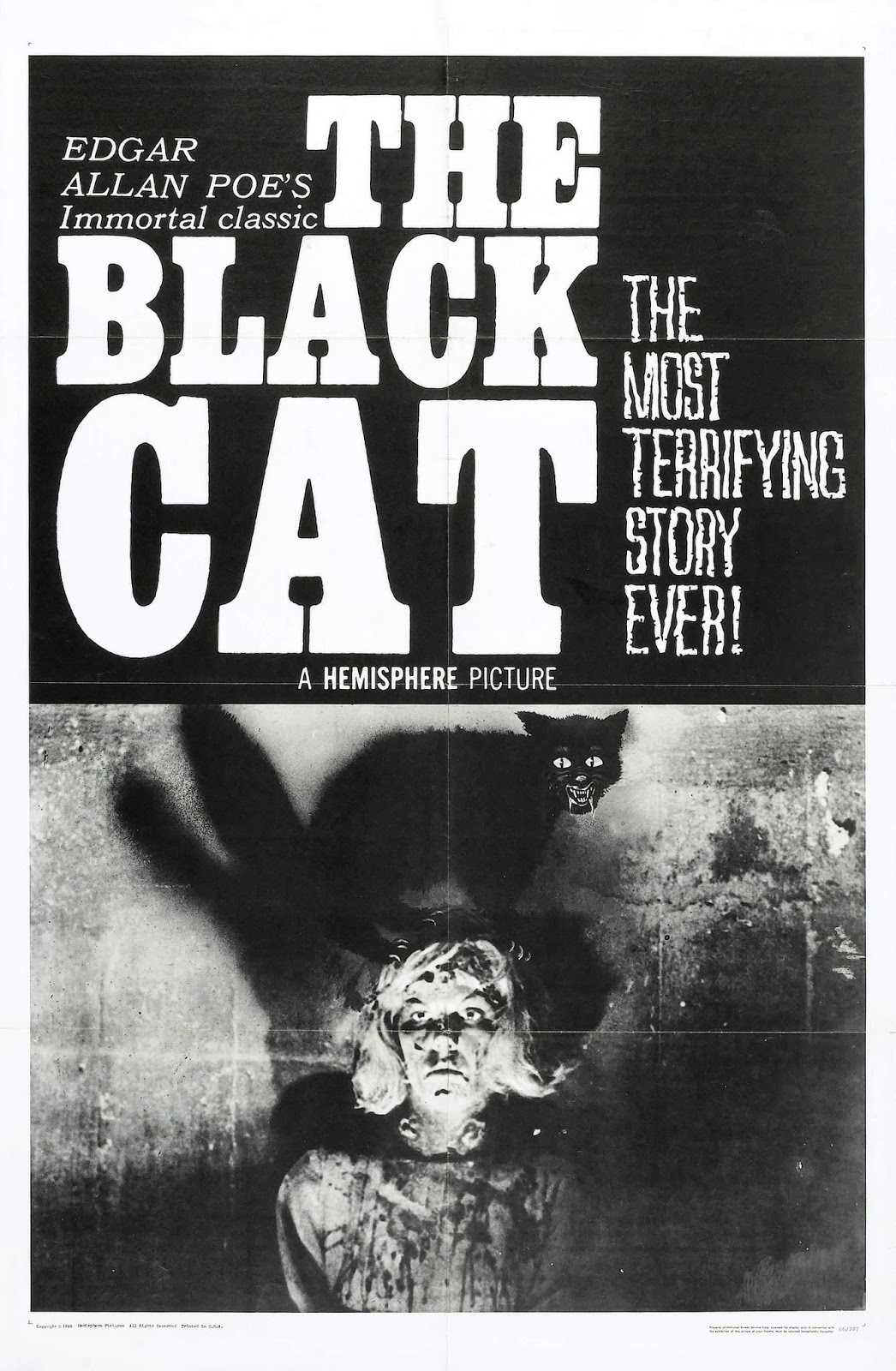
The 60's was the age of Edgar Allan Poe, kicked off by Roger Corman's priceless series with Vincent Price and copied endlessly by those who like making money.  The Black Cat (1966), while one of several adaptations and probably not the objective best of them, is a swift, stylish update on the tale, made in Texas and largely unseen until Something Weird's The Black Cat/The Fat Black Pussycat double feature DVD.  A young married couple collects animals, but this doesn't keep the husband from trying to strangle his wife.  Though he's unsuccessful, he takes his rage out on Pluto, a black cat his wife got him as a present, taking its eye out (in a really shoddy effect) and electrocuting it!  He takes an electroshock vacation at the sanitarium, eventually befriending a new black cat with a bad eye, and then madness and guilt start to close in on him, but not before we see a performance of a go-go band donning eye patches, complete with the audience frugging to "Bo Diddley."  All of this is really nicely shot, using its blacks and whites to full effect and at times letting the setpieces engulf the viewer.  It's apparently quite faithful to the original story despite its modern setting, so Poe enthusiasts will find it an interesting variation at the very least.  The other movie on the DVD is a sloppy, faux-Beat infused mess, so start with The Black Cat and sink in for 73 minutes of stylish creeps.


One of the most famous licenses Something Weird got was the library of Harry Novak, a legendary sleaze peddler from the drive-in days whose movies are the very definition of enticement.  Just look at that poster - total vintage greatness, and the movie's ripe for the picking, too.  A unique-esque horror mash-up, The Child (1977) follows the foreboding mystery of 11-year-old Rosalie, a precocious and seemingly evil girl whose hidden skills turn what should be a pleasant visit from a neighbor into a waking nightmare.  Everything about the movie evokes Halloween, from the scrumptiously hokey plot to the peppering of jack-o-lanterns throughout the film, right down to a Gol-Dang zombie attack.  Something Weird's DVD looks fantastic, the transfer dripping in deep color contrast and luscious film grain, and the clarity of DVD means we can see all the seams in the crude zombie makeup.  One drawback is that the movie's dialog is entirely dubbed, not because it was made in Europe but because the director was too cheap to record sound on the set, but I think it's some of the better dubbing in these kinds of horror movies.  Something Weird's Harry Novak DVD's went out of print a while ago, so if you see a copy of this one snatch it up ASAP.  It also comes with Del Tenney's I Eat Your Skin, if that's any kind of incentive.


Now hold on just a sec - Scream of the Butterfly (1965) ain't exactly an "Adults Only" affair.  It's mostly a tale of infidelity and entertaining melodramatics told in flashback by a room full of snark-butt divorce lawyers.  Two days after her marriage, Marla Williams (or "Miss Slutsy-Wutsy" as one of the lawyers saddles with her) falls deeply in lust with her "young Adonis" Paul, leading to lots of swimming and slow-mo, string-orchestra-throbbing making out.  The big twist in the movie, aside from the surprisingly hiply directed presentation of the thing, is the reveal that Paul is bi and sleeping with an older man on the side, and this evidence isn't taken lightly in the flash-forward bickering.  While the plot may not sound too creative, this movie is way, WAY cooler than its material calls for, wildly energetic and drenched in acidic humor.  It's actually the "B-side" movie on SWV's Day of the Nightmare/Scream of the Butterfly DVD but it should be the "A-side", as Day of the Nightmare was far too clumsy and boring to get me to care about crossdressing husbands.  If you're worried about that "Adults Only" label, don't - it's much more hyperactive soap opera than pseudo-porn, as there's really no porn, or even nudity, to be found. If you're in the mood for a wicked good time with B&W beachfront hysterics, Scream of the Butterfly should do the trick - Who Could Resist?


While many people continue to debate as to which movie featured on Mystery Science Theater 3000 was the worst, my vote will always go to the one that occupied my Wost Movie I've Ever Seen slot for many years (until the Final Boss of Film showed up) - The Starfighters (1964).  While the production may have begun as a drama centered around air force pilots, something must have gone horribly wrong, or at the very least the money ran out, because the film is about 30% drama and 70% stock footage of jets taking off, jets landing, jets refueling, jets dropping bombs, and jets just flying around for the heck of it, and that's a generous estimate.  The fact that the movie was released to theaters is insulting, and the distributors should have just shelved the footage and moved on.  Imagine my surprise when I found that its director, Will Zens, made a good movie a few years before called Capture that Capsule! (1961, aka Spy Squad), a Kold War Komedy about a couple of bumbling Soviet agents trying to get a rocket capsule with secret information and the US agents who foil them at every turn.  Made a year before the Cuban Missile Crisis, Capture that Capsule! makes up for its amateurish direction and bargain-bin acting with some genuine laughs and a steady pace, bouncing from one gag to the next with a breezy smile.  The DVD page tries to play up how bad it is, but if you just unclench your sphincters for a bit it's a really enjoyable goof-off satire that remains a fascinating piece of Cold War ephemera.  Just wait until we finally get to see what's in the capsule.


While most of Something Weird's catalog is best for belly laughing, Axe is a stark contrast in every sense of the word.  Another Harry Novak entry, 1977's Axe (aka Lisa, Lisa aka The Virgin Slaughter aka California Axe Massacre, even though the movie isn't set in California) follows a frightening group of criminals as they scum-spree their way away from a murder, driving the backroads of the wintry South and at one point stopping at a grocery store to scare and humiliate the check-out girl.  They stop at an isolated farmhouse inhabited by Lisa, a monotone, socially tone deaf teenager, and her near-catatonic grandfather, who spends most of the day watching TV static.  They blunder their way into the house, demanding meals and lusting after Lisa, and while Lisa's non-reaction to chicken butchering should have been a cue to her unhinged mental state nobody could have predicted what she would do with that hatchet.  Axe is a minor masterpiece of desolation and economy, wringing so much atmosphere and dread out of so little.  The bleak setting of the farmhouse is overwhelmingly sparse, the music is wonderful in that beautifully creepy 70's way (like the title music, which you should click on to restore your faith in low budget film scores, but look out for red housepaint chicken blood and fan editing), and the plot's morality vacuum only grows in power with each viewing.  This is the kind of horror the 70's was so celebrated for - creative, ruthless and free of stock plots, using any method and idea to scare its audience.  The Axe DVD is also way out of print, and while I'd recommend you get it here's the whole thing on YouTube so you can see it for yourself before dropping a pretty penny.  Axe is calling, and it'll hold you in its icy grip if you pick up the phone.


Meet Frederic Hobbs, outsider artist, inventor of the art car, and occasional b-moviemaker.  His '69-'74 run as a director wrought four movies - Troika (an experimental movie so obscure even I can't find it), the nude hippie-infested sight and sound journey/historical revisionist musical Roseland (featuring the song "You Cannot Fart Around with Love"), the turn-of-the-century-magician-revival-meets-international-vampire-conspiracy wonder Alabama's Ghost, and my personal favorite, Godmonster of Indian Flats.  Set in the real-life Wild West tourist town Virginia City, NV, Godmonster of Indian Flats follows two plots - one with a mining executive trying to cut a deal with the protective, ornery townsfolk, and the other with a mad scientist who makes an eight-foot-tall radioactive sheep monster.  This movie is unbelievably fun, keeping its loony plot cooking with a fast pace and directorial flair, and while Hobbs didn't have Jim Henson's Creature Shop at his disposable I guarantee you'll never forget the sheep monster.  What kind of gorgeous, unglued mind came up with this holy mess?  Only one that begs you to come back for more, and if this clip doesn't look like the greatest movie ever you might as well just lock yourself in the basement with a drum of tap water and a lifetime subscription to Oatmeal Monthly, because life ain't worth living without movies like this.  

Let's raise a glass to Mike Vraney and everybody at Something Weird for their tireless enthusiasm, as few other people would be willing to take chances on the stuff they find.  While not every movie they release is enjoyable (or watchable, for that matter), their catalog is one of a kind and always eye-opening.  If you have a taste for adventure, track these flicks down and get watching.  One of the things people at the memorial said repeatedly is that Mike Vraney was a man of passion and determination, and he knew that if you cared deeply about something you needed to get out there and do it yourself, because nobody'll do it for you.  He did just that, and Something Weird is a testament to his spirit.  Gosh Bless SMV and a blessed watching to you all.


~PNK

Sunday, January 5, 2014

Chatterbox Spiderwebs - CITIZENS BAND (1977)


Though it seems silly now (and probably did doubly back in the day), the trucker craze of the 70's was a real cultural force for its brief life, and a big part of it was the CB radio craze.  It was a goofy glimpse into the future, as people were jabbering with relative strangers just for the sake of human contact, and no movie plunged deeper into the phenomenon than Citizens Band, an early effort not only for director Jonathan Demme (the first big studio project after his three-movie stint under Roger Corman) but also for Risky Business writer/director Paul Brickman.  It's never seen any video releases past its initial, long-gone VHS issue, and while it may seem like the most dated thing ever in cocncept it stands as a fascinating cultural portrait and an effortless, insightful ensemble comedy, and its recent appearance in the roster of Amazon Instant Video may help its reputation some, even if to just preserve it as an encapsulation of a unique social bubble before it popped.

Playing the Altman gambit, Citizens Band follows a loose collection of people in a small Texas town all connected through their CB radios.  The closest thing to a main character is Spider (Paul Le Mat), the local CB coordinator and sporter of the finest flannel/light brown hair combo I've seen in a while.  Other characters spiderweb (heh) off him, like his alcoholic, crusty father Papa Thermodyne (Roberts Blossom, aka the old man from Home Alone) and his hard-ass gym teacher brother, Blood (Bruce McGill of The Insider, Matchstick Men and everything else).  His best bits are in the middle of the movie when he decides to "clean up the band" - he screws a big antenna to the top of his car and prowls around town looking for unlicensed, FCC-disapproved rogue chatterboxes, like a little kid skipping school to jabber about his secret identity as The Hustler.  He fancies himself not only a CB watchdog but a crusader for sanity and community standards - one of his biggest jobs is taking down a far-right nutjob jabbering about "commie peapickers".  Another memorable bust is his pursuit of The Priest, played with slimy superchurch cheese by Ed Begley, Jr., and it's the only time you'll hear a man use clergy axioms to argue against getting an FCC license.

We also see the trials of Chrome Angel (Charles Napier, The Silence of the Lambs and Fred Olen Ray's Deep Space across from Firefly's Ron Glass), a cattle trucker who starts the movie by nearly running his truck off the road when a 900-number-style sexy voice cuts into his transmissions.  Later on we meet a pair of women at a bus station who exchange stories of their husbands' infidelities, and they also exchange photos of their families.  Once they pull out pictures of their husbands, it turns out they're the same man - Chrome Angel - and he'd been stringing them along by taking trips and talking to them on his CB (and is currently bunking in a new trailer with a third wife, Hot Coffee).  Some of the most charming stuff in the movie involves the two women dealing with the situation, and growing friendlier with each other in the process.

All of this, as well as a number of funny throwaway jokes*, are woven together with an incessant stream of CB code chatter, with "10-4"'s flying left and right and goofy nicknames as anchors.  While it's never laugh-out-loud funny, it's consistently laid-back and puts a smile on my face, keeping with the movie's steady pace and patchwork feel.  It's kind of like switching channels, with a number of personal stories going on at once, none of them aware of the others.  If you don't like any of them the change-over is pretty quick, and none of the character sketches wear out their welcome.  While none of the stories totally converge, all the characters do meet each other in a community effort to solve a comedic crisis - the weird little CB kinship finally producing an objectively good result.  Much of the CB analysis painted the subculture in a poor light, giving insecure people a semi-anonymous platform to air dirty laundry and occasionally make threats.  The movie keeps a close watch on the emotional heart of its characters, and real drama creeps in as subplots come to their conclusions.  Jonathan Demme's direction is quite creative for such small-scale storytelling, with lots of interesting tricks, like vérité-style handheld work, fast dolly shots, double exposure montages and quirky transitions, keeping the energy high.  The opening credits are a treat, as the camera pans across the interiors of CB radios as odd-sounding channels whiz past.  Paul Brickman shows a real knack for characterization and naturally witty dialogue, things that came in very handy for Risky Business and kept it from becoming bogged down in 80's artsiness or sex-comedy clichés.  The actors are properly professional, putting fast character communication at top priority, an essential factor in ensemble flicks.  All of this has a compliment in the Texas landscape, dry, glowing and always inviting.

Citizens Band is a movie that is more relevant now than when it was released, as instant messaging and internet avatars have made the handle jabbering a major part of daily life in the Western World.  It may have been this prophetic quality that prompted its addition to the Amazon Instant Video roster, so you can see it (for $9.99) without having to gamble on the old VHS.  If you're a Jonathan Demme fan you'll want to see it anyways, so grab the nearest copy and breath in the smell of CB wiring - and look out for FCC crusaders.


~PNK

*My favorite is when Spider sneaks up on an old woman chattering to nobody in particular.  Stock war movie music plays as he crawls up to the exposed wire on the side of her house, and when he cuts it not only does the woman's voice cut out but so does the music, as if she had a record playing on her channel.