Showing posts with label Made-for-TV. Show all posts

Wednesday, January 28, 2015

Short-Order - MR. HUMPHREYS AND HIS INHERITANCE (1976)


After I did my article on Whistle and I'll Come to You I rewatched the first of the M. R. James adaptations I'd seen, A Warning to the Curious, which was excellent, and decided that if one of them can be great they can all be great.  This led me to checking out the only one of the BBC James adaptations to get an official DVD release in the states, 1979's Casting the Runes.  It blows.  That is, aside from a hilariously fake giant rubber spider and the worst floating head effect I've ever seen.  If those things float your boat, that is.  Fortunately, a special feature on the DVD put things back on track; it was a true short film adaptation of a James story I'd never heard of, Mr. Humphreys and His Inheritance.  Presented as part of a beautifully dated 70's music show called Music Scene, the short was introduced by Philip Wilby, the man who wrote the score, urging viewers to consider how the music was written to aid the horror and furthermore to discuss it in class or work or whathaveyou.  While that intro might be the best thing ever broadcast I can safely say that the film itself is pretty dang good, only taking 16 minutes but sticking in the viewer's dreams for much longer than that.

The eponymous Mr. Humphreys has just inherited, quite unexpectedly from a distant uncle, a semi-grand old country house.  His uncle was apparently a strange man, strange enough that his body isn't kept in the family vault, and the property features a large hedge maze, the gate of which features a plaque reading "SECRETUM MEUM MIHI ET FILIS DOMUS MEUM" (MY SECRET TO MYSELF, AND THE SONS OF THIS HOUSE).  Mr. Humphreys is as naturally curious as every other James protagonist, so he goes in, and at the center finds a pedestal with a metal orb on top*; the base reads "TERRITORY OF DEATH", which is enough to get Humphreys to temporarily retreat.  He investigates further in an attempt to get the maze cleaned up enough for general use (as his uncle forbade visitors from using it), but despite Humphreys's insistence that mazes are easily understood he can't begin to predict what might be preventing him from mapping the maze...or what lies beneath its center.

Working on a more modest scale than Whistle and Warning, Mr. Humphreys is just right.  As with Whistle and Warning, the key to good James adaptations appears to be Location, Location and another dose of Location for good measure (I can't wait to see what could be done with "Canon Alberic's Scrapbook"), as the country house is both properly old but also eerily unkempt.  Once again James's ideas are engaging and unique, drawing the reader/viewer in with elements that surprise in how creepy they are in his hands.  As per the much-hyped music, it's actually pretty good, created in that brief window when horror scores could be somewhat Avant Garde.  It's a lot like Gerald Busby's score for Robert Altman's 3 Women, and much like Busby Wilby little to nothing else to his name as a composer, which is a it unfortunate as I'd like to hear more from him.  It's also quite a bit like the classical music Frank Zappa wrote in the 60's with its heavy emphasis on winds and thick harmonic scoring.  If anything is wrong with the short it's its pacing - too much wandering around for this little time, and an ending rushed enough that the narrator can't even finish his sentence before the end credits start rolling.

Perhaps there's virtue in not overstaying one's welcome, and at a scant 16 minutes there's really no time, or reason, to complain.  I found an upload and included it below, but if you don't like watching a TV short being played by an outmoded video player on a new video player (with a bit of lag and missing the Music Scene intro) you might want to hunt down that Casting the Runes DVD, if only to laugh your ass off at floating heads and funk-music intros.  Either way Humphreys is a quick-'n'-satisfying way to get your James fix and a worthy interlude to its larger cousins.  And remember, if a hole mysteriously appears in a map you're making, don't look in.


~PNK

*The spiderweb budget for this short must have been through the roof, let me tell you.

Monday, December 8, 2014

What is Dreamt and What is Coming - WHISTLE AND I'LL COME TO YOU (1968)


"There are more things in philosophy than are dreamt of in the Heaven and Earth.
There are more things in the Heaven and Earth that are dreamt of in your philosophy."

While Americans tend to think that Christmas is owned and operated by the US of A, England has a great many Christmas traditions all its own, very few of which have made it across the Atlantic.  Among them is the Christmas cracker, a tube pulled at each end which makes a loud bang and holds small toys and candy inside, as well as a terrible joke.  Another, and one I wish we would adopt on these shores, is the telling of ghost stories on Christmas Eve.  The Victorian era and the early 20th century was a golden age of the old-school ghost story, with British authors such as J. Sheridan le Fanu, Oliver Onions* and the Benson siblings reigning supreme, as well figures like Ambrose Bierce, Robert Chambers and H. P. Lovecraft on our side of the pond.  Arguably the most revered British ghost story writer was M. R. James, an antiquarian and Medieval scholar who wrote stories as a sideline and as a way to explore the dark possibilities of his antiquarian interests, many of them written specifically to be read aloud at Christmas Eve.  A favorite of British filmmakers, a number of his stories were adapted for television by the BBC, largely as part of a series called A Ghost Story for Christmas which adapted a different story annually from 1971 to 1978.  I've seen one of these, A Warning to the Curious, and it's a damn creepy horror experience that excels far beyond its time constraints and budgetary limitations.  The main precursor to this series is the teleplay I'm talking about today, Whistle and I'll Come to You, based on James's "Oh, Whistle, And I'll Come To You My Lad".  Lasting barely more than 40 minutes, Whistle knocked me on my ass, an unnervingly effective ghost yarn best approached with little foreknowledge and an acute lack of lighting in the room, and considering that it was broadcast on Christmas Eve I can only assume all of England was gripped by an endless, sleepless night.

A man walks on a windswept beach towards the camera as a narrator tells us of M. R. James and the story in question, pitched as his darkest and promising a tale of hubris and internal destruction.  The man is Professor Parkin of Cambridge (played by the veteran character actor Michael Hordern), a simultaneously fastidious and out-of-sorts man who has come to stay at a seaside hotel during the off-season. Bumbling in the face of a largely empty resort, Parkin eats his breakfast loudly on his first morning and goes for a seaside stroll, eventually reaching an old graveyard.  Approaching a grave on a cliffside he sees a bone sticking out of the cliff face, seemingly belonging to whoever was buried there hundreds of years ago, and puts it in his satchel, saying "Finders, Keepers".  That evening he inspects the bone to see it is actually a primitive flute which bears an inscription; he makes a rubbing of it and translates it to read "Who is this who is coming?"  He says "We shall blow it and see," and does just that.  A strange wind begins to howl, putting Parkin to bed in an uneasy state.  In conversation at breakfast the next morning he insists he doesn't believe in ghosts, raising the point to the man who brought the subject up that ghosts should be subject to the same scrutiny as any scientific enquiry and that there isn't a real consensus on what a ghost is anyways.  He thinks little of ghosts and the flute until bedtime, when he is once again dogged by the inscription, only to dream...dream of running on the shore, running from his own heartbeat, running for his life, running from something ancient, unreal, and hungry.  Only the next day knows if he will have to run for real.

If producer/adapter/director Jonathan Miller should be commended for anything at the start it's his ability to induce claustrophobia in the viewer.  Very little dialogue is spoken for quite a while at the start and the viewer is treated to the sounds of stuffy rooms and amplified human scrabblings, their sight forced into long diagonal framing.  Shot in pristine B&W, Whistle looks gorgeous and foreboding, its hotel nearly choking in its lack of customers and crushing in its insistence on making every microscopic noise Parkins makes overwhelmingly present.  This meets Hordern's performance as Parkin head on, as Hordern's turn here is one of the most hypnotically eccentric and precisely realized performances I've ever seen in a horror film.  Every little head turn, speech hiccup and emotional curl is beautifully embellished, painting a picture of congenial self-absorption specific to career scholars and strangely rare in horror cinema.  Whether by script or improvisation Parkin utters many subtle, yet baffling, phrase peculiarities, such as when he finds the flute and says "Give the dog a bone" to himself.  If all of this sounds funny to you, keep a grip on the arm of your chair, as Whistle makes sure the terror is both present and uniquely gripping.  Trust me when I say you'll never look at late-60's audio tape distortion the same way again.  What is so remarkable is just how memorable an uneasy an experience the 41-minute film is in spite of its short length and rather simple story, and when it comes down to it not much really happens - it's just that what happens is undeniably disturbing, and then that open ending...that ending...

Whatever you're doing this Christmas season, you've probably got a spare 41 minutes to check out this spare, creepy little gem.  I may visit the proper A Ghost Story for Christmas series in time (especially A Warning to the Curious), but this will more than suffice for the time being.  Forget whatever image you have in your head of a mild-mannered made-for-TV horror short and just let Whistle and I'll Come to You sweep you away.  That is, if you can handle things dreamt outside of your philosophy.


~PNK

*Yes, that's his real name.

Monday, February 10, 2014

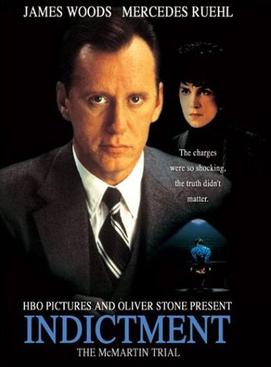
The Depths of Wild Imagination - INDICTMENT: THE MCMARTIN TRIAL (1995)


HBO is spoiled these days, what with all the good shows and TV movies confined to pay walled-in channels and the premium channels winning ALL the Emmys.  Back in the Dark Ages (the 90's) only a handfull of shows ever broke into the mainstream, the big winner being Mr. Show, until The Sopranos came along and changed the channel's fortunes forever.  I covered another 90's movie of their's in my review of The Second Civil War, and today we're looking at another hidden gem - Indictment: The McMartin Trial.  Executive Produced by Oliver Stone and starring James Woods and Mercedes Ruehl, Indictment has never seen the exposure you think its names would warrant, and it's doubly odd considering the ridiculous true story it faithfully documented, the longest and most expensive criminal trial in US history, one that sparked a nationwide panic but resulted in zero guilty verdicts and went down as a textbook example of mass hysteria.

In the mid-'80's, a horrifyed mother calls to report that her local preschool, run by the trusted and longstanding McMartin/Buckey family, has been physically and sexually abusing her son as part of Satanic rituals.  The family is arrested and the 200 or so children in the class are taken to an innovative child abuse therapy center, Children's Institute International, to be questioned by a counselor.  As the media frenzy grows, attorney Danny Davis (James Woods), a man used to defending drug dealers and society's rejects, sees through the media blitz and takes on their defense, partially to uphold the American virtue of "innocent until proven guilty" but more because it's a "hell of a case."  That hellfulness also attracts prosecuting attorney Lael Rubin (Mercedes Ruehl), and their first meeting is one of adversarial ribbing and snickering at the prospect of their careers skyrocketing as a result of the trial.  Their adversarying can't equal the wide smiling of CII's head Kee MacFarlane (Lolita Davidovich), obviously quite proud of her work wringing accusations out of the children.  Everybody, with the notable exception of Davis, is quick to accept the increasingly outrageous accusations, and Davis points immediately to the huge-framed 80's glasses sported by Virginia McMartin (Sada Thompson), teacher Peggy Buckey (Shirley Knight) and her son Ray (Henry Thomas), the latter of which Davis says "looks like a child molester."


As the hearings and investigations from both sides get underway it becomes increasingly apparent that not only does all the prosecution's evidence consist the testimony of small children, the children's statements are bizarre to the point of farce.  One claims that the Buckeys killed a horse with a baseball bat; another claims they flew the kids on an airplane, then says they went to a car wash instead, then says the car had no windows.  A boy claims that a man put his penis inside the boy's penis.  When shown a row of possible molesters, another boy identifies a City Council member and Chuck Norris as participating Satanists.  The one that sends the media into the most uproar is one overenthusiastic boy's claim that everybody dressed in black robes and sacrificed a rabbit, drinking its blood.  And to think that some townspeople had set fire to the preschool before the trial even started - thank God the family was protected from the outside.


All of CII's sessions were videotaped, and as Davis looks over the sessions he notices something very striking - the techniques used by the therapists are less encouraging the truth and more coercing the right answers out.  His hypothesis is that the therapists were fed a general claim of abuse from the parents or some officials and used any means necessary to get the kids to admit to the claims, oftentimes saying that all their friends were smart for telling them they were abused, and "you don't want to be stupid, do you?"  The kids were also shown dolls with anatomically detailed (ahem) dolls meant to represent the Buckeys, accompanied by remarks as to how Peggy's breasts had lines on them, and in one instance a kid is encouraged to slam the doll on the table.  It's very clear to not only Davis but one of the prosecution's investigators that the children are being led on, most likely afraid that if they don't say what the adults want that it will get them in trouble, and the hearings show just how easy it is to lead these young witnesses.  That doesn't stop the judge from blatantly favoring the prosecution, allowing their questioning while letting objections stick on the defense's countering.  All of this actually convinces the prosecuting investigator to resign, leaving Rubin in a state of righteous frustration that only grows as the trial progresses.  Davis's case only grows in the process, skillfully piercing holes in not only CII's techniques and MacFarlane's credibility as a social worker but also demolishing a witness who claimed that Ray admitted to sodomizing children and successfully turning the preferential tables not only for the judge but the jury and the audience.  The most entertaining part of all of this is when Rubin begins her personality attack on Ray, citing his interest in "pyramid power."  I won't dare spoil it for you, except to say it's incredibly funny and produces some of the best lines in the movie.


It's important to note that the mother who made the first accusations, the claims upon which the whole case is based, was a severe alcoholic and was diagnosed with paranoid schizophrenia, a fact that the prosecution deliberately hid from the defense.  It's also important to note that she died from alcohol poisoning before the trial even started, and the entire ordeal, from the arrests through the final, merciful ending, lasted seven years and resulted in zero guilty verdicts.  It ended up being the longest and most expensive criminal trial in American history, a doubly ridiculous fact considering that nobody went to jail for it, though the Buckeys most of that time in prison anyways.  To the delight of docudrama fans Indictment is just about the most accurate representation of the real trial as you're likely to see on film, and even the most ludicrous elements are completely true to life.  I've read reviews of the movie that accuse it of being one-sided, but how can it be anything else when the accusations are patently false?  What, did these reviewers really think that there was a Satanist conspiracy bent on molesting children and ritual sacrifice?  There are real Satanist organizations in America that the police could have talked to at any time, such as The Church of Satan, and none of them have any kind of abusive or sacrificial agenda and are in fact pretty harmless in the grand scheme of things.


The case marked the turning point in the public's willingness to believe in Satanist conspiracy horsehockey, and Indictment was the final nail in the moral panic's coffin.  The movie is incredibly well done for a TV movie, its filming style reminiscent of Oliver Stone's over-the-top style familiar to viewers of JFK and Natural Born Killers but knowingly restrained.  The performances are excellent, with Woods and Ruehl in top form and the supporting cast fully committed and at times heart-wrenching.  James Woods is one of my favorite actors and he was born to play this kind of role, a third-banana lawyer who uses his smarts and rhetoric to not only win over the jury but redeem his unillustrious career defending drug dealers and scumbags.  Henry Thomas, who plays Ray, gets the most well-developed arc in the movie and his performance is the most compelling of the film, quite remarkable for an actor I've never paid much attention to (the only role I'd seen him in before was as Amsterdam's best friend in Gangs of New York).  The movie is shot much more like a theatrical film than a TV show, and the camera is free to sweep and accentuate the story beyond our TV-movie expectations.


The true story of the McMartin trial is a fascinating portrait of the peak and decline of one of the most idiotic moral panics this side of rainbow parties, and the movie does the facts great justice while making its own identity as an entertaining and tense courtroom drama.  If you've got a spare slightly-more-than-two-hours and can secure a copy you're in for a true-story ride on the same level as docudrama masterpieces like Zodiac and All the President's Men.  You've got my guarantee that at no point will Chuck Norris show up to put his penis inside your child's penis.


~PNK

Thursday, August 15, 2013

Special Report - THE TURN OF THE SCREW (1959, episode of "Startime")


One of the benefits of living in Seattle is the blessing of Scarecrow Video, the largest video store I've ever seen and widely considered one of the best in the world.  If you can think of a movie, they've got it as well as a dozen others like it you didn't know existed, or were even possible under the current understanding of quantum mechanics.  They've even published a mammoth review book, and many big film names have visited the place and signed their own work's boxes.  Having recently revamped the portion of the store previously reserved for selling used videos, Scarecrow has started hosting events (including the upcoming VHS Swapmeet, where I'll have a table (!)), and this month is VHS month in honor of their large collection of such and the current retro-craze for the obsolete and less-than-snuff format.  Though later in the month we'll get to see such treats as the ultra-obscure kung-fu-and-magic headscratcher Furious (1984) and the legendary shot-on-video anthology baffler Tales from the Quadead Zone (1987), Monday night's screening was much different - John Frankenheimer's The Turn of the Screw.

The concept of "made-for-TV movie" wasn't always a simile for "forgotten stool sample on the bus"; in the 50's and 60's there were programs dedicated to high-quality 75 minute adaptations and originals, with big names in front of the camera and talented workhorses behind.  Robert Altman started out in these productions, as did John Frankenheimer, director of The Manchurian Candidate and Seconds.  His name wasn't the least bit recognizable when he helmed Turn, but his work is exemplary, and it's a shame this version of Henry James's novella is so hard to find because it's a surprisingly scary, visually engrossing piece of film-making brevity.

I've never had the pleasure of reading the story, and haven't seen any other adaptations (with The Innocents being a shameful hole in my horror-viewing repertoire).  No matter - Startime makes it easy for us.  A young governess (Ingrid Bergman) has been hired by a London-based man who has been charged with taking care of his nephew and niece whose parents have just died.  He has no interest in looking after for them himself, so the governess makes for their country mansion, Bly (which has its own carriage bearing its seal).  The niece, Flora (Alexandra Wager) is chipper enough, with far too many teeth visible at a time, but the nephew Miles (Hayward Morse) has been expelled from his private school, and will be home any day now.  The governess and their maid surmise that the only cause (because none is stated) would be causing harm to others, though what harm that is we may never know.  Plenty of creepy harms are implied, though, as well as many other phantomic creeps (faces in the window, songs from distant rooms).  When he does return he meets his sister's cute precociousness with an unsettling precociousness, and the governess's grip on the children and reality start to spiral out of control.

Horror fare from this time period can usually be shelved under quaint anti-fright, but Turn has far too much going on to be punted to that oubliette.  B&W fullscreen has never looked better, as Frankenheimer takes a fluid, askew method to filming a deeply shadowed house.  There are many small uniquities, my favorite being a panning shot across a staircase that ends looking down a hallway, the camera tilting slightly at the entrance to uproot the Earth in wait of Bergman's discoveries.  Anybody who has seen the Shining-centric documentary Room 237 will remember the observation that during the first half of The Shining Kubrick transitioned between scenes with very slow dissolves, so slow they forced you to study the superimposition.  While Kubrick may not have meant anything like that, Frankenheimer certainly does, pulling out double- and triple-exposures to great effect (my favorite being the Bly house seal over a doll in a pond).  

Production designer Warren Clymer utilizes the handful of sets offered to him to great effect, allowing period design to fold into darkness and creating some of the most unsettlingly fake exteriors I've ever seen.  Flying in the face of 50's TV, the soon-to-be-accomplished classical composer David Amram supplies a hair-raising Avant-Garde soundtrack, terse and shrieking with a healthy supply of alien clangs and burbles.  It's always nice to see that quirk of Victorian wear in film whereby too-tight dresses make the wearer look like a gliding bobblehead.  As for the actors, Bergman is excellent, steadily mounting upon a professional manner with nervous terror.  The two child actors are unbelievable, displaying a creativity and control beyond their years; Hayward Morse is so precocious in his performance it makes his later scenes downright chilling.

I've never been much of a fan of ghost movies, mostly because ghosts, by design, shouldn't be scary.  When you get down to their motivations and what they were like alive the darn things just don't make any sense, and all the frights come from what might be there rather than what's actually there.  If there's a lesson we learned from The Blair Witch Project it's that suggestion is far more fear-inducing than explanation.  The Turn of the Screw renews my faith that a traditional ghost story can induce frights if done properly, and much like the classic Witchboard the usual logistical issues are sidestepped via careful details.  At the end of the 75 minutes I was invigorated and a little spooked, and if you can track it down you won't be disappointed.  I have to emphasize the "if" here, because this movie is so rare that Scarecrow's copy was hand-donated by Frankenheimer himself (!) and comes with a hefty rental deposit.  That screencap standing in for a poster was on YouTube, so there must be a torrent floating around there somewhere.  Hopefully it looks better than Scarecrow's copy, which had a slow warble and seemed to have grown a coat of cheesecloth.  For my money, a smudgy presentation may have helped the experience, as the shadows are that much more concealing.  Get it ASAP.  Don't wait.

~PNK

Monday, April 15, 2013

Weaving Family Across the Land: TRAMP AT THE DOOR (1985)


When I was taking Music History in undergrad, we were visited by a Canadian composer for a special lecture on the classical tradition of the Tundra Not Unda.  Her general thesis was that being a composer in Canada (or any other artist seeking state funding) meant that government financiers were mainly interested in two subjects that theoretically made up the “Canadian Experience”: space and identity.  Space may have come from the wide open spaces of the Canadian wilderness, and how the pioneering spirit still lingered through the generations and built a foundation for country life.  Identity seems to come with living in North America, as the histories of Canada, the U.S., and Mexico were rich with the trials and tribulations of colonialism and immigration.  I can’t speak for all Canadian arts as to whether anybody producing art explores these concepts by choice or by necessity, but I can attest to the late writer Gabrielle Roy and director Allan Kroeker, whose combined arts made this wonderful TV movie from the mid-80’s that occupies that interesting slot of videos that have been out of print for decades but are very cheap to acquire online.


Tramp at the Door is set in the Manitoban Prarieside in the mid-30’s, following Gabrielle Roy herself (newcomer Joanna Schellenberg), her Justice-of-the-Peace father (August Schellenberg, Joanna’s real-life father) and her mother (Monique Mercure, who has been in things I’ve seen but I’ve never recognized her).  Her father was born of an immigrant family in Quebec, and forged a new existence for himself in early adulthood, away from his family.  His only connection left with his roots are his stories and memories, as was common with people living far away from each other in those days.  That is, until the Roy’s (called the Fornier’s in the film) are approached by a strange visitor (Ed McNamara, who died within a year of this film’s release), who we had recently seen conning a train conductor into thinking he had bought a ticket by wearing a stranger’s coat while he was in the  bathroom and getting the ticket punched before the coat’s owner returned.


The stranger approaches one rainy evening and introduces himself as Gustav, a cousin from Quebec.  Gabrielle is the one to answer the door, and she doesn’t believe him at first, because he gets her name wrong (calling her Agnes) and saying Fortnier instead of Fornier.  He is only invited inside and to the table because of the father’s curiosity in meeting a cousin from the old home.  The news of family developments spill forth, but Gustav seems to only speak of cousins as their names and details are offered to him by the family (my favorite is when he insists that a cousin who had lost his legs in the war ended up running the family farm).  Gabrielle and her mother immediately suspect that Gustav is a liar, but the father is in the mood of fool-suffering because he likes the illusion of family connection across the horizon.  Despite grumblings from his wife, he attempts sending Gustav off in the morning.  This is unsuccessful, with the father claiming that the roads are unsuitable for horseback riding.


The mother, also in the mood of fool-suffering (for her husband, anyways), gives Gustav an old work-outfit and sets him to help out around the house.  He throws himself into the help, tending to farm duties and even fetching mail from town on foot despite the great distance.  By night, he becomes a fountain of stories from the family, speaking of many cousins from the past: one who lived to be ninety after failed suicide attempts, a bootlegger who became a priest and another who killed her husband by putting glass in his soup.  Each story has a captivation to it, and Gustav often stops his stories right at a climactic point, ensuring that the family will keep him at the house for another day.  The mother is the most interesting in her reaction to all this, admitting that even though she doesn’t trust Gustav or believe the stories for a second, all information she did get of her husband’s past was in the form of stories, anecdotes, comparisons, and fragments.  Her husband’s stories were in their own way no more or less real to her than Gustav’s.


This continues for some time, with the web of history that Gustav spins becoming more and more thick and emotionally grabbing for the family.  One of the most incredible was the story of Cousin Cleofas, who apparently died aboard the Titanic with his wife, and his family didn’t find out about it until a decade later.  It’s in these moments that a thick air fills the living room, an air of rapt fascination, one that is represented beautifully by the music and lighting.  Even more fascinating is a story that he tells to Gabrielle one day, about a cousin who pulled himself up by his bootstraps by giving bottles of a cure-all cough syrup to his townspeople, and became a well-regarded and wealthy man despite having no real credentials or medical skill.  Of course, the story of how he lost all his money is for another time, stringing her along with yet another cliffhanger.


Throughout all of this a strange balance is maintained, with Gustav’s illusion keeping the family looking the other way, even though they always question him implicitly, and internally.  In a curious moment, the father finds a notice of an older, possibly deranged older man being in town on the board next to his office.  He takes the notice down, and when a coworker questions him he claims the notice was for a team of horses he wants to buy (even though he already has one), and gets defensive when probed.  Gustav has become a member of the family through pure charm, a feat that may never happen again in this day and age, where people have to undo sixteen locks on the door just to pay for pizza delivery.  He is blessed with the enormous gift of observation, and knowing how to play on people’s needs.  At one point, he breaks through to the mother’s religious bent by spinning a story of a miracle-working Brother Andre at St. John’s Oratory (a Quebec basilica).  She sees the gift of compassion in his heart, a gift that seemed obvious to them all along, by his ability to weave tales for no other purpose than to fill his hosts’ hearts with joy.


And then, he's gone.


But, not really.  Merely, he has moved onward, further West, towards another town and another family.  Nothing was taken from the Fornier’s home, and no ill feelings were kept; he just knew that it was time to keep moving.  And then the letters start coming, as Gustav tells of more family members he supposedly visits in his journeys, each one having a kind word for Mr. Fornier.  The Fornier’s spend their evenings pawing through old photographs and correspondences.  One night they think they recognize Gustav’s voice in a radio serial, and realize that his Scheherazade-like technique of cliffhangerismo may have been lifted from them.  The letters start to create a trail across the Prairie, a line of experience and warm feelings that can’t be proven by the Fornier’s but are a joy to relish.  Relatives that the father had never heard of were seemingly happy to send their regards through Gustav.  And then, he is silent.  In a pivotal scene, Gabrielle forecasts her own future as a writer by re-telling the story of the cough-syrup cousin to her classroom.   And, in her own burgeoning talent, she weaves Gustav into the character, while wearing her teacher’s coat and hat.


Much more of the plot, I shouldn’t tell, but it might not be what you expect.  It is this film’s gift to create a warm, sprawling texture that engulfs the viewer during its tidy 80-minute running time.  I can imagine that the original TV broadcast was an inferior way to view the film, as the depth of the cinematography, design, and acting is far too much for the small screen.  The cinematographer Ron Orieux and art director Bonnie von Helmot have a love affair with natural light, and the way it plays across skin, wallpaper, and wheatfields (I suspect Days of Heaven was influential in the look of the piece).  The direction by Kroeker is superb at capturing the experience of hearing Gustav’s stories, often following his inflections and movements with a handheld camera, imitating the spectator.  I got the feeling throughout most of the film that I could simply walk through the screen and live the life of a Manitoban farmer in the 1930’s, as the rhythms and moods of this kind of life are made luminous and endearing by the director’s touch.  As for the acting, it’s just right, and especially excellent from the young actress playing Gabrielle.  Ed McNamara as Gustav is astounding, giving the huckster an enormous charisma despite his obvious façading.


Few films I’ve seen have been better at exploring the relationship between family ties and storytelling, perceived connection and realistic disconnection, than this one.  Gustav opened a world of life and love spanning across thousands of kilometers, allowing an extended family spread throughout the prairie to flood into a single household.  In a way, he also was hugely helpful to the family’s immigrant experience, as immigrants have to hold onto their connections in a new world; the Fornier’s were no stranger to this, even though their ancestral homeland is never truly revealed.  Another film that expounded on the importance of immigrant family ties was Barry Levinson’s Avalon, one of my favorite family epics and a movie you should see immediately.  Referring back to my earlier point on the nature of Canadian art, Tramp at the Door is a beautiful entwining of space and identity, as well as a loving ode to the power of storytelling.  Gabrielle Roy went on to become one of the foremost Francophone writers in Canadian history, and I’m of the opinion that this story is an expression of the birth of her love for the storytelling craft (she died not long before this film was made, and it is dedicated to her memory).  The best writers in the world are those who seep compassion from every pore, can see to the heart of people and make monuments to the human experience.  It is just this gift that Gabrielle’s mother sees in Gustav, noting that he was a creature of true grace.  I believe that an Amen is in order for everybody involved.

I was unable to find the movie on YouTube, but the good news is that the old VHS copies are pretty cheap used at the Amazonz: http://www.amazon.com/gp/offer-listing/B000MC1FHS/ref=dp_olp_used?ie=UTF8&condition=used

~PNK

Monday, March 11, 2013

Live from the Ruins of the Melting Pot: THE SECOND CIVIL WAR (1997)


If there’s one thing I love it’s a really smart political movie and it’s even better if it’s satirical (copies of Wag the Dog for all!).  Another thing I love is a really, really dang good TV movie, largely because of their relative rarity in the great movie canon.  At the intersection of these genres is The Second Civil War, a movie that begins with India nuking Pakistan, and only gets funnier.  We’ve got a fantastic cast on our hands, including Beau Bridges, Phil Hartman, James Coburn, Elizabeth Peña, Dan Hedaya, James Earl Jones, Ron Perlman, and Denis Leary, as well as a sizeable pile of welcome character players.  We also have a fantastic director, Joe Dante (Gremlins, The Howling, The ‘Burbs, and Matinee (which will be spoken of in a future review, BTW)).

The whole mess takes place “sometime in the near future,” wherein the Department of Ethnic Affairs has been formed to deal with a staggering number of international crises (including a billion-person increase in population, “standing room only from Maine to California”).  Their answer is allowing boat- and plane-loads of refugees enter certain U.S. states, and reaction has been mixed (especially considering lunacy such as Rhode Island becoming mostly Chinese overnight).  For reasons that are certainly harebrained, a plane full of Pakistani orphan children is due to be flown to Idaho, and Governor Jim Farley (Bridges) has responded by closing Idaho’s borders.  There are many wrinkles in this action, his own being his growing affair with Christina Fernandez (Peña), a News Net reporter and official Mexican immigrant.  Closing his borders to immigrants probably wouldn’t allow him to marry her (which he insists upon), and this situation gets a lot of scenes where Christina’s boss, Mel (Hedaya), asks her to stay close to Farley for the story, and she just happens to be on the couch in his office.  The News Net room is in scramble mode, including using infrared satellite photos of the Pentagon to determine if America will retaliate against Idaho (which it will), and reporter Jim Kalla (Jones) provides deep narration.

The President (Hartman) is flabbergasted, and seems to turn solely to Jack Buchan (Coburn), a public image specialist who insists that the President move his deadline for Idaho to open its borders a bit sooner than 72 hours to not interrupt All My Children.  The revised time is 67½ hours, naturally.  Buchan also has a team of quote-writers, all of them non-Americans, whip up an Eisenhower quote to go along with the President’s TV declaration.  Things aren’t much more sane at News Net, as a serious suggestion is to superimpose the faces of the Pakistani orphans on the heads of the singers in the “We Are The World” music video.”  The orphans themselves are driven to the Idaho border, which was of course a good idea considering the amassing Idaho National Guard.  Meanwhile, the mayor of Los Angeles Javier Clark makes an anti-Idaho address entirely in Spanish, and is promptly shot at by American nationalists.  Not only is Christina asked to translate Javier’s speech (making it much more impassioned due to her personal interest in the issue), but it appears she has morning sickness, too.  The Alamo is bombed by Mexico, and the generals on the two sides of Idaho’s border are two old farts whose main concern is showing each other up as a resolution to petty quarrels.  And all of this is woven together with tons of funny dialogue and the wise, sober presence of James Earl Jones.

In ensemble pieces all the performances need to be spot on, and each of The Second Civil War’s are spectacularly placed.  Phil Hartman as the unnamed President is hysterical, continually stupid but determined to emulate the great former presidents about which he is deeply misinformed.  Beau Bridges is colloquial and likeable as always, giving his Governor role a fast-talking, Bush, Jr. feel (before Bush, no less).  His character is given the deepest focus, and despite his radical decision he maintains a childlike fascination with America and truly loves Christina and their future child.  Other essential performances are Peña’s continual annoyance at life, Hedaya’s wide-eyed, manic network boss, and a spectacularly blue-collar reporter played by Ron Perlman.  The high-quality acting allows for some hilarious throwaway characters, such as the White House’s Nation of Islam consul and a Sikh with a comically thick Alabama accent.

I can’t speak too much on the direction, suffice to say that the pacing is excellent at keeping up with the many plotlines.  The writer, Martyn Burke, is a name I’m not familiar with but now I’ll have to investigate (including his other made-for-HBO movie The Pentagon Wars, starring Kelsey Grammar and Cary Elwes).  Burke has fashioned a wickedly incisive, bullet-paced satire that is worthy of joining the ranks of the best films in the genre; too bad nobody ever talks about it, or Pentagon.  Why not?  Who could say no to that cast?  Maybe it’s not just the venue in which it was shown; it might be too satirical, playing fast and loose with our inherent racism and turning surprisingly serious at points.  That ending is a bit odd (not that I’d dare reveal it), not a climax in hilarity but one that leaves the audience in a more thoughtful mood they woke up with that morning.  The good thing is that the DVD is cheap, so there’s another addition to your wish list if you care to indulge.  Just be forewarned that it’s an incendiary ride, so don’t get too politically correct; after all, as James Earl Jones closes the film, “all art is messy as hell.”

~PNK