Monday, January 20, 2014

In Memoriam Mike Vraney (1957-2014) - some Something Weird gems


I'm sitting here at Cinebarre, a movie theater in Mountlake Terrace, WA that also serves food and drinks to your seat.  I'm amongst about 100 people who have amassed in honor of Mike Vraney, a man who the general public has never heard of but really should have.  In the early 90's he founded Something Weird Video, a company dedicated to unearthing and supplying video distribution for hundreds of ultra-obscure exploitation and sexploitation movies, primarily 60's and 70's stuff by the likes of Herschell Gordon Lewis (The Wizard of Gore) and Doris Wishman (Indecent Desires).  These were movies relegated to the drive-in circuit and skeezy 42nd Street theaters, made for next to nothing and quickly forgotten by whatever fraction of the public saw them to begin with.  With little tradition and virtually no MPAA-esque oversight, these rag-tag filmmakers whipped up some of the loosest, most memorable hunks of genre insanity you've ever seen, and Something Weird's near-endless catalog is a Hall of Infame, constantly surprising and often jawdropping.  I've barely scratched the surface of their stock myself, largely because of the bazillion other movies I want to see but also because much of their catalog is 60's sexploitation, a gray-area genre that mixes plots with porn (or just chaste nudity), and I can't bring myself to be interested in old-school skin flicks.  They also offer pretty much everything else from gore fests to kiddie matinees and educational reels, so if one section of their site turns you off you can always find something completely different.

Because Something Weird's catalog is something of a niche market it's not surprising that not too many people outside of the obscure weirdities film geekdom would have heard of them, so in recognition of Vraney's efforts I've decided to go over a handful of my favorite films in their catalog in order to make a "gateway" list.  Despite what some people may think, I don't like every bad old movie I see, and I've tried to gear this blog to many different genres in the expectation that my readers have a taste for "real" movies, a type of movie Something Weird expressly ignored.  While all these movies appeal to that geekdom I mentioned they have the potential to be enjoyed by the outside world, and I love 'em so, so shush if you think I've fallen down the rabbit hole.  The last one is a movie I've been meaning to review for a while, but now is the perfect time.  The DVD Mike Vraney was the most proud of was Monsters Crash the Pajama Party: Spook Show Spectacular, a packed-to-the-gills home video extravaganza wherein page after page of Halloweeny menu screens go without labels, leaving the viewer to be surprised and delighted with the treasures they find.  The only reason I'm not doing that is that it's not a movie but rather a dozen or so short subjects and goofy extras, and that masterpiece needs no help from me in the fanbase department.   Without this company we may not have ever been given the chance to see these flicks, so thank god for home video and a tip of the hat to Vraney and crew.  Movie night wouldn't be as demented without them.
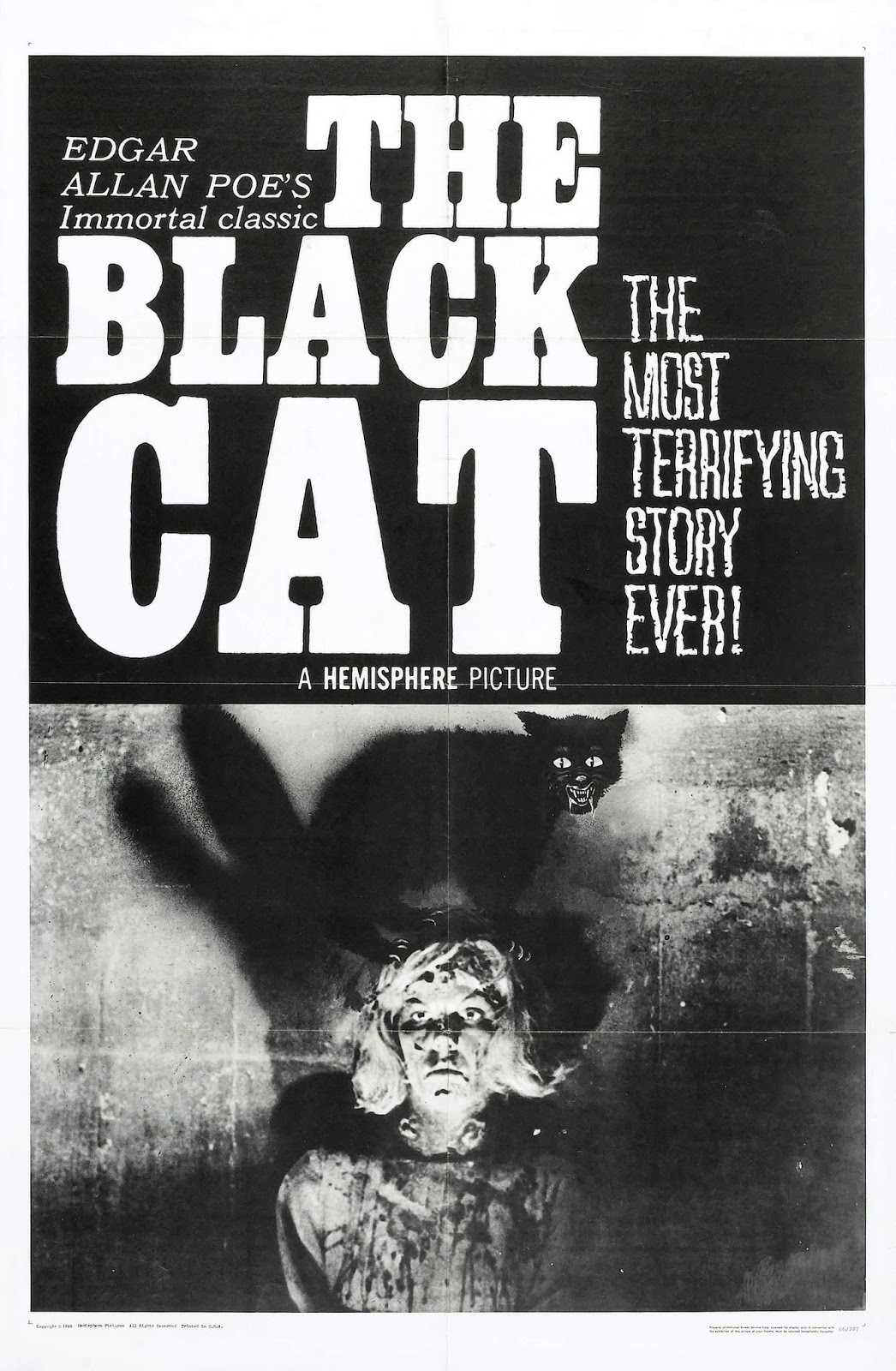


The 60's was the age of Edgar Allan Poe, kicked off by Roger Corman's priceless series with Vincent Price and copied endlessly by those who like making money.  The Black Cat (1966), while one of several adaptations and probably not the objective best of them, is a swift, stylish update on the tale, made in Texas and largely unseen until Something Weird's The Black Cat/The Fat Black Pussycat double feature DVD.  A young married couple collects animals, but this doesn't keep the husband from trying to strangle his wife.  Though he's unsuccessful, he takes his rage out on Pluto, a black cat his wife got him as a present, taking its eye out (in a really shoddy effect) and electrocuting it!  He takes an electroshock vacation at the sanitarium, eventually befriending a new black cat with a bad eye, and then madness and guilt start to close in on him, but not before we see a performance of a go-go band donning eye patches, complete with the audience frugging to "Bo Diddley."  All of this is really nicely shot, using its blacks and whites to full effect and at times letting the setpieces engulf the viewer.  It's apparently quite faithful to the original story despite its modern setting, so Poe enthusiasts will find it an interesting variation at the very least.  The other movie on the DVD is a sloppy, faux-Beat infused mess, so start with The Black Cat and sink in for 73 minutes of stylish creeps.


One of the most famous licenses Something Weird got was the library of Harry Novak, a legendary sleaze peddler from the drive-in days whose movies are the very definition of enticement.  Just look at that poster - total vintage greatness, and the movie's ripe for the picking, too.  A unique-esque horror mash-up, The Child (1977) follows the foreboding mystery of 11-year-old Rosalie, a precocious and seemingly evil girl whose hidden skills turn what should be a pleasant visit from a neighbor into a waking nightmare.  Everything about the movie evokes Halloween, from the scrumptiously hokey plot to the peppering of jack-o-lanterns throughout the film, right down to a Gol-Dang zombie attack.  Something Weird's DVD looks fantastic, the transfer dripping in deep color contrast and luscious film grain, and the clarity of DVD means we can see all the seams in the crude zombie makeup.  One drawback is that the movie's dialog is entirely dubbed, not because it was made in Europe but because the director was too cheap to record sound on the set, but I think it's some of the better dubbing in these kinds of horror movies.  Something Weird's Harry Novak DVD's went out of print a while ago, so if you see a copy of this one snatch it up ASAP.  It also comes with Del Tenney's I Eat Your Skin, if that's any kind of incentive.


Now hold on just a sec - Scream of the Butterfly (1965) ain't exactly an "Adults Only" affair.  It's mostly a tale of infidelity and entertaining melodramatics told in flashback by a room full of snark-butt divorce lawyers.  Two days after her marriage, Marla Williams (or "Miss Slutsy-Wutsy" as one of the lawyers saddles with her) falls deeply in lust with her "young Adonis" Paul, leading to lots of swimming and slow-mo, string-orchestra-throbbing making out.  The big twist in the movie, aside from the surprisingly hiply directed presentation of the thing, is the reveal that Paul is bi and sleeping with an older man on the side, and this evidence isn't taken lightly in the flash-forward bickering.  While the plot may not sound too creative, this movie is way, WAY cooler than its material calls for, wildly energetic and drenched in acidic humor.  It's actually the "B-side" movie on SWV's Day of the Nightmare/Scream of the Butterfly DVD but it should be the "A-side", as Day of the Nightmare was far too clumsy and boring to get me to care about crossdressing husbands.  If you're worried about that "Adults Only" label, don't - it's much more hyperactive soap opera than pseudo-porn, as there's really no porn, or even nudity, to be found. If you're in the mood for a wicked good time with B&W beachfront hysterics, Scream of the Butterfly should do the trick - Who Could Resist?


While many people continue to debate as to which movie featured on Mystery Science Theater 3000 was the worst, my vote will always go to the one that occupied my Wost Movie I've Ever Seen slot for many years (until the Final Boss of Film showed up) - The Starfighters (1964).  While the production may have begun as a drama centered around air force pilots, something must have gone horribly wrong, or at the very least the money ran out, because the film is about 30% drama and 70% stock footage of jets taking off, jets landing, jets refueling, jets dropping bombs, and jets just flying around for the heck of it, and that's a generous estimate.  The fact that the movie was released to theaters is insulting, and the distributors should have just shelved the footage and moved on.  Imagine my surprise when I found that its director, Will Zens, made a good movie a few years before called Capture that Capsule! (1961, aka Spy Squad), a Kold War Komedy about a couple of bumbling Soviet agents trying to get a rocket capsule with secret information and the US agents who foil them at every turn.  Made a year before the Cuban Missile Crisis, Capture that Capsule! makes up for its amateurish direction and bargain-bin acting with some genuine laughs and a steady pace, bouncing from one gag to the next with a breezy smile.  The DVD page tries to play up how bad it is, but if you just unclench your sphincters for a bit it's a really enjoyable goof-off satire that remains a fascinating piece of Cold War ephemera.  Just wait until we finally get to see what's in the capsule.


While most of Something Weird's catalog is best for belly laughing, Axe is a stark contrast in every sense of the word.  Another Harry Novak entry, 1977's Axe (aka Lisa, Lisa aka The Virgin Slaughter aka California Axe Massacre, even though the movie isn't set in California) follows a frightening group of criminals as they scum-spree their way away from a murder, driving the backroads of the wintry South and at one point stopping at a grocery store to scare and humiliate the check-out girl.  They stop at an isolated farmhouse inhabited by Lisa, a monotone, socially tone deaf teenager, and her near-catatonic grandfather, who spends most of the day watching TV static.  They blunder their way into the house, demanding meals and lusting after Lisa, and while Lisa's non-reaction to chicken butchering should have been a cue to her unhinged mental state nobody could have predicted what she would do with that hatchet.  Axe is a minor masterpiece of desolation and economy, wringing so much atmosphere and dread out of so little.  The bleak setting of the farmhouse is overwhelmingly sparse, the music is wonderful in that beautifully creepy 70's way (like the title music, which you should click on to restore your faith in low budget film scores, but look out for red housepaint chicken blood and fan editing), and the plot's morality vacuum only grows in power with each viewing.  This is the kind of horror the 70's was so celebrated for - creative, ruthless and free of stock plots, using any method and idea to scare its audience.  The Axe DVD is also way out of print, and while I'd recommend you get it here's the whole thing on YouTube so you can see it for yourself before dropping a pretty penny.  Axe is calling, and it'll hold you in its icy grip if you pick up the phone.


Meet Frederic Hobbs, outsider artist, inventor of the art car, and occasional b-moviemaker.  His '69-'74 run as a director wrought four movies - Troika (an experimental movie so obscure even I can't find it), the nude hippie-infested sight and sound journey/historical revisionist musical Roseland (featuring the song "You Cannot Fart Around with Love"), the turn-of-the-century-magician-revival-meets-international-vampire-conspiracy wonder Alabama's Ghost, and my personal favorite, Godmonster of Indian Flats.  Set in the real-life Wild West tourist town Virginia City, NV, Godmonster of Indian Flats follows two plots - one with a mining executive trying to cut a deal with the protective, ornery townsfolk, and the other with a mad scientist who makes an eight-foot-tall radioactive sheep monster.  This movie is unbelievably fun, keeping its loony plot cooking with a fast pace and directorial flair, and while Hobbs didn't have Jim Henson's Creature Shop at his disposable I guarantee you'll never forget the sheep monster.  What kind of gorgeous, unglued mind came up with this holy mess?  Only one that begs you to come back for more, and if this clip doesn't look like the greatest movie ever you might as well just lock yourself in the basement with a drum of tap water and a lifetime subscription to Oatmeal Monthly, because life ain't worth living without movies like this.  

Let's raise a glass to Mike Vraney and everybody at Something Weird for their tireless enthusiasm, as few other people would be willing to take chances on the stuff they find.  While not every movie they release is enjoyable (or watchable, for that matter), their catalog is one of a kind and always eye-opening.  If you have a taste for adventure, track these flicks down and get watching.  One of the things people at the memorial said repeatedly is that Mike Vraney was a man of passion and determination, and he knew that if you cared deeply about something you needed to get out there and do it yourself, because nobody'll do it for you.  He did just that, and Something Weird is a testament to his spirit.  Gosh Bless SMV and a blessed watching to you all.


~PNK

Saturday, January 11, 2014

Mirage-Monsters and Talk-Boxes - THE TERRORNAUTS (1967)


Science Fiction movies can be put into two categories - pre-2001 and post-2001.*  Whether or not you like Kubrick's monument to humanity's inability to evolve on its own, it's impossible to deny how 2001: A Space Odyssey revolutionized the production values, character and intellectual depth of Science Fiction movies forever.  The industry as a whole took some time to catch up (with that earlier asterisk pointing the way to the future of merchandising), as Sci-Fi was a genre dominated by low budgets, poor special effects and shallow sensationalism, and the public was willing to swallow all that in the name of Date Night.  Only a scant handful of Sci-Fi flicks were comparable to "real" movies in terms of intelligence and production value in those days, and the 50's, the heyday of schlocky space/atomic monster movies, may not have produced a dang one (some would point to The Thing from Another World, but Carpenter's 1982 remake eclipses the original).  The 60's saw both Robinson Crusoe on Mars (1964), a fascinating survival tale of a man marooned on the surface of Mars, and Quatermass and the Pit (1967), one of England's great Sci-Fi films and a seriously creative alternate history treat, but one more great film popped up before the Year of 2001 - The Terrornauts, straight from Amicus Productions.  In case you're wondering, the poster is much stupider than the movie itself.

Based on the novel The Wailing Asteroid by Murray Leinster, The Terrornauts follows a team of astronomers in Star Talk, a SETI-like enterprise on its last financial legs.  The man running the project, Dr. Joe Burke (Simon Oates, a dead ringer for Martin Freeman in look and character), was inspired to search for life in outer space when he was a little boy - his archeologist father dug up a mysterious, bottle-like object at an ancient dig site.  He accidentally broke it one day, and it was filled with blue rocks.  That night he dreamed he was on an alien planet, and ever since then has been trying to reach out to whomever left that object.  
Their financier from an unnamed Foundation arrives one day to tell them they have only three months to get results with their half-million-pound telescope, and wouldn't you know it!, they get a repeating audio signal from an approaching object.  That object is an asteroid carrying a base, and a spaceship launches towards Star Talk, tractor-beaming the whole dang main building up with the team in it, as well as their cockney tea-cart lady and a cowardly accountant sent from the Foundation.  On board, they are greeted by a spindly robot vaguely reminiscent of NOMAD...or DREXL.  The robot leads them through a series of tests, such as being able to open a box of food with a strange handle, and having the compassion to give food to a hideous mirage-beast rather than kill it.  What are the aliens' motives?  What is the purpose of the tests?  How would I know if you were worthy to save humanity if I told you?

I'll be a straight shooter with you here - the effects aren't much better than an episode of Thunderbirds, but those deficiencies are entirely made up for by the smart screenplay and dedicated cast and crew.  While the ideas may not be new in the realm of Sci-Fi literature, they were pretty fresh at the time and are very well-developed, using the logical mystery of the aliens and their methods to draw the audience through the tasks and subsequent events right along with the characters.  The context of a search for intelligent life hampered by spotty funding and suspicious management is a welcome dose of realism when compared to the pie-in-the-sky utopian visions of previous generations of space opera filmmakers, and beats Contact to the punch by decades.  Not only does the movie capture the feeling of wonder at the secrets of the cosmos, it also shows a world where higher moral ideals can somehow traverse space and time, and mind beats out brawn.  The actors are all fine, especially Simon Oates, whose modest determination in the face of ridicule and absurdity is quite admirable (much like Michael Caine crafting an excellent Scrooge across from Muppets).  Yes, there are two useless tag-along comic reliefs, but they play off each other very well and end up getting all the best lines.  As for the folks behind the camera, the most noteworthy one is Elisabeth Lutyens, an acclaimed British composer whose score for this movie is outstanding, miles beyond most space opera scores before it and worth a release on CD.

DVD?  Feh.  The only official video release in the states is the long-OOP Charter Entertainment VHS, and don't bother hunting it down unless you feel like blowing $49.99.  I would point you to Sinister Cinema but they sadly discontinued their version (which came with the trailer in front of it).  Your best bet outside of torrenting is All Clues, No Solutions, which has loads and loads of gray-market movies in their catalog for $7.00 a pop.  Any way you get a hold of it, you won't be disappointed as long as you can turn a blind eye to the chintzy effects (or relish them, like I did).  The Terrornauts is a very creative, very fun Sci-Fi adventure that'll leave you wondering why more of these kinds of Sci-Fi flicks weren't made back in the day, or now, for that matter.


~PNK

*Hah!  You thought I was going to say Star Wars, didn't you?  Too easy!!!

Sunday, January 5, 2014

Chatterbox Spiderwebs - CITIZENS BAND (1977)


Though it seems silly now (and probably did doubly back in the day), the trucker craze of the 70's was a real cultural force for its brief life, and a big part of it was the CB radio craze.  It was a goofy glimpse into the future, as people were jabbering with relative strangers just for the sake of human contact, and no movie plunged deeper into the phenomenon than Citizens Band, an early effort not only for director Jonathan Demme (the first big studio project after his three-movie stint under Roger Corman) but also for Risky Business writer/director Paul Brickman.  It's never seen any video releases past its initial, long-gone VHS issue, and while it may seem like the most dated thing ever in cocncept it stands as a fascinating cultural portrait and an effortless, insightful ensemble comedy, and its recent appearance in the roster of Amazon Instant Video may help its reputation some, even if to just preserve it as an encapsulation of a unique social bubble before it popped.

Playing the Altman gambit, Citizens Band follows a loose collection of people in a small Texas town all connected through their CB radios.  The closest thing to a main character is Spider (Paul Le Mat), the local CB coordinator and sporter of the finest flannel/light brown hair combo I've seen in a while.  Other characters spiderweb (heh) off him, like his alcoholic, crusty father Papa Thermodyne (Roberts Blossom, aka the old man from Home Alone) and his hard-ass gym teacher brother, Blood (Bruce McGill of The Insider, Matchstick Men and everything else).  His best bits are in the middle of the movie when he decides to "clean up the band" - he screws a big antenna to the top of his car and prowls around town looking for unlicensed, FCC-disapproved rogue chatterboxes, like a little kid skipping school to jabber about his secret identity as The Hustler.  He fancies himself not only a CB watchdog but a crusader for sanity and community standards - one of his biggest jobs is taking down a far-right nutjob jabbering about "commie peapickers".  Another memorable bust is his pursuit of The Priest, played with slimy superchurch cheese by Ed Begley, Jr., and it's the only time you'll hear a man use clergy axioms to argue against getting an FCC license.

We also see the trials of Chrome Angel (Charles Napier, The Silence of the Lambs and Fred Olen Ray's Deep Space across from Firefly's Ron Glass), a cattle trucker who starts the movie by nearly running his truck off the road when a 900-number-style sexy voice cuts into his transmissions.  Later on we meet a pair of women at a bus station who exchange stories of their husbands' infidelities, and they also exchange photos of their families.  Once they pull out pictures of their husbands, it turns out they're the same man - Chrome Angel - and he'd been stringing them along by taking trips and talking to them on his CB (and is currently bunking in a new trailer with a third wife, Hot Coffee).  Some of the most charming stuff in the movie involves the two women dealing with the situation, and growing friendlier with each other in the process.

All of this, as well as a number of funny throwaway jokes*, are woven together with an incessant stream of CB code chatter, with "10-4"'s flying left and right and goofy nicknames as anchors.  While it's never laugh-out-loud funny, it's consistently laid-back and puts a smile on my face, keeping with the movie's steady pace and patchwork feel.  It's kind of like switching channels, with a number of personal stories going on at once, none of them aware of the others.  If you don't like any of them the change-over is pretty quick, and none of the character sketches wear out their welcome.  While none of the stories totally converge, all the characters do meet each other in a community effort to solve a comedic crisis - the weird little CB kinship finally producing an objectively good result.  Much of the CB analysis painted the subculture in a poor light, giving insecure people a semi-anonymous platform to air dirty laundry and occasionally make threats.  The movie keeps a close watch on the emotional heart of its characters, and real drama creeps in as subplots come to their conclusions.  Jonathan Demme's direction is quite creative for such small-scale storytelling, with lots of interesting tricks, like vĂ©ritĂ©-style handheld work, fast dolly shots, double exposure montages and quirky transitions, keeping the energy high.  The opening credits are a treat, as the camera pans across the interiors of CB radios as odd-sounding channels whiz past.  Paul Brickman shows a real knack for characterization and naturally witty dialogue, things that came in very handy for Risky Business and kept it from becoming bogged down in 80's artsiness or sex-comedy clichĂ©s.  The actors are properly professional, putting fast character communication at top priority, an essential factor in ensemble flicks.  All of this has a compliment in the Texas landscape, dry, glowing and always inviting.

Citizens Band is a movie that is more relevant now than when it was released, as instant messaging and internet avatars have made the handle jabbering a major part of daily life in the Western World.  It may have been this prophetic quality that prompted its addition to the Amazon Instant Video roster, so you can see it (for $9.99) without having to gamble on the old VHS.  If you're a Jonathan Demme fan you'll want to see it anyways, so grab the nearest copy and breath in the smell of CB wiring - and look out for FCC crusaders.


~PNK

*My favorite is when Spider sneaks up on an old woman chattering to nobody in particular.  Stock war movie music plays as he crawls up to the exposed wire on the side of her house, and when he cuts it not only does the woman's voice cut out but so does the music, as if she had a record playing on her channel.

Saturday, January 4, 2014

I'm ready for my slice-up, Mr. de Mille - SAVAGE INTRUDER (1970)


The horror fan can sometimes feel left out - there are so many acclaimed classic movies out there, but why do so few of them feed their need for horrific kicks?  I'm sure there's a Mummy fan out there who wished The English Patient had more attacking Ramses offspring, and I can tell you that Fred Astaire is rolling in his grave for not having the chance to make a vampire musical complete with dancing bats.  Sunset Boulevard needs no replacement or upgrade - it's wickedly smart and grandly cynical, a gem that only gains more lustre with each passing year.  Of course, there weren't any psychedelic chop-up-your-mother drug-trip sequences, and Savage Intruder (aka Hollywood Horror House) sets out to fill that gap and much more.  AWOL soon after its release, the movie has languished in obscurity save for a few super-rare VHS releases, and luckily Scarecrow Video in Seattle had a copy of the Unicorn Video release, which I happily duped.  After reading Bleeding Skull's review I wasn't sure what to expect, but luckily I found a smart, surprisingly well made riff on Wilder's classic with a lot of energy and style to keep things fresh.

The opening credits play out over a haunting, exquisitely shot ruin - the Hollywood sign.  I should warn you that some body parts may rear their ugly (lone) head.


This leads into a news report about a rash of murders of middle-aged women in the Hollywood area, and another woman nearly gets her hand electric-carved off before screaming loud enough to attract attention.  A tour bus stops in view of the mansion of the once-starpowerful Katharine Packard (real-life ex-star Miriam Hopkins, The Invisible Man), and Vic (David Garfield), a hippie-esque 30-something gets off the back bumper with bags in hand.  He insinuates himself into the household of the newly wheelchair-bound Packard by claiming to be a nurse, and while the unhinged, alcoholic Packard appreciates the young, attractive company the movie makes it very clear that Vic is the biddy-killer, bringing his knives and mommy issues with him.

While this could have been a tired retread of Psycho/Psycho-Biddy tropes, onetime writer/director/producer Donald Wolfe had savvier plans for his baby.  The camerawork is a joy to see from a novice director, working with the interiors of Packard's mansion to drive the viewer through to suspense and keep something interesting on screen to look at.  The editing is quick on its feet, and judicious use of odd lenses lets certain moments, like a falling vodka bottle, grip the eye and inspire the retina's color cones.  While the film is a knowing nod to classic Hollywood, complete with engagingly hokey acting and a credited gown supplier for Miriam Hopkins, these nods are balanced with the scunge and counterculture malaise of the early-70's Hollywood strip, leading Packard to bemoan the town's "hooligans and queers" in a breakdown during a real-life Christmas parade.  The horror elements are steeped in that first-half-of-the-70's grimy abandon we've come to love so well, and while the violence is spread out quite a bit it is a bit shocking for the time (though all the victims have blood type Sherwin Williams+).  Miriam Hopkins gleefully eats the scenery, swaying and cackling and having a ball just like she should, and David Garfield as Vic is quite creepy, even if his mommy issues are no more developed than his inner child coming across mommy in a hairy, fish-eye-lensed swinger party and chopping her hand off with an ax.  Composer Stu Phillips had a good time writing the movie's score, and while it never strays too far from the horror toolbox there's a lot of small details to perk the eardrums.  The dream sequences are dated as all Sam Hill, so if you can't take Yellow Submarine checkerboard hallways and sub-Doors organ freakouts you may want to keep away.  I'd be in remiss if I didn't tell you about how the pacing screeches to a halt 15 minutes from the end, but I wasn't too mad by that point and if you want to see the thing after all I've said it probably won't bother you either.

Don't bother trying to hunt down the VHS unless you've got a few hundred dollars lying around and a taste for gambling with old tape quality.  Not only have the bootleggers made it easy one company has made it a 70's horror double feature.  Behold Just For the Hell of It's Dear Dead Delilah/Savage Intruder double feature, and dang does that look like $30 well spent.  Dear Dead Delilah is a quirky, violent Southern Gothic treat from novelist John Farris that makes up for its long-haul talk scenes with witty overacting and saucy, melodramatic familial hatred.  I'm sure other companies can get you your fix otherwise, so if you've got a hankering for savvy-yet-bloody horror with a satirical bent Savage Intruder will suit your gullet well.  Why would you want Hollywood to make more classics anyways?  It's all hooligans and queers now - Katharine told me so.

(WARNING: GORE)

~PNK

Tuesday, December 24, 2013

Get Christmas Over With in a BLAST OF SILENCE (1961)


Christmas is almost here, and if there's one thing nobody talks about it's that it's perfectly fine to not be in the Modern Christmas Mood.  Even though the stories of people getting trampled in a mad search for Tickle Me Biebers are exaggerated, there's a secret contingent of those who want them to be true in hopes that Kristmas Kommercialism will be shut down for good and they can get back to holing up next to the space heater with their complete series box set of Gilligan's Planet.  While Bad Santa is a logical choice for an anti-Christmas movie, it still manages to squeeze in the True Meaning of Christmas at the end, if only jokingly, so consider this movie an ode to the X-Mas Discontent.  A longtime staple of festival circuits and why-in-the-fudge-isn't-this-on-video-yet lists, Blast of Silence is a 1961 crime thriller shot in crisp B&W on the holiday decked streets of New York, and I couldn't think of a more black-hearted plot to garnish the birthday of Baby Jesus.

A train hurtles through a black tunnel towards the light as blacklisted actor Lionel Stander narrates:

"Remembering out of the black silence...you were born in pain.  Easy!  Easy does it, little mother...you've never lost a father!  You're job is done, little mother... You were born with hate and anger built in, with a slap on the backside to blast out the scream..."

Hitman Frank Bono (played by Allen Baron, the movie's writer/director) returns to New York after a stint in Cleveland, and though he hates Christmas decorations and music surround him at every turn.  A contact meets him on a ferry to tell him his instructions, reminding him not to be spotted or else the deal is off.  His target is a mob boss nestled in suburbia, and the narrator quips, "His neighbors will say 'But he was such a respectable man!'"  Beneath all the narration is a wild jazz score by none other than Meyer Kupferman, one of Classical music's great nutballs and an equally nutty Re-Composing subject.  Also a great subject of discussion is Larry Tucker, here supplying Bono his gun as Big Ralph, who you may remember as Pagliacci from Sam Fuller's Shock Corridor.  He was more notable as a writer, having worked on Bob & Carol & Ted & Alice (movie and series!) and I Love You, Alice B. Toklas, as well as developing The Monkees.  I'd like to think it was his idea for his character to hide his money in the oil well of a student lamp, or keep several mice as pets.

Much of Blast of Silence is made up of "Baby Boy" Frank Bono, in wait for his target to be alone, walking the streets of New York, dense with life and detail, a character in itself.  The narrator swings between Bono's internal thoughts and a persistently cynical micro-manager, and he may hate Christmas more than Bono himself.  It's more than just grinchiness, as Bono doesn't want to spend "another Christmas running from the cops," and Stander blows his mood out to searing existential bitterness.  The long and directionless waiting of a hired gun is a deft portrait of loneliness, and the extended handheld tracking shots of Bono make a grand spectacle of late-50's modern design, doubly gaudy with the multicolored (I assume) lights, with a reindeer merry-go-round as a capstone.  As much as we all love late-50's/early-60's design it's very easy for the look to turn tacky, and I can only imagine what a vacuum of taste it must have felt like to be trapped in Blast of Silence's Department Store Metropolis.

He is invited to a party by old friends, but the narrator reminds him how much he hates parties.  The mood is bizarre - a mixture of doped-up swing music and a guy with a conga drum, spiced up by a contest wherein Bono and his friend push peanuts across the floor with their noses.  The next day brings more bells and boychoirs, and Bono goes to see Lori, an old flame who he met at the party.  After a tense conversation about what Bono was doing in Cleveland, the two kiss and Bono gets a little too carried away; Lori asks him to leave, as well as why he doesn't have a girlfriend.  Perhaps it's because he spends all his time stalking murder targets, and having to kill Big Ralph for demanding more money after an accidental moment of exposure doesn't help things - there are only more people waiting in the wings to do Bono in.

The plot doesn't get any cheerier - people are going to die and nobody is going to be wished a Happy New Year*.  In many ways Blast of Silence is the polar opposite of a Christmas movie - it's every man for himself, eternal strife on Earth and ill will towards men.  The black & white cinematography makes Winter in the city especially bleak, all bare trees and bare asphalt.  Bono doesn't crack a smile the whole time, and he has no reason to.  The narrator is out for blood, his snide death rattle of a voice leading the audience to the spirit-crushing end with a twisted grin.  All of this is in the spirit of noir cinema, of course, and Blast of Silence was one of the last true noirs ever made, the end of an era kissing the fresh behind of 60's B&W underground cinema.  It's unblinking brutality and breakneck pace made it a sleeper classic, and much like the coming blogtraction A Cold Wind in August has been kept in a meek limelight by devoted fans of vintage independent rarities.  It didn't receive a video release until 2008, when the Criterion Collection added it to their ranks, complete with a comic book insert recreating the movie's opening with stark, pulpy glee.  I'm a bit mad as I write this, because while somebody had uploaded the whole thing to YouTube it was taken down, and so I can't be as generous as I'd like, but I do have the brilliant opening sequence, courtesy of another reviewer.  And hey, you've still got time to shop on Christmas Eve, so you've got a chance to make Blast of Silence an icy gift for that special, pessimistic someone.  See it ASAP, and blast out the scream of Yuletide Malice.


~PNK

* Rats, rats, double rats, of course I wrote that sentence before Lori wishes Bono a Happy New Year over the phone.

Sunday, December 15, 2013

A Roaring Short-Order - LIONPOWER FROM MGM (1967)


You come up to a ramshackle treehouse with a rope ladder.  As you ascend the ladder, you notice a sign on the door:  "FANZ OF THE 60S ONLEE - ALL OTHERS R POOPOO HEADS!!!".  If you're not game for a blast of late-60's nostalgia, turn back now.  For those of you still left, come on in - the Cinerama is warm tonight.

Lionpower from MGM is an unusual entry for this blog - it's a 27-minute promotional reel of MGM's 1967-68 season, only shown to distributors and exhibitors.  I saw it as a filler short on TCM the other night and it blew me away, and I watched it again tonight with and equally wide grin fixed on my face.  I've always had a soft spot for late-60's movies ever since I saw 2001: A Space Odyssey, and this is one of the best payloads of late-60's Hollywood hooey I've ever seen.  The studio system was falling into a state of crisis, as the introduction of the ratings system, the growing counterculture, and the phasing out of short subjects were all radical changes to how movies were made and marketed.  One of the treats with these kinds of promotional reels is how well its content has dated, and this particular selection of films is heavily conflicted, at once readying for the future and clinging desperately to old models - and man is it a hoot.


The lineup is split into five seasons: the usual four of Fall, Winter, Spring and Summer, and a fifth "season" of roadshow movies, meaning they got a limited big-city release before a wide release and required reservations (a practice phased out in the 70's).  It's narrated with glorious cheesiness by Karl Weber (Search for Tomorrow, Perry Mason) and initially set to music from the 1950 movie The Magnificent Yankee, fixing MGM's grasp of promotion squarely in the past.  He boasts the most "creative filmmakers" and the "biggest stars", and doesn't lie in either claim - not only are directors like John Frankenheimer and Stanley Kubrick in the roster, nearly every movie has a huge, blockbuster star at the helm, some of them baffling in their combinations (two in particular I won't dare spoil, but be forewarned that David Niven and Raquel Welch are embarrassing themselves).  This short also makes for a fine drinking game, wherein the viewer takes a shot for every movie they've actually seen - the majority of them have fallen into obscurity, with a few popping up in the recent wave of big-studio on-demand DVD-R releasing catalogs (and a couple of those may show up on this blog in good time).  

The transitions from film to film are hysterical, such as the transition from Fall's Point Blank (a stylish thriller starring Lee Marvin) to Roman Polanski's The Fearless Vampire Killers, or Your Teeth are in My Neck: "From murder...to madness...and biting comedy at its best!"  A George Hamilton heist flick, Jack of Diamonds (never released to video, more common than you'd think in this lineup) has the narrator stating, "Excitement is another breed of cat - a cat burglar who dares danger at every height!"  Another fall movie, Our Mother's House, is another never-on-video movie that I've been seeking for ages, and if you know where I can find it I'd give you 12 million Mickey Mouse monies for the privilege.  Fall tops off with the bloated-looking Sophia Loren/Omar Sharif historical romance More than a Miracle, and then Winter "surges ahead on Lionpower!".  Elizabeth Taylor and Richard Burton headline - "People...politics....passion...in heat...in Haiti...in Graham Greene's The Comedians!"  David MacCallum fires guns in the go-go-riffic Sol Madrid (which I've got to see, but is not on video, much to the dismay (or is it relief?) of fellow stars Rip Torn and Telly Savalas).  Dark of the Sun is the serious-sounding filling to an unbelievable dud sandwich of The Biggest Bundle of Them All (whose VHS is available for the low, low price of $84.99 on Amazon) and The Extraordinary Seaman (mercifully never released to video), both of whose segments must be seen to be believed.  Also MIA for the home market is another go-go inflected thriller, A Man Called Dagger, and the Charles Bronson co-starring-western Guns for San Sebastian has a VHS for the comparatively modest price of $47.96 when compared to the aforementioned Bundle.  

"Lionpower springs into Spring", and I'll bet that most of you forgot that Hermans' Hermits even had a movie, much less that it had the portentious title Mrs. Brown, You've Got a Lovely Daughter.  If your eyes recover, the mysterious force of The Power, another George Hamilton flick but seemingly much better than Jack of Diamonds, will knock them right out (or turn them upside down, or whatever happened to that one guy strapped in the g-force chair...).  Once Lionpower "roars into summer" the viewer is subjected to an Elvis movie, Speedway, here paired with the comparatively poor singing voice of Nancy Sinatra in a year when these movies should have been dead for a long time.  Surprisingly, the Richard Burton-helmed Where Eagles Dare doesn't even have footage ready, and the spot is illustrated through delightfully cheesy "animation".


However, it's not nearly as cheesy as Where Were You When the Lights Went Out?, with Doris Day heading up an embarrassed cast trapped in a chintzy living room and stock sex komedy krap.  Ice Station Zebra is another big hit in the lineup, but beforehand we get a glimpse of the Sunset Boulevard-esque psychological drama The Legend of Lylah Clare.  Now come the two Roadshow pictures, both well-known now: Far from the Madding Crowd, which gets the longest segment of them all, and 2001: A Space Odyssey, which the narrator doesn't elaborate upon in terms of plot or stars.  Instead, all we see is one of Douglas Trumbull's slit-screen effects and some stars while Karl Weber talks about "all the stars of the solar system".


The most curious portion is a parade of cartoon teasers for movies yet to be produced, done in the same minimalist 60's style of the Where Eagles Dare bit, as nothing had been shot yet.  Some of them are remembered fondly, such as The Shoes of the Fisherman, Goodbye, Mr. Chips and The Phantom Tollbooth (not released until 1970 and done in a completely different art style from the one in the bit).


Some others are less well-known, such as The Fixer from the novel by Bernard Malamud, Tai-Pan (not released until 1986), James Michener's Caravans, released ten years later by a different studio, and The Appointment, an apparently terrible Sidney Lumet movie that features the funniest piece of animation:


The most unusual are a trio of movie that were never made, two of them: Cornelius Ryan's WWII history The Last Battle, James Eastwood's totally forgotten mystery The Chinese Visitor, and The Tower of Babel, a Middle East-set political thriller to be directed by Peter Glenville (whose last film turned out to be The Comedians).  Announcements rise and fall all the time, but it's odd to see promotion for movies that never came to be, and it's impossible to tell if those would have been any good.


Whatever your tastes, the short is a ton of fun, and most of the films will be new on you unless you're a near-masochistic freak for 60's pop culture.  If you've got TCM they may play it again as an interstitial, but I have no idea how often they do it.  It's the exact kind of thing that'll never get a video release, so don't hesitate if you get the chance to see it in high quality.  For those of you who don't care about clarity of picture, here's a generous YouTube upload, which is where I got all those screencaps.  I guarantee you'll laugh, cry, or puke no matter which movie you're rooting for.


~PNK

Monday, December 2, 2013

The Here of Over There - 1918 (1985)


It's easy to forget that our current distaste for war and gung-ho patriotism is a fairly recent one, due in no small part to the proliferation of global communication.  It's harder to kill somebody when you have the chance to talk to them, and many wars in the past had mutual isolation and disinformation for catalysts.  War is impossible for one person to fully comprehend - statistics and battlefield footage are mere suggestions of forces much greater than the individual, and if the battles aren't taking place in their own back yard they might as well not exist.  The problem is that a fantasy vision of war is essential for it to continue, as the general populace wouldn't want to throw anybody into battle if they experienced it firsthand.  World War I was a distant, incomprehensible mess to America, and we only got involved near the end after a great deal of resistance.  It never reached our soil, but another incomprehensibility did - the influenza epidemic of 1918, which took between 50 and 100 million lives, eclipsing the casualties of the war.  Mostly known as the screenwriter of To Kill a Mockingbird, playwright Horton Foote depicted the intersections of these two forces with meticulous detail and sensitivity in 1918, a slice of his massive theater trilogy The Orphan's Home Cycle and a reminder that excitement, values and delusion are closely related.

Set in a small Texas town in the fall of Guess When, 1918 follows the lives of the Robedauxs, including the tailor Horace (William Converse-Roberts), his pregnant wife Elizabeth (Hallie Foote, Horton's daughter) and his ne'er-do-well brother Brother (Matthew Broderick).  As the war draws to a close the pressure of joining the cause comes to the Robedauxs, and Horace is intent on taking an offer to hire a doctor to lie about his health so he can stay with his wife.  He's also trying to locate his father's grave - he lost a three-year-old daughter to the flu and he wants everybody buried together.  Brother is more enthusiastic about joining up, but most of his information comes from newsreels and he talks too much about German spies in neighboring towns.  His gambling debts make an uneasy garnish to his snideness.  A misguided group of good ol' boys march around town in makeshift uniforms, waiting for a tour that will never come.  Gossip spreads like wildfire, and debates spring up as to whether one can legitimately be a dual citizen (especially with Germany).  Everybody hears the wails of mothers who have lost their children, including Bessie, an emotionally challenged girl who visits tge Robedauxs from time to time.  None of this is helped by Horace getting the flu, of course.

The story keeps a real distance from the Big Parade overseas, and in reseaeching this film I found critics who were disappointed in the film's unwavering focus on uninvolved people.  I think that's what makes the movie interesting.  Everybody's afraid of the big dangers but they don't have enough distrust in others to peer behind the curtain.  Foote's interests lie more in exploring the attitudes and customs that kept such a proper face on things in disaster times, and the film's best moments of pathos come from characters trying desperately to maintain composure.  The acting is pitch-perfect, with the unfortunate exception of the eternally wooden Matthew Broderick, who was in the original stage production and may have been the reason the movie got financed.  Shot on location in Texas, director Ken Harrison opens up the landscape with enormous warmth and attention to shot composition and lighting.  The perennial problem with adapting plays to the screen, how to expand the setting, is dealt with elegantly and without force.  While I think the movie stands just fine on its own, it's good to keep in mind that it's only one ninth of the whole cycle, so I suspect I'd feel much differently about everything that had happened if the rest of Foote's magnum opus came to my DVD player.

The film is very, VERY small scale, so if you're not interested in a highly detailed period portrait you may end up ejecting the disc into the wastebasket.  The DVD is way out of print and used copies are expensive, so I'd try your local library instead of dropping $35 on a movie you may not like.  If you're game for it and you have a taste for modern theater you'll be just peachy, and perhaps an increase in fandom can bring more of Foote's Robedaux saga to the big screen.

~PNK