Thursday, October 3, 2013

The American Dream Is Alien - INVADER (1992)


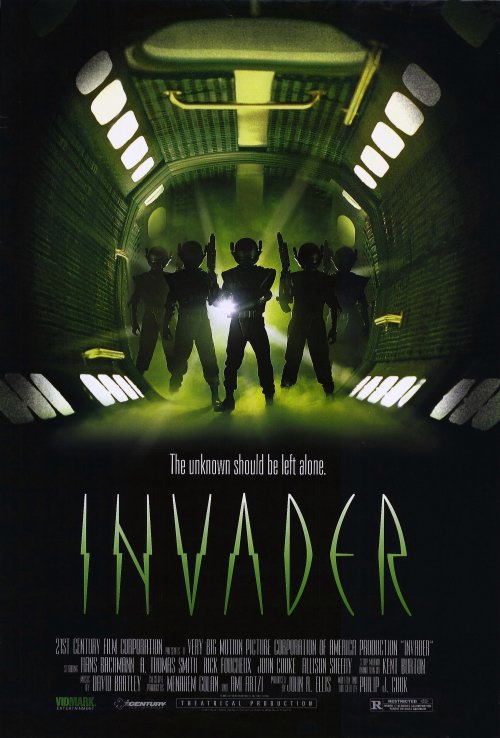
There's two kinds of direct-to-video product: theatrical movies that sat on a shelf before being pooped out onto video to avoid massive losses, and movies made to be direct-to-video.  It's uncommon for the latter to appear on recommendation lists, and often there's good reason, but some transcend their supposed limitations and become classics in the field.  For my money, Philip Cook's Invader is not only my favorite DTV sci-fi flick, it might be my favorite move ever made to premiere on video.  It's fast-paced, wickedly funny and very smart, featuring impressive special effects and good performances all around.  After I tell you all of this in more detail it may be time for you to dust off your VCR and give this one a go-round.  (Don't expect the guys on the poster to show up, though; they're not in the movie).

Frank McCall (Hans Bachmann) is an ace reporter at the National Scandal, an Enquirer-styled rag that specializes in flying saucer and mutant baby fare.  He stumbles across a bizarre multiple homicide scene where soldiers were fried to a crisp while on a routine bus ride.  He is met by Capt. Harry Anders (A. Thomas Smith) of the Department of Defense, and Col. Faraday (Rick Foucheux) who operates the Air Force base the murdered men were stationed.  The incident couldn't come at a worse time, as Faraday is unveiling a new fighter jet at a show that night, which McCall sneaks in to.  During the test flight, the autopilot switches from normal flight mode to attack mode, and eventually crashes, killing the pilot.  As people scramble, McCall gets whisked to a back room by robotic men in sunglasses, who strap him into a chair with the intention of injecting a green glowing liquid into him.  They're stopped by Anders, and the three men convene to hear the truth: the ship's onboard computer, A.S.M.O.D.S (Asmodeus), was recovered from a crashed alien vessel, and now has grown a mind of its own, taking over the base's men and working tirelessly on a sinister plot to take over America's defense systems for a hilariously unwise ambition.

While this may seem a bit boil-in-the-bag in its setup, Invader is far more intelligent, funny and accomplished than the majority of its peers.  The dialogue is hilarious, containing some of the best one-liners I've heard in a DTV flick ("Why is it that every time somebody tries to photograph something spectacular it's with a shitty camera?!").  The odd couple of the snarky, disobedient McCall and the no-nonsense, bureaucratic Anders is a joy to behold, with both actors nailing the parts and making the film's glue.  While the concept of an alien ship gone rogue isn't new, the payoff is, and the film transforms from routine sci-fi popcorn-muncher to freewheeling satire on military excess and unchecked nationalism.  It's one of the few movies I know of that exposes the bureaucratic red-tape of the military, making it a surprisingly comedic environment.  The special effects are excellent for a low-budget movie like this, featuring some impressive stop-motion and some of the most vast and detailed models I've seen since Total Recall.  WARNING: the DVD special edition decided that the accomplished practical effects of the original release weren't good enough for the 21st century and revamped the film Lucas-style with hideous CGI monstrosities that would cause Douglas Trumbull to dig himself a grave and roll in it.  Let's pray for a re-release of the original, at the very least for the legacy of practical effects.


Either way you see it, Invader is a wild ride, full of laughs, action and satire, a shining beacon for B-moviedom.  If you're going to make something entertaining this is how you do it, and the flick far outshines its DTV limitations (or assets, depending on how you're counting it).  This is the kind of movie that Saturday nights were invented for, so get out the VCR, snag a copy and get to watching.  If you're disappointed you may as well be shuttled off to Asmodeus for "retraining".


(Ignore the CGI!)

~PNK

Saturday, September 28, 2013

Crisis of Interfaith - ETHAN (1964)


Look at that.  Just look at it.

It won't take long for you to notice how repellent that cover is to anybody looking for a serious dramatic work.  Genesis Home Video was a semi-obscure '80's VHS label that mostly offered cheap genre pictures with even cheaper licenses.  Rather than use the posters for their movies, Genesis opted to make new art in-house, setting up hilarious photo shoots like this one.  Their transfers were some of the worst around, blown out and cropped and often drowning in soundtrack noise.  These qualities have endeared the company to me greatly, and I jump at any chance to get a hold of their stuff - I've got their releases for Haunts and Slipping into Darkness (aka Crazed aka Bloodshed) upstairs as we speak.  All of this is what makes Ethan such an anomalous release, and also helped ensure the film's tenure in purgatory. The Genesis release is the only video release, and the film is so obscure I wasn't able to find the original poster anywhere online.

After playing host to a number of revolutions and counter-revolutions, the Philippines of 1964 was a nation still reeling from overarching American colonial influence and was just breaking into the film industry.  The majority of Filipino movies that made it to the states were B-grade war and horror movies, which makes Ethan, a religious-themed romantic drama, such an interesting piece of its film history.  Ethan's title character, played by Robert Sampson (Bridgite Loves BernieRe-Animator), is an American Catholic priest stationed in a primarily Muslim community.  The town seems tolerant enough of his presence; while they take their faith seriously they see him as a good man and not a threat to their way of life.  There is also the artist Carlos (Jennings Sturgeon), the only other white man in the film and possessed by a crippling alcohol dependency, and Ethan's friend Mobien (Eddie Infante).  He strikes up a friendship with Andai (Rosa Rosal, I believe), and their relationship moves gradually from understanding and emotional support to romantic, a clear violation of Ethan's role in the church.  Andai confides her feelings with Yakoub (Joseph de Cordova), who believes that Ethan is a bad influence in the community and convinces Andai to seduce Ethan as a way to tear down his reputation.  She approaches him in his sleep, and though he is flustered and shocked they make love (a scene featuring some surprising nudity for the time).  Questioning his actions and his faith, he is soon tracked down by Andai's father, who has vowed to kill him in revenge.  Just before he is about to die, he is called out to by Carlos, and the assassin gets into a fight with Carlos, killing him instead.  Ethan runs away, shucking off his priestly garments and unsure of where to go or what to be.  Through all of this, an internal scriptural monologue anchors the film with dignified pathos.

Americans have a very skewed view of what it is to be Muslim, specifically the notion that all Muslims live in the Middle East and live Fundamentalist lifestyles.  On the contrary, the majority of Islam's followers live in Southeast Asia, with Indonesia containing the bulk of its population.  The relationship between Catholicism and Islam is very intelligently and carefully handled in Ethan, as the Filipino populace can retain their faith and dignity just fine without having to drive out the tiny sphere of influence the Catholic church has carved out in their land.  The landscape and culture of the nation is a fascinating counterpart to the central drama - the mixture of urban and rural, Western and Eastern, secular and sacred paint a picture of a country coming out of strife and occupation with varying results.  The relationship between Ethan and Andai is delicate and deeply written; any push in either direction would have destroyed the dramatic thrust of the film and made for a hackneyed viewing experience.  The other personal relationships, such as between Ethan and Carlos (especially a powerful early scene when Ethan talks a drunken Carlos out of dancing on a bar) and Andai with her fellow townsfolk are equally well-explored.  The acting is excellent, not only from Sampson but from everybody, turning surprisingly good performances from Filipino actors I've never seen before or since.  Shot in Technicolor-Technoscope, the light and color of the Philippines shine quite beautifully, and the soundtrack has some richly beautiful moments in the spirit of great dramas of the '50's and '60's, despite a few goofy moments.

There aren't enough films (that I know of, anyways) that seriously examine the lives of the clergy, and so Ethan is a welcome addition to the genre, anchored by a powerful performance by Sampson and saturated with culture and conflict.  Its video release is a sham; the print is blown out and cropped, and the soundtrack is ripped across with crackling noise.  The climax takes place in a day-for-night shot, and the poor transfer makes the characters hard to make out.  Regardless, there are copies of the VHS out there (and for very cheap), so if print is no object you can have a field day.  The product review on the Amazon page is the most detailed information I've found on the film, and another version of the review can be read here at Bamboo Gods and Bionic Boys, a blog on Filipino cinema.  A comment on the latter implies that a DVD may be available if you do a bit of searching, and hopefully that release restores the film to its former visual and aural glory.  If you've got a hankering for a serious, mid-century Hollywood-styled drama with a downbeat touch, Ethan's got you covered, no matter how crummy the presentation.

~PNK

A History Oral and Lived - THE MAN FROM EARTH (2007)


In Shadow of the Vampire, Max Schreck (Willem Dafoe) recites from Tennyson's poem "Tithonus", a monodrama of the Greek mythological figure who is immortal but continues to age physically.  He yearns for death because it will release him from his ever withering state, and the poem is a reminder that immortality isn't all it's cracked up to be, mirroring Schreck's own unfortunate existence.  There have been many works exploring the dark side of eternal life (Highlander), but only one of them can be categorized with My Dinner with Andre.

The Man from Earth was written by the late Jerome Bixby, a talented and lauded science fiction screenwriter who authored episodes of The Twilight Zone and Star Trek.  The script was found among his papers after his death in 1998, and this film makes one wonder why it wasn't produced earlier, or at least performed as a play.  It's a deeply written, heartbreaking work, a confession of a hidden life that throws everything the listeners believe in out the window.


John Oldman* (David Lee Smith of CSI: Miami and five seconds of Zodiacis a professor at a California college, and invites his fellow profs over for drinks as he is leaving town the next day.  The peanut gallery (including Tony Todd and William Katt) covers a wide swath of disciplines from anthropology to art, and Oldman has been careful to assemble great minds for what he has to say.  The rest of them came by to drink and hash out the past, not aware of what past Oldman is referring to.  After some pleasantries and puzzlements, such as the discovery of a seemingly caveman-era tool and an authentic-looking Van Gogh, the real subject reveals itself, though at first as a hypothetical.  What if a prehistoric man simply didn't die, avoiding war and discovery through  history and surviving until the present?  At first the conversation is jovial, with theories of perfectly replicating cells and shifting identities put forth, but people are puzzled as to why he didn't pose the question as a normal hypothetical, saying "I" instead of "he".

As the "game" drags on further, his friends have caught on and the tone turns from lighthearted to frustrated.  His story, while unbelievable, is at the very least well constructed - he was a Cro-Magnon (a fact he had to figure out much later), and when his tribe shunned him for possessing evil magic and stealing their life to lengthen his, he wandered across the land, falling into whatever company would take him and leaving when they found out the truth.  Each logical query, such as how he knew where he came from and whether or not he remembers his first language, have plausible explanations offered, though coolly received.  Some are more angry than others, and eventually a psychologist is called in.  And everything that happens after that isn't mine to spoil.

All the acting is pitch-perfect (well, except for a woman who has a crush on Oldman, but whatever), and the dialogue is extraordinarily intelligent and well-researched.  Bixby has accomplished a difficult task: make the absurd not only believable but engrossing.  Oldman's life is not only exceptional but ultimately tragic, and the intellectual, and in some cases moral, trials posed to the listeners are equally heart-wrenching.  Set almost entirely in Oldman's living room, the script is a shining example of how science fiction doesn't need to have flashy special effects or expansive locales in order to provoke thought and discussion - it's a triumph of pure storytelling.  A couple of wrinkles do trip up the film, though - shot on a pair of Panasonic DVX100 camcorders and processed through Filmlook, the viewing experience is particularly grainy, especially when the conversation drags into night and pixels the size of postage stamps dominate the frame.  Also, the ending's a bit shaky, and the fact that it hinges on that female character I mentioned earlier doesn't help.  All of these are, of course, minor details.  The movie is not even 90 minutes long, an economic detail passed down from TV writing, so if you think for a second this movie will waste your time those thoughts should be put to rest.  Don't believe me?  The DVD company put it up on YouTube for free:


http://www.youtube.com/watch?v=hAarR4tVEHU (no embedding, sorry)

~PNK

*Get it?  Get it?!  LAUGH, CLOWN! LAUGH!!!

Thursday, August 15, 2013

Special Report - THE TURN OF THE SCREW (1959, episode of "Startime")


One of the benefits of living in Seattle is the blessing of Scarecrow Video, the largest video store I've ever seen and widely considered one of the best in the world.  If you can think of a movie, they've got it as well as a dozen others like it you didn't know existed, or were even possible under the current understanding of quantum mechanics.  They've even published a mammoth review book, and many big film names have visited the place and signed their own work's boxes.  Having recently revamped the portion of the store previously reserved for selling used videos, Scarecrow has started hosting events (including the upcoming VHS Swapmeet, where I'll have a table (!)), and this month is VHS month in honor of their large collection of such and the current retro-craze for the obsolete and less-than-snuff format.  Though later in the month we'll get to see such treats as the ultra-obscure kung-fu-and-magic headscratcher Furious (1984) and the legendary shot-on-video anthology baffler Tales from the Quadead Zone (1987), Monday night's screening was much different - John Frankenheimer's The Turn of the Screw.

The concept of "made-for-TV movie" wasn't always a simile for "forgotten stool sample on the bus"; in the 50's and 60's there were programs dedicated to high-quality 75 minute adaptations and originals, with big names in front of the camera and talented workhorses behind.  Robert Altman started out in these productions, as did John Frankenheimer, director of The Manchurian Candidate and Seconds.  His name wasn't the least bit recognizable when he helmed Turn, but his work is exemplary, and it's a shame this version of Henry James's novella is so hard to find because it's a surprisingly scary, visually engrossing piece of film-making brevity.

I've never had the pleasure of reading the story, and haven't seen any other adaptations (with The Innocents being a shameful hole in my horror-viewing repertoire).  No matter - Startime makes it easy for us.  A young governess (Ingrid Bergman) has been hired by a London-based man who has been charged with taking care of his nephew and niece whose parents have just died.  He has no interest in looking after for them himself, so the governess makes for their country mansion, Bly (which has its own carriage bearing its seal).  The niece, Flora (Alexandra Wager) is chipper enough, with far too many teeth visible at a time, but the nephew Miles (Hayward Morse) has been expelled from his private school, and will be home any day now.  The governess and their maid surmise that the only cause (because none is stated) would be causing harm to others, though what harm that is we may never know.  Plenty of creepy harms are implied, though, as well as many other phantomic creeps (faces in the window, songs from distant rooms).  When he does return he meets his sister's cute precociousness with an unsettling precociousness, and the governess's grip on the children and reality start to spiral out of control.

Horror fare from this time period can usually be shelved under quaint anti-fright, but Turn has far too much going on to be punted to that oubliette.  B&W fullscreen has never looked better, as Frankenheimer takes a fluid, askew method to filming a deeply shadowed house.  There are many small uniquities, my favorite being a panning shot across a staircase that ends looking down a hallway, the camera tilting slightly at the entrance to uproot the Earth in wait of Bergman's discoveries.  Anybody who has seen the Shining-centric documentary Room 237 will remember the observation that during the first half of The Shining Kubrick transitioned between scenes with very slow dissolves, so slow they forced you to study the superimposition.  While Kubrick may not have meant anything like that, Frankenheimer certainly does, pulling out double- and triple-exposures to great effect (my favorite being the Bly house seal over a doll in a pond).  

Production designer Warren Clymer utilizes the handful of sets offered to him to great effect, allowing period design to fold into darkness and creating some of the most unsettlingly fake exteriors I've ever seen.  Flying in the face of 50's TV, the soon-to-be-accomplished classical composer David Amram supplies a hair-raising Avant-Garde soundtrack, terse and shrieking with a healthy supply of alien clangs and burbles.  It's always nice to see that quirk of Victorian wear in film whereby too-tight dresses make the wearer look like a gliding bobblehead.  As for the actors, Bergman is excellent, steadily mounting upon a professional manner with nervous terror.  The two child actors are unbelievable, displaying a creativity and control beyond their years; Hayward Morse is so precocious in his performance it makes his later scenes downright chilling.

I've never been much of a fan of ghost movies, mostly because ghosts, by design, shouldn't be scary.  When you get down to their motivations and what they were like alive the darn things just don't make any sense, and all the frights come from what might be there rather than what's actually there.  If there's a lesson we learned from The Blair Witch Project it's that suggestion is far more fear-inducing than explanation.  The Turn of the Screw renews my faith that a traditional ghost story can induce frights if done properly, and much like the classic Witchboard the usual logistical issues are sidestepped via careful details.  At the end of the 75 minutes I was invigorated and a little spooked, and if you can track it down you won't be disappointed.  I have to emphasize the "if" here, because this movie is so rare that Scarecrow's copy was hand-donated by Frankenheimer himself (!) and comes with a hefty rental deposit.  That screencap standing in for a poster was on YouTube, so there must be a torrent floating around there somewhere.  Hopefully it looks better than Scarecrow's copy, which had a slow warble and seemed to have grown a coat of cheesecloth.  For my money, a smudgy presentation may have helped the experience, as the shadows are that much more concealing.  Get it ASAP.  Don't wait.

~PNK

Sunday, August 4, 2013

Swimming in Now-stalgia - CUADECUC, VAMPIR (1970/71)


Here's a neat contest for cinephiles: list every Dracula movie you can off the top of your head.  Not just adaptations of the novel, but every movie he's ever appeared in.  If you've spouted out more titles than you have fingers and toes, don't worry - you haven't even scratched the surface.  According to IMDB the not-really-a-dragon-at-all has appeared in 326 movies and TV shows.  Attempting to rank the central performance is such a lost cause it needs its keys on a necklace, much like squabbling over the extreme excess in Ebenezer Scrooges.  Dracula isn't a story anymore - it's a pageant, a Thanksgiving turkey, anything but vital unless met with an assured hand.  Cuadecuc, Vampir isn't Dracula, rather an account of the making of one.  The subject isn't the least bit vital.  Its chronicler is. 

Spanish director Jesús Franco has the unique trait of being un-recommendable to just about anybody.  A legend among fans of 70's-and-80's exploitation hooey, his impossibly vast filmography swings between Nyquilled horror and disquieting porn.  After attempting to watch his work, I am reminded of the golden Siskel & Ebert law by which it's perfectly fine to walk out on a movie if you fully admit to the act.  In 1970 Mr. Franco decided to syphon off some sweet Hammer moolah and pulled out Count Dracula, attaching fangs to Christopher Lee in proper Hammer fashion.  I'll save you some time by relaying the stark fact that Count Dracula is worth less of your time than Billy the Kid vs. Dracula and certainly less than Alabama's Ghost (look it up, you won't be sorry).  Vaguely atmospheric and mostly vague, Franco's approach uses cheap 70's zoom knobs and opaque padding to create total, devastating detachment in the name of Hurry Up I Start Shooting My Next Movie On Tuesday.  Which is why Cuadecuc is not only the only way to watch Franco but also a fascinating piece of contemporaneous upcycling.

Looped synths and smeary B&W photography beckon to us, playing out an early scene from the film with none of the original sound in place (and eventually no sound at all).  Soon after the title flies out from the center of the screen, switching over to smooth 60's soundtrack orchestral jazz placed over a car driving through the countryside.  A man with a crude fog machine.  Bouts of tape collage experiments and semi-comprehensible Dracula moments.  Christopher Lee giving us the finger.  Fake spiderwebs.  Clashes of soft-focus with sharp-focus via hueless exposures.  Long stretches of total silence.  These are the techniques by which director (later politician) Pere Portabella makes not only one of the best production documentaries ever made, but also his own Dracula adaptation as well as entrancing statements on artifice, meta-fiction, and collective memory.  If you thought I was going to agree with the conventional criticisms of this work (which you are of course well-researched upon) and say that a documentary that deconstructs the filming of a bad horror movie is a metaphor for Gen. Franco's regime, then get ready for me to take some more interesting paths.


Rather than following the production schedule, Portabella orders the footage to follow Count Dracula's plot, encapsulating the story in gauzy silence.  I'll save you from a plot description because you already know it.  Everybody knows it, and fortunately for Portabella Franco doesn't stray too far from the novel that we'd miss serious elements of the story without sound.  At the very least you can point at the screen and shout whenever Dracula appears, and I wouldn't want to deny you that small pleasure.  It's fitting that a documentary on a Dracula movie also be Dracula itself; Stoker was no stranger to narrative layers.  Keeping with the tradition of Gothic Horror, Dracula is told via journal entries, letters, and other types of records to give the illusion that the story was a real event, experienced and recorded by several people and compiled rather than authored by Stoker.  Frankenstein also pulled this trick, and its effect is that of a found-footage movie (such as The Blair Witch Project), applying a veneer of stark realism to the supernatural.  In the case of Cuadecuc, the veneer is that of a moldy, forgotten reel of film left in a closet in an asylum, or in the attic of an elder relative who had recently passed away, leaving you with their puzzling hobby-art.


If we allow for a meta-fiction route of analysis we can safely say that Cuadecuc turns the Dracula structure on its head.  Whereas realist elements were added to Dracula to draw the reader into the world of the story, Cuadecuc uses realist elements to draw attention to how fake the whole thing is.   The word Cuadecuc translates from the Spanish to "worm's tail," but importantly here also refers to the tail end of a reel of film.  Jesús Franco's production foibles are frequently spotlighted, such as makeup sessions with cheesy music, that guy with the fog concoction, and a hilariously awful bat effect, as well as Franco's trademark zoom-heavy photography.  And why shouldn't it?  Franco stated publicly that he hated most of his movies, and their often-times rushed, lifeless productions end up reflecting that whether he liked it or not.  There are few novels more dead-horsed into the public subconscious than Dracula, and so any attempt to make the story seem real is almost a moot point.  Christopher Lee had already played the Count in two movies prior, and would go on to play him five more times, so why not wear sunglasses on set and flip the bird?  Why not laugh and roll your eyes at the artifice of it all?  Consider the last time you went to an elementary school production of the Nativity, and you'll understand that sometimes its okay to joke with tradition.


And for that matter, if Dracula is burned into our gray matter and need not repeating, why not play off that?  A tried and true rule of fiction is that some things are more emotionally resonant when a certain amount of distance is woven into the storytelling, evoking rather than imposing, showing rather than telling.  One of my favorite adaptations of Dracula is Jon Muth's gorgeous graphic novel Dracula: A Symphony in Moonlight and Nightmares.  The plot remains the same as with Stoker, but the presentation splits the pages between lines of dialogue suspended in air with extraordinarily beautiful paintings depicting scenes and moods.  Nothing is lost in translation.  The disconnection allows the reader to see each half on their own terms and let them experience the power of Dracula with a certain degree of discovery.  It's the simple effort of combining the words and the images in your head that gives a boost to your emotional reaction, as if you were the one who found out the true meaning and it's shouting down your door.  With the smudgy, ambiguous footage and the largely nonsensical soundtrack, a little extra brainpower is required to glean a complete Dracula from Cuadecuc, seeming more like a distant memory than a sober experience.  Consider this piece from the eccentric YouTube video artist Chriddof (and don't worry about watching all 9 minutes):


Technically all the footage is from Dooby Duck's Disco Bus but the effect is an opaque wash of imagery under a D-major drone.  The frequent tape damage in the transfer only adds to the disconnection.  In a previous upload of the video a comment appeared praising the video as being a perfect representation of nostalgia, consistent with a damaged old tape of a children's TV special.  I'd like to posit that if asked, most people would have a memory of the first time they saw a Dracula movie and how old they were, as the 1931 version is often cited as one of the first horror movies people see in their lives.  Fans of the genre often have fond memories of their first "real" horror movies (mine being the Universal monster movies followed by Psycho), and the fact that horror movies are often watched on Halloween and/or late at night adds to their dreamy quality in our minds.  Cuadecuc is a strange, lovely recollection of a mediocre Dracula movie, allowing the viewer to feel nostalgic for something they may have never personally experienced.  Oddly enough, it's nostalgia made contemporaneously with its source, as if we needn't actually sit through Count Dracula to get to the good stuff.  And though you may never fully be in the mood to watch Cuadecuc, vampir, it's short enough that you don't really have to be.  For the benefit of mankind it's been uploaded to YouTube, so drift with it when you've got a spare 66 minutes and a hankering for cheap surrealism.


~PNK


Tuesday, July 30, 2013

A quick three chairs for PERFECT FRIDAY (1970)


I love a good heist movie, and there's no better era for them than the late 60's and early 70's, when Mod stylings and twist endings abounded.  This one has slipped through the cracks, so much so that I only found out about it in researching the great Theatre of Blood, required viewing for fans of black comedy, Shakespeare and Vincent Price.  Specifically, I was looking into Anthony Greville-Bell, a man with a fabulously British name who co-wrote this as well as the oddly excellent thriller The Strange Vengeance of Rosalie (which I'll get to in good time).  I can't speak to how much he actually contributed to this screenplay or the others but in my mind a man with a name that clever should have contributed to the quirkiness and smart dialogue of these movies.  And while Perfect Friday is the most conventional of the three movies it's a great little caper for an empty afternoon.

Mr. Graham (Stanley Baker) is the deputy manager at a London bank, stiffly professional and secretly fed up.  Enter Lady Dorset (Ursula Andress), whose light accent and Andressness swiftly sucks Graham into an affair that births a crazy idea: use the inside connection to rob the bank.  The sadly foppish Lord Dorset (a young David Warner) gets involved as the third party, and as the plan is formed it seems each of the men want to make off with the money and Lady without the other's being any the wiser.  Of course, the snazzy heist sequence.  Of course, a race to the airport.  Of course, a twist ending that assures a moral-minded censor office that even though they get away with it, they don't REALLY get away with it.

Though the plot has an assembly line feel, I have the advantage of ignoring that if the Knack is present.  Perfect Friday floats above a stock plot through simple panache and tight technique, meeting the action's inherent fun with surprisingly sharp photography, off-kilter editing tricks, knowing restraint and an infectious, enthusiastic soundtrack.  The performances are all effortless and perfectly played off each other, and the pacing never falters, especially in the heist sequence itself, proving once again that real tension can be made through a lack of music rather than a girth.  An early Spring setting meets the performances and the bank's minimalist 70's futurism for a crisp, satisfying mood, a fine counterpoint to the outlandish feel of older capers like Ocean's 11 and Who's Minding the Mint?  Everything points to a nifty, fittingly British confidence, leaning over and whispering sweet nothings into your ear.

Never available on video in the U.S., Perfect Friday may need a bit of digging to find, but I'm sure torrenting and iOffer have you covered.  The boot I viewed was sourced from a widescreen BBC broadcast and looked great, so if you can get that one go for it.  I wasn't able to find it on YouTube but I did find a trailer for a recent PAL DVD/Blu-Ray release, so if you've got a region-free DVD player you've got yourself a winner.  It probably won't become your favorite caper but it still put a grin on my face, like an unexpected free latte or finding five bucks in a gutter.  Do as you will and remember to make a smooth getaway.

~PNK

Sunday, July 7, 2013

Point and Line to Joy: the Animation of Paul Glabicki


It occurs to me that there hasn't been nearly enough animation on this blog.  Sure, I began with my favorite animated movie of all time but that's no excuse for slacking off.  The animators sure haven't been slacking, and you're (I'm) just bringing the whole enterprise down (as this is the first post here in about a month).  Animation is really, really time consuming, its efforts only fully understood by its practitioners, and when it gets experimental or somebody dares to make a short film in this day and age festival curators are the only people who give it a shot.  Though I'm not a junkie for animation festival compilations I've admitted myself into AA (Animataddicts Anonymous) for future reference; those lonely-looking discs and tapes are goldmines of creativity and joy, showcasing some of the most astounding work in the medium and a heck of a lot of variety.  Seriously, just rent any one of them (like The Animation Show, anything from the National Film Board of Canada, anything from Expanded Entertainment) and have a blast with the illusion of movement.  With that said, I don't know if anything by our friendly artist today has shown up on those comps, but he did get a solo tape (The Paul Glabicki Animation Tape) from the arthouse distributor Facets Video, and if you'll click any of my links it'll show the Amazon page for it (used, O.C.(of course)).  Don't worry, I've supplied free stuff below, as well as the rest of the article.

Paul Glabicki is a multi-media artist who teaches at the University of Pittsburgh, and is seen up top with the best background for a Jefferson Airplane show I've seen since Woodstock.  Swerving through not only animation but also painting, photography, sound design and installation art, Glabicki has made a name for himself internationally via his profound exploration of geometry (hence the Kandinsky joke in the title).  Not just geometry with lines but also psychological association of line and form, and how formal relationships work in other mediums such as language and memory.  If you just went slack-jawed I'll give you a second to pick your chin up off the floor, because what I'm going to show you is fun.  FUN.  When was the last time geometrical experiments were fun, aside from Donald in Mathemagic Land (and do watch that, it's amazing)?  Glabicki not only dives into linework with enormous skill but also with enormous entertainment value.  Edwin Abbott won't know what hit him.


Those of you dorky enough to know a bit of history of early fantastic film (or happened to see Hugo) will notice the Man in the Moon from George Méliès's Le Voyage dans la lune as one of the two central repeated images.  If you're a superdork like me and recognized Winsor McKay's Gertie the Dinosaur as the other your toaster oven is in the mail.  Small polygons and seemingly random strings of letters and numbers fly across the screen, and I'd look close to catch a guy at the bottom center of the frame.  Each new sound collage brings a new dimension and humor to the cycle, the third one pushing the short into Don Hertzfeldt territory with the use of Italian opera.  The linework is fantastic, so fantastic that you'd think computers had to have been used.  Nopez.  All by hand.  Including that cartoony little fall-apart at the end.  I can't even draw a circle freehand, and Pauly's kicking graphs and taking names.  And that's just before he started working in kitchen tables.


(sorry about the video decay)

Object Conversation explodes sound and language in a series of bracing and humorous sound collages, accompanied by lively blueprint-esque animations.  The fixed yet constantly shifting tableaux allow the viewer to focus on different elements of the frame, and encourage repeated viewings to catch all the interplay and allusion on display.  The effect is a little indescribable, but is highly reminiscent of the Beatles' "Revolution 9" as seemingly improvisatory collage art.  As with Five Improvisations the line work is fantastic and beautifully 3-D, making up for the lack of color with movement and definition.  There's so much going on it's impossible to talk about specific moments, but it's never overwhelming, maintaining a perfectly watchable balance of elements (unlike a lot of complex film art that ends up being confusing and therefore dull).  I think my favorite detail is the pair of scissors that closes and cuts a bunch of lines behind it, sending them falling down in impeccable slow motion.


Despite the recognition he received for these films his IMDB list is only five items long, four of which were collected on The Paul Glabicki Animation Tape, released in the 90's by Facets Video and never released to DVD.  I would highly recommend tracking it down if you have a working VCR, as the other two films on the tape are larger and even better than these two, especially his 30 minute magnum opus Film-Wipe-Film.  He's continued working in other mediums, and what I've seen is quite cool and worth investigating.  I'll close with a collaborative piece he contributed to called Academy Leader Variations (1987), a fantastic collection of unique countdowns by an international animation roster (including the jawdropping Swiss paint-on-glass animator Georges Schwizgebel).  According to YouTube his film is number 15, but in reality it's number 7 (you'll know).


~PNK