Saturday, February 15, 2014

Evil Embryos and Funny Masks - THE JOHNSONS (1992)


I'm a huge sucker for fictional religions and cults.  I was raised with ancient Greek mythology and tend to go nuts whenever a Greek pantheon movie comes out (like the recent, underrated Immortals).  I also get a huge kick out of movies that depict Christian cosmology and the dense mythology of Catholocism, however successfully.  For my money, the coolest stuff is movies that either tinker with the Catholic mythos (John Carpenter's Prince of Darkness, the staggering Giulio Paradisi-Ovidio Assonitis mindscrew The Visitor) or create new mythologies - it should come as no surprise that Ghostbusters is one of my favorite movies.  Keeping the latter in mind, The Johnsons was right up my alley and turned out to be a wickedly creative and very fun cult-prophecy horror flick, and probably the only horror movie from the Netherlands you're likely to see.

The movie begins with a narrator telling us of an anthropologist's 1930's expedition to study the Mahxitu tribe in the Amazon.  The tribe worshiped Xangadix, a god of pure evil who would beget seven sons who would bring eternal darkness to the world through an incestuous ritual.  The professor disappeared, and decades later a trunk of his studies would wind up in Amsterdam, to be unearthed by Surinamese anthropology Professor Keller.  21 years before he does, a Dr. Johnson performs the c-section birth of male septuplets (uh...), complete with a shot inside the womb, and that night goes out to the Biesbosch National Park to smear mud on his face and summon the Embryo of Xangadix (...oh), which rises out of the swamp with fire surrounding it.  In the present, the professor examines the expedition materials with no help from his witch doctory father, who tries to destroy any records of Xangadix he can find.  He is also rudely tasked by a secret government agency to help deal with seven male siblings (hmm...) who committed a horrible massacre at age 7 and were committed, now at the whim of the state as the sanitarium is being closed.  The men never speak and once tore one of the guards apart, drawing symbols on the wall in his blood.  Meanwhile, a newspaper photographer is assigned to try to photograph the rare night heron in the Biesbosch, and her nearly 14-year-old daughter tags along.  The daughter has been having unsettling dreams involving bald young boys drawing blood symbols on walls, as well as being ritualistically gang-bred by naked men wearing hilarious masks, and not-so-coincidentally she's been worried about how late her first period is becoming.  With everything that's been going on she should be a heck of a lot more worried.

While I don't think The Johnsons is truly scary it is really damn fun, and with a movie this nifty fun is a very welcome adjective.  This is crowd pleasing stuff - inventive, bloody and action packed - and it's much smarter than your average junk-horror rental.  The movie could have sustained itself on its ideas alone, but fortunately for us the acting is top notch and it's very well made, the look rising above its obvious shot-on-video-then-processed-by-Film-Look appearance.  While the horror and action is taken seriously it's pretty funny; the narrator at the beginning ends his tale of the doomed expedition by saying "Holy Shit!", and a character kills a villain via TV set, then blows the end of the remote control as if it was a gun barrel.  It's the kind of movie Midnight screenings were made for, a dang good time with Guts 'n' Laffs (and the Embryo!) that doesn't overstay its welcome.  Anchor Bay released a special edition DVD some years ago, so the next time you've got too much popcorn to eat by yourself round up some friends and give The Johnsons a spin.  Just don't ask why there's a garbage strike in Amsterdam that has nothing to do with anything.


~PNK

Monday, February 10, 2014

Nightmare's Balancing Act - THE APPOINTMENT (1981)


Horror has long been a genre for hopeful directors to get some moviemaking experience in before going on to "better things", mostly because horror movies can be maid cheaply and are almost guaranteed to make money, and if there's a movie you don't want to lose money it's the first one you get out of the gate.  The lineage of directors who got their start in horror includes such luminaries as Francis Ford Coppola (Dementia 13) and Oliver Stone (Seizure), but not all of them made the leap, such as Carnival of Souls director Herk Harvey.  While Harvey had a steady career he returned to and has resurfaced for interviews and retrospectives, Lindsey C. Vickers, director of The Appointment (1981), only had a couple more appearances working for Channel 4 and then disappeared completely, his sole feature film languishing in obscurity.  I first saw The Appointment a few years ago and was completely floored - it's one of the most unusual and effective horror movies I've ever seen, and its non-presence among genre fandom is a crime.  Much like Let's Scare Jessica to DeathThe Appointment is a film best experienced with as little foreknowledge as possible, but its value is so great it would be worse not to talk about it.

"THREE YEARS AGO"...after a school orchestra rehearsal wraps up a young girl takes a forest shortcut home.  An ominous, classified police report talks about a mysterious disappearance of a teenage girl, and soon enough the girl on screen starts hearing voices and growls from the bushes.  She's suddenly pulled into the trees, and the camera focuses on her smashed violin.  "...THREE YEARS LATER" we see teenager Joanne (Samantha Weysom), the star violinist at the same school, returning home to tell her parents Ian (Edward Woodward) and Dianna (Jane Merrow) about her upcoming violin recital with the orchestra.  Before she gets home she stops by the trail the girl disappeared from, now blocked by a tall iron fence, and talks to someone on the other side which we can't see.  Her Dad Ian has to go out of town for a business trip and will miss the concert, but breaking this news to her is a delicate task.  Joanne is a bit...attached to her father, in a very immature, childish way and perhaps more.  The night before he leaves, Ian and Dianna have a series of unsettling dreams, and rottweilers mysteriously make their way into their house and strange things happen. Ian leaves early the next morning, and what happens on his trip is creepy, surprising and aesthetically fascinating.

While that's not much of a set-up on paper, the horror in The Appointment is drawn out of small details, running symbology, and mounting dread.  The uncomfortable relationship between Ian and Joanna is an odd starting point for a horror movie, and the directions the movie goes with that unspoken truth is magnetically unnerving and wholly unexpected.  It's hard to explain exactly what happens in the movie without wrecking the whole thing because on paper it doesn't look like much happens, but what does happen is some of the most masterful horror moments of the time.  For example, the climax involves a kind of set piece that has shown up in countless other movies, but in Vickers's hands it becomes the most intense, detailed and terrifying example of its type, such an insane sequence that you think the movie wouldn't be able to top it...and then the coda knocks you on your ass.  Edward Woodward is well-loved by horror fans for his impassioned performance in Robin Hardy's The Wicker Man, and his performance in The Appointment is a fine compliment, his arc a composed, practical man being sucked into a vortex of mystery and terror.  Jane Merrow as Dianna isn't in much of the movie, but her role is essential and her performance is perfectly placed.  I can't say that Samantha Weysom, who plays Joanne, is any great shakes, but she was a teenager and the film was a small production, and it can be counted among the film's few faults.


The movie is really built upon its production, a brilliant combination of cinematography, music, editing, sound design and pacing that shows an enormous talent in Vickers.  If any of these things was out of place the mood would have broken and the audience would have immediately been taken out of the story.  It's so skillfully made that I'm very frustrated that Vickers dropped off the face of the Earth.  Unable to secure theatrical distribution due to its confusing structure and defiance of horror tropes, The Appointment was quietly dumped onto video (3M Video in England, Sony Video Software in America) and has never been reissued in any form.  Vickers later did work at the BBC, producing the miniseries Zastrozzi: A Romance (based upon a novel by Percy Shelley) and co-producing the Aardman short Babylon (directed by Peter Lord and David Sproxton, both behind Chicken Run and Wallace and Gromit: The Curse of the Were Rabbit), both in 1986.  The only other credit is The Lake, a 33-minute short film Vickers made in 1978, shot in 11 days for 28,000 pounds and shown in front of screenings of the Chuck Norris movie A Force of One (because lame cop thrillers should always be preceded by atmospheric horror shorts).  I found an article written after a 2012 screening as part of BFI's Flipside festival, and if anybody has a copy of the film or knows where I can find it I'll give them a million Monopoly dollars.


While The Appointment has the good fortune to be a horror movie made in the 80's it's a far cry from the kinds of popcorn flicks that are such a booming cult market today.  It's much more akin to horror practices of the 70's, and in my mind is the last example of a film genre that has never before been defined but needs to be talked about.  I call it Psycho-Aestheticism - films in the genre used psychological and paranoid stories as launching pads for unique horror experiences driven by heightened film technique, symbology and aesthetic intoxication.  Rather than rely on monsters, violence and sleaze, Psycho-Aestheticist movies built dread through sight and sound experiences, banking heavily on mystery and beauty to let the audiences' mind expand upon the film's story and ideas.  I've written about two Psycho-Aestheticist movies before - Let's Scare Jessica to Death and Symptoms - but there are many others (mostly from the mid-60's through the mid-70's), including Roman Polanski's RepulsionIngmar Bergman's Hour of the Wolf and Nicholas Roeg's Don't Look Now.  The 70's was a time of unparalleled freedom for horror directors, as the old studio standards had nearly collapsed and no huge successes had set marketable trends (like Halloween and Friday the 13th would at the end of the decade).  An odd link between these films is how the directors didn't spend much time in the horror genre, instead ducking in to make a film or two and then moving on to other things.  The singular nature of these films could be attributed to that interloping, the filmmakers more concerned with making a movie than a Horror Movie.  That singularity also ensures the difficulty in marketing these movies, and many of them have had neglectful distribution or were simply forgotten about.  For example, look at that idiotic video box at the top of the article.  Not only is the cover chintzy as hell (though endearing in its cheapness, like the box for Ethan) the blurb on the back is extremely misleading and was probably written by somebody who'd never seen the movie.  

I'll cover a few more Psycho-Aestheticist movies in the future (*cough* Images *cough*), suffice to say that none of them were made any later than The Appointment.  The genre film landscape changed dramatically in the 80's, with horror a more codified industry and distributors more conservative, and a fright flick that emphasized slow burn atmosphere over violence didn't stand a chance.  Heck, this movie didn't stand a chance, and it's high time it got a DVD release or at least showed up at a festival or two.  I've watched it several times now and every time I find some new detail to admire, and while I think I've got a pretty good idea as to what it all means I'd love to debate with fellow viewers.  It's a movie worth debating, a totally unique horror experiment that holds up just as well today as it did 33 years ago.  If you're worried about having to drop $14 on the ancient VHS, don't worry - somebody thankfully uploaded the whole thing to YouTube.

(This is part 1 of 7; when the video ends find the next part in the "watch next" screen.)

~PNK

The Depths of Wild Imagination - INDICTMENT: THE MCMARTIN TRIAL (1995)


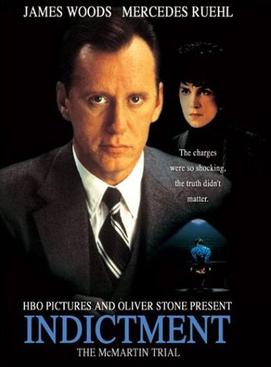
HBO is spoiled these days, what with all the good shows and TV movies confined to pay walled-in channels and the premium channels winning ALL the Emmys.  Back in the Dark Ages (the 90's) only a handfull of shows ever broke into the mainstream, the big winner being Mr. Show, until The Sopranos came along and changed the channel's fortunes forever.  I covered another 90's movie of their's in my review of The Second Civil War, and today we're looking at another hidden gem - Indictment: The McMartin Trial.  Executive Produced by Oliver Stone and starring James Woods and Mercedes Ruehl, Indictment has never seen the exposure you think its names would warrant, and it's doubly odd considering the ridiculous true story it faithfully documented, the longest and most expensive criminal trial in US history, one that sparked a nationwide panic but resulted in zero guilty verdicts and went down as a textbook example of mass hysteria.

In the mid-'80's, a horrifyed mother calls to report that her local preschool, run by the trusted and longstanding McMartin/Buckey family, has been physically and sexually abusing her son as part of Satanic rituals.  The family is arrested and the 200 or so children in the class are taken to an innovative child abuse therapy center, Children's Institute International, to be questioned by a counselor.  As the media frenzy grows, attorney Danny Davis (James Woods), a man used to defending drug dealers and society's rejects, sees through the media blitz and takes on their defense, partially to uphold the American virtue of "innocent until proven guilty" but more because it's a "hell of a case."  That hellfulness also attracts prosecuting attorney Lael Rubin (Mercedes Ruehl), and their first meeting is one of adversarial ribbing and snickering at the prospect of their careers skyrocketing as a result of the trial.  Their adversarying can't equal the wide smiling of CII's head Kee MacFarlane (Lolita Davidovich), obviously quite proud of her work wringing accusations out of the children.  Everybody, with the notable exception of Davis, is quick to accept the increasingly outrageous accusations, and Davis points immediately to the huge-framed 80's glasses sported by Virginia McMartin (Sada Thompson), teacher Peggy Buckey (Shirley Knight) and her son Ray (Henry Thomas), the latter of which Davis says "looks like a child molester."


As the hearings and investigations from both sides get underway it becomes increasingly apparent that not only does all the prosecution's evidence consist the testimony of small children, the children's statements are bizarre to the point of farce.  One claims that the Buckeys killed a horse with a baseball bat; another claims they flew the kids on an airplane, then says they went to a car wash instead, then says the car had no windows.  A boy claims that a man put his penis inside the boy's penis.  When shown a row of possible molesters, another boy identifies a City Council member and Chuck Norris as participating Satanists.  The one that sends the media into the most uproar is one overenthusiastic boy's claim that everybody dressed in black robes and sacrificed a rabbit, drinking its blood.  And to think that some townspeople had set fire to the preschool before the trial even started - thank God the family was protected from the outside.


All of CII's sessions were videotaped, and as Davis looks over the sessions he notices something very striking - the techniques used by the therapists are less encouraging the truth and more coercing the right answers out.  His hypothesis is that the therapists were fed a general claim of abuse from the parents or some officials and used any means necessary to get the kids to admit to the claims, oftentimes saying that all their friends were smart for telling them they were abused, and "you don't want to be stupid, do you?"  The kids were also shown dolls with anatomically detailed (ahem) dolls meant to represent the Buckeys, accompanied by remarks as to how Peggy's breasts had lines on them, and in one instance a kid is encouraged to slam the doll on the table.  It's very clear to not only Davis but one of the prosecution's investigators that the children are being led on, most likely afraid that if they don't say what the adults want that it will get them in trouble, and the hearings show just how easy it is to lead these young witnesses.  That doesn't stop the judge from blatantly favoring the prosecution, allowing their questioning while letting objections stick on the defense's countering.  All of this actually convinces the prosecuting investigator to resign, leaving Rubin in a state of righteous frustration that only grows as the trial progresses.  Davis's case only grows in the process, skillfully piercing holes in not only CII's techniques and MacFarlane's credibility as a social worker but also demolishing a witness who claimed that Ray admitted to sodomizing children and successfully turning the preferential tables not only for the judge but the jury and the audience.  The most entertaining part of all of this is when Rubin begins her personality attack on Ray, citing his interest in "pyramid power."  I won't dare spoil it for you, except to say it's incredibly funny and produces some of the best lines in the movie.


It's important to note that the mother who made the first accusations, the claims upon which the whole case is based, was a severe alcoholic and was diagnosed with paranoid schizophrenia, a fact that the prosecution deliberately hid from the defense.  It's also important to note that she died from alcohol poisoning before the trial even started, and the entire ordeal, from the arrests through the final, merciful ending, lasted seven years and resulted in zero guilty verdicts.  It ended up being the longest and most expensive criminal trial in American history, a doubly ridiculous fact considering that nobody went to jail for it, though the Buckeys most of that time in prison anyways.  To the delight of docudrama fans Indictment is just about the most accurate representation of the real trial as you're likely to see on film, and even the most ludicrous elements are completely true to life.  I've read reviews of the movie that accuse it of being one-sided, but how can it be anything else when the accusations are patently false?  What, did these reviewers really think that there was a Satanist conspiracy bent on molesting children and ritual sacrifice?  There are real Satanist organizations in America that the police could have talked to at any time, such as The Church of Satan, and none of them have any kind of abusive or sacrificial agenda and are in fact pretty harmless in the grand scheme of things.


The case marked the turning point in the public's willingness to believe in Satanist conspiracy horsehockey, and Indictment was the final nail in the moral panic's coffin.  The movie is incredibly well done for a TV movie, its filming style reminiscent of Oliver Stone's over-the-top style familiar to viewers of JFK and Natural Born Killers but knowingly restrained.  The performances are excellent, with Woods and Ruehl in top form and the supporting cast fully committed and at times heart-wrenching.  James Woods is one of my favorite actors and he was born to play this kind of role, a third-banana lawyer who uses his smarts and rhetoric to not only win over the jury but redeem his unillustrious career defending drug dealers and scumbags.  Henry Thomas, who plays Ray, gets the most well-developed arc in the movie and his performance is the most compelling of the film, quite remarkable for an actor I've never paid much attention to (the only role I'd seen him in before was as Amsterdam's best friend in Gangs of New York).  The movie is shot much more like a theatrical film than a TV show, and the camera is free to sweep and accentuate the story beyond our TV-movie expectations.


The true story of the McMartin trial is a fascinating portrait of the peak and decline of one of the most idiotic moral panics this side of rainbow parties, and the movie does the facts great justice while making its own identity as an entertaining and tense courtroom drama.  If you've got a spare slightly-more-than-two-hours and can secure a copy you're in for a true-story ride on the same level as docudrama masterpieces like Zodiac and All the President's Men.  You've got my guarantee that at no point will Chuck Norris show up to put his penis inside your child's penis.


~PNK

Monday, January 20, 2014

In Memoriam Mike Vraney (1957-2014) - some Something Weird gems


I'm sitting here at Cinebarre, a movie theater in Mountlake Terrace, WA that also serves food and drinks to your seat.  I'm amongst about 100 people who have amassed in honor of Mike Vraney, a man who the general public has never heard of but really should have.  In the early 90's he founded Something Weird Video, a company dedicated to unearthing and supplying video distribution for hundreds of ultra-obscure exploitation and sexploitation movies, primarily 60's and 70's stuff by the likes of Herschell Gordon Lewis (The Wizard of Gore) and Doris Wishman (Indecent Desires).  These were movies relegated to the drive-in circuit and skeezy 42nd Street theaters, made for next to nothing and quickly forgotten by whatever fraction of the public saw them to begin with.  With little tradition and virtually no MPAA-esque oversight, these rag-tag filmmakers whipped up some of the loosest, most memorable hunks of genre insanity you've ever seen, and Something Weird's near-endless catalog is a Hall of Infame, constantly surprising and often jawdropping.  I've barely scratched the surface of their stock myself, largely because of the bazillion other movies I want to see but also because much of their catalog is 60's sexploitation, a gray-area genre that mixes plots with porn (or just chaste nudity), and I can't bring myself to be interested in old-school skin flicks.  They also offer pretty much everything else from gore fests to kiddie matinees and educational reels, so if one section of their site turns you off you can always find something completely different.

Because Something Weird's catalog is something of a niche market it's not surprising that not too many people outside of the obscure weirdities film geekdom would have heard of them, so in recognition of Vraney's efforts I've decided to go over a handful of my favorite films in their catalog in order to make a "gateway" list.  Despite what some people may think, I don't like every bad old movie I see, and I've tried to gear this blog to many different genres in the expectation that my readers have a taste for "real" movies, a type of movie Something Weird expressly ignored.  While all these movies appeal to that geekdom I mentioned they have the potential to be enjoyed by the outside world, and I love 'em so, so shush if you think I've fallen down the rabbit hole.  The last one is a movie I've been meaning to review for a while, but now is the perfect time.  The DVD Mike Vraney was the most proud of was Monsters Crash the Pajama Party: Spook Show Spectacular, a packed-to-the-gills home video extravaganza wherein page after page of Halloweeny menu screens go without labels, leaving the viewer to be surprised and delighted with the treasures they find.  The only reason I'm not doing that is that it's not a movie but rather a dozen or so short subjects and goofy extras, and that masterpiece needs no help from me in the fanbase department.   Without this company we may not have ever been given the chance to see these flicks, so thank god for home video and a tip of the hat to Vraney and crew.  Movie night wouldn't be as demented without them.


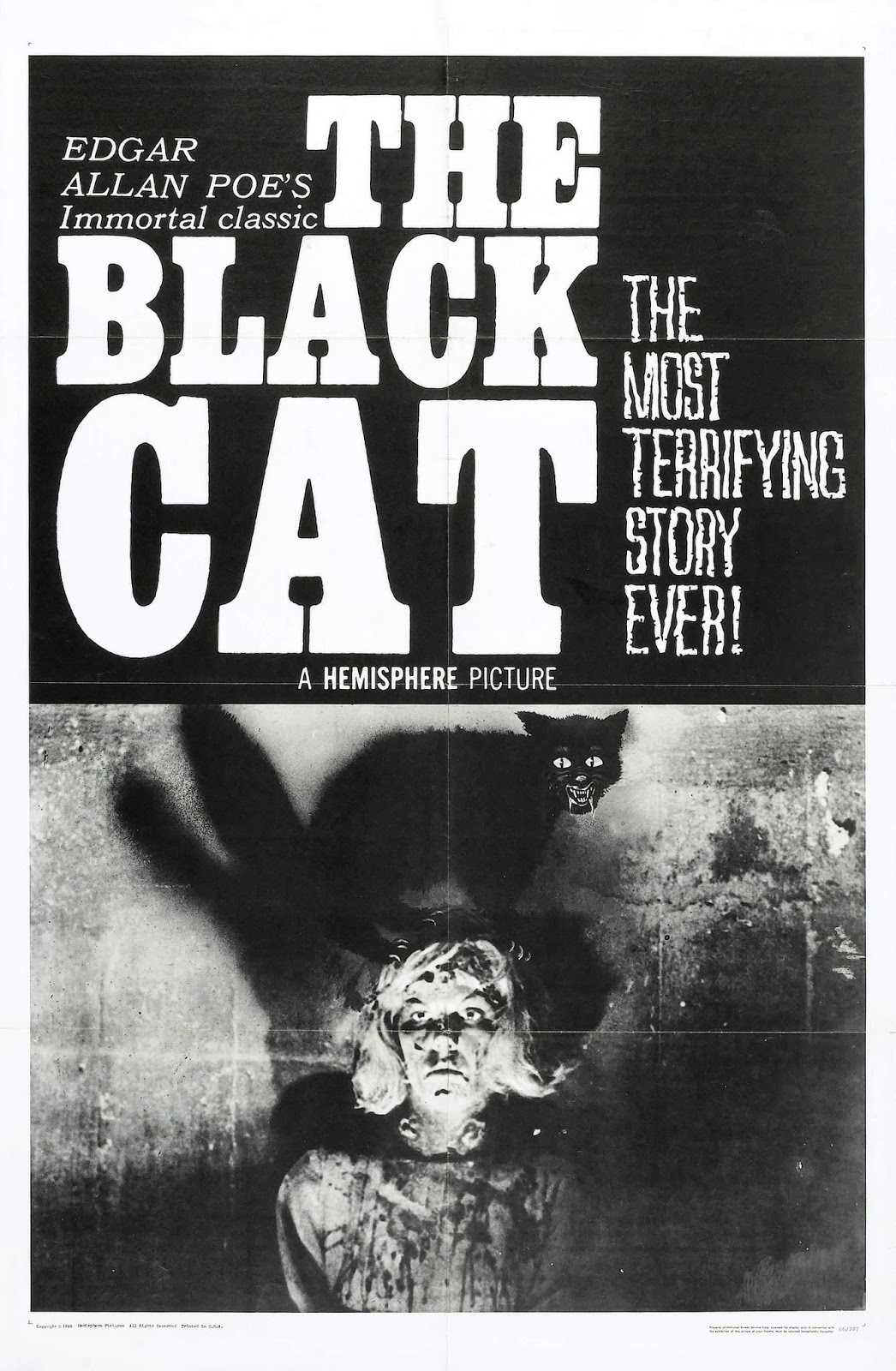
The 60's was the age of Edgar Allan Poe, kicked off by Roger Corman's priceless series with Vincent Price and copied endlessly by those who like making money.  The Black Cat (1966), while one of several adaptations and probably not the objective best of them, is a swift, stylish update on the tale, made in Texas and largely unseen until Something Weird's The Black Cat/The Fat Black Pussycat double feature DVD.  A young married couple collects animals, but this doesn't keep the husband from trying to strangle his wife.  Though he's unsuccessful, he takes his rage out on Pluto, a black cat his wife got him as a present, taking its eye out (in a really shoddy effect) and electrocuting it!  He takes an electroshock vacation at the sanitarium, eventually befriending a new black cat with a bad eye, and then madness and guilt start to close in on him, but not before we see a performance of a go-go band donning eye patches, complete with the audience frugging to "Bo Diddley."  All of this is really nicely shot, using its blacks and whites to full effect and at times letting the setpieces engulf the viewer.  It's apparently quite faithful to the original story despite its modern setting, so Poe enthusiasts will find it an interesting variation at the very least.  The other movie on the DVD is a sloppy, faux-Beat infused mess, so start with The Black Cat and sink in for 73 minutes of stylish creeps.


One of the most famous licenses Something Weird got was the library of Harry Novak, a legendary sleaze peddler from the drive-in days whose movies are the very definition of enticement.  Just look at that poster - total vintage greatness, and the movie's ripe for the picking, too.  A unique-esque horror mash-up, The Child (1977) follows the foreboding mystery of 11-year-old Rosalie, a precocious and seemingly evil girl whose hidden skills turn what should be a pleasant visit from a neighbor into a waking nightmare.  Everything about the movie evokes Halloween, from the scrumptiously hokey plot to the peppering of jack-o-lanterns throughout the film, right down to a Gol-Dang zombie attack.  Something Weird's DVD looks fantastic, the transfer dripping in deep color contrast and luscious film grain, and the clarity of DVD means we can see all the seams in the crude zombie makeup.  One drawback is that the movie's dialog is entirely dubbed, not because it was made in Europe but because the director was too cheap to record sound on the set, but I think it's some of the better dubbing in these kinds of horror movies.  Something Weird's Harry Novak DVD's went out of print a while ago, so if you see a copy of this one snatch it up ASAP.  It also comes with Del Tenney's I Eat Your Skin, if that's any kind of incentive.


Now hold on just a sec - Scream of the Butterfly (1965) ain't exactly an "Adults Only" affair.  It's mostly a tale of infidelity and entertaining melodramatics told in flashback by a room full of snark-butt divorce lawyers.  Two days after her marriage, Marla Williams (or "Miss Slutsy-Wutsy" as one of the lawyers saddles with her) falls deeply in lust with her "young Adonis" Paul, leading to lots of swimming and slow-mo, string-orchestra-throbbing making out.  The big twist in the movie, aside from the surprisingly hiply directed presentation of the thing, is the reveal that Paul is bi and sleeping with an older man on the side, and this evidence isn't taken lightly in the flash-forward bickering.  While the plot may not sound too creative, this movie is way, WAY cooler than its material calls for, wildly energetic and drenched in acidic humor.  It's actually the "B-side" movie on SWV's Day of the Nightmare/Scream of the Butterfly DVD but it should be the "A-side", as Day of the Nightmare was far too clumsy and boring to get me to care about crossdressing husbands.  If you're worried about that "Adults Only" label, don't - it's much more hyperactive soap opera than pseudo-porn, as there's really no porn, or even nudity, to be found. If you're in the mood for a wicked good time with B&W beachfront hysterics, Scream of the Butterfly should do the trick - Who Could Resist?


While many people continue to debate as to which movie featured on Mystery Science Theater 3000 was the worst, my vote will always go to the one that occupied my Wost Movie I've Ever Seen slot for many years (until the Final Boss of Film showed up) - The Starfighters (1964).  While the production may have begun as a drama centered around air force pilots, something must have gone horribly wrong, or at the very least the money ran out, because the film is about 30% drama and 70% stock footage of jets taking off, jets landing, jets refueling, jets dropping bombs, and jets just flying around for the heck of it, and that's a generous estimate.  The fact that the movie was released to theaters is insulting, and the distributors should have just shelved the footage and moved on.  Imagine my surprise when I found that its director, Will Zens, made a good movie a few years before called Capture that Capsule! (1961, aka Spy Squad), a Kold War Komedy about a couple of bumbling Soviet agents trying to get a rocket capsule with secret information and the US agents who foil them at every turn.  Made a year before the Cuban Missile Crisis, Capture that Capsule! makes up for its amateurish direction and bargain-bin acting with some genuine laughs and a steady pace, bouncing from one gag to the next with a breezy smile.  The DVD page tries to play up how bad it is, but if you just unclench your sphincters for a bit it's a really enjoyable goof-off satire that remains a fascinating piece of Cold War ephemera.  Just wait until we finally get to see what's in the capsule.


While most of Something Weird's catalog is best for belly laughing, Axe is a stark contrast in every sense of the word.  Another Harry Novak entry, 1977's Axe (aka Lisa, Lisa aka The Virgin Slaughter aka California Axe Massacre, even though the movie isn't set in California) follows a frightening group of criminals as they scum-spree their way away from a murder, driving the backroads of the wintry South and at one point stopping at a grocery store to scare and humiliate the check-out girl.  They stop at an isolated farmhouse inhabited by Lisa, a monotone, socially tone deaf teenager, and her near-catatonic grandfather, who spends most of the day watching TV static.  They blunder their way into the house, demanding meals and lusting after Lisa, and while Lisa's non-reaction to chicken butchering should have been a cue to her unhinged mental state nobody could have predicted what she would do with that hatchet.  Axe is a minor masterpiece of desolation and economy, wringing so much atmosphere and dread out of so little.  The bleak setting of the farmhouse is overwhelmingly sparse, the music is wonderful in that beautifully creepy 70's way (like the title music, which you should click on to restore your faith in low budget film scores, but look out for red housepaint chicken blood and fan editing), and the plot's morality vacuum only grows in power with each viewing.  This is the kind of horror the 70's was so celebrated for - creative, ruthless and free of stock plots, using any method and idea to scare its audience.  The Axe DVD is also way out of print, and while I'd recommend you get it here's the whole thing on YouTube so you can see it for yourself before dropping a pretty penny.  Axe is calling, and it'll hold you in its icy grip if you pick up the phone.


Meet Frederic Hobbs, outsider artist, inventor of the art car, and occasional b-moviemaker.  His '69-'74 run as a director wrought four movies - Troika (an experimental movie so obscure even I can't find it), the nude hippie-infested sight and sound journey/historical revisionist musical Roseland (featuring the song "You Cannot Fart Around with Love"), the turn-of-the-century-magician-revival-meets-international-vampire-conspiracy wonder Alabama's Ghost, and my personal favorite, Godmonster of Indian Flats.  Set in the real-life Wild West tourist town Virginia City, NV, Godmonster of Indian Flats follows two plots - one with a mining executive trying to cut a deal with the protective, ornery townsfolk, and the other with a mad scientist who makes an eight-foot-tall radioactive sheep monster.  This movie is unbelievably fun, keeping its loony plot cooking with a fast pace and directorial flair, and while Hobbs didn't have Jim Henson's Creature Shop at his disposable I guarantee you'll never forget the sheep monster.  What kind of gorgeous, unglued mind came up with this holy mess?  Only one that begs you to come back for more, and if this clip doesn't look like the greatest movie ever you might as well just lock yourself in the basement with a drum of tap water and a lifetime subscription to Oatmeal Monthly, because life ain't worth living without movies like this.  

Let's raise a glass to Mike Vraney and everybody at Something Weird for their tireless enthusiasm, as few other people would be willing to take chances on the stuff they find.  While not every movie they release is enjoyable (or watchable, for that matter), their catalog is one of a kind and always eye-opening.  If you have a taste for adventure, track these flicks down and get watching.  One of the things people at the memorial said repeatedly is that Mike Vraney was a man of passion and determination, and he knew that if you cared deeply about something you needed to get out there and do it yourself, because nobody'll do it for you.  He did just that, and Something Weird is a testament to his spirit.  Gosh Bless SMV and a blessed watching to you all.


~PNK

Saturday, January 11, 2014

Mirage-Monsters and Talk-Boxes - THE TERRORNAUTS (1967)


Science Fiction movies can be put into two categories - pre-2001 and post-2001.*  Whether or not you like Kubrick's monument to humanity's inability to evolve on its own, it's impossible to deny how 2001: A Space Odyssey revolutionized the production values, character and intellectual depth of Science Fiction movies forever.  The industry as a whole took some time to catch up (with that earlier asterisk pointing the way to the future of merchandising), as Sci-Fi was a genre dominated by low budgets, poor special effects and shallow sensationalism, and the public was willing to swallow all that in the name of Date Night.  Only a scant handful of Sci-Fi flicks were comparable to "real" movies in terms of intelligence and production value in those days, and the 50's, the heyday of schlocky space/atomic monster movies, may not have produced a dang one (some would point to The Thing from Another World, but Carpenter's 1982 remake eclipses the original).  The 60's saw both Robinson Crusoe on Mars (1964), a fascinating survival tale of a man marooned on the surface of Mars, and Quatermass and the Pit (1967), one of England's great Sci-Fi films and a seriously creative alternate history treat, but one more great film popped up before the Year of 2001 - The Terrornauts, straight from Amicus Productions.  In case you're wondering, the poster is much stupider than the movie itself.

Based on the novel The Wailing Asteroid by Murray LeinsterThe Terrornauts follows a team of astronomers in Star Talk, a SETI-like enterprise on its last financial legs.  The man running the project, Dr. Joe Burke (Simon Oates, a dead ringer for Martin Freeman in look and character), was inspired to search for life in outer space when he was a little boy - his archeologist father dug up a mysterious, bottle-like object at an ancient dig site.  He accidentally broke it one day, and it was filled with blue rocks.  That night he dreamed he was on an alien planet, and ever since then has been trying to reach out to whomever left that object.  
Their financier from an unnamed Foundation arrives one day to tell them they have only three months to get results with their half-million-pound telescope, and wouldn't you know it!, they get a repeating audio signal from an approaching object.  That object is an asteroid carrying a base, and a spaceship launches towards Star Talk, tractor-beaming the whole dang main building up with the team in it, as well as their cockney tea-cart lady and a cowardly accountant sent from the Foundation.  On board, they are greeted by a spindly robot vaguely reminiscent of NOMAD...or DREXL.  The robot leads them through a series of tests, such as being able to open a box of food with a strange handle, and having the compassion to give food to a hideous mirage-beast rather than kill it.  What are the aliens' motives?  What is the purpose of the tests?  How would I know if you were worthy to save humanity if I told you?

I'll be a straight shooter with you here - the effects aren't much better than an episode of Thunderbirds, but those deficiencies are entirely made up for by the smart screenplay and dedicated cast and crew.  While the ideas may not be new in the realm of Sci-Fi literature, they were pretty fresh at the time and are very well-developed, using the logical mystery of the aliens and their methods to draw the audience through the tasks and subsequent events right along with the characters.  The context of a search for intelligent life hampered by spotty funding and suspicious management is a welcome dose of realism when compared to the pie-in-the-sky utopian visions of previous generations of space opera filmmakers, and beats Contact to the punch by decades.  Not only does the movie capture the feeling of wonder at the secrets of the cosmos, it also shows a world where higher moral ideals can somehow traverse space and time, and mind beats out brawn.  The actors are all fine, especially Simon Oates, whose modest determination in the face of ridicule and absurdity is quite admirable (much like Michael Caine crafting an excellent Scrooge across from Muppets).  Yes, there are two useless tag-along comic reliefs, but they play off each other very well and end up getting all the best lines.  As for the folks behind the camera, the most noteworthy one is Elisabeth Lutyens, an acclaimed British composer whose score for this movie is outstanding, miles beyond most space opera scores before it and worth a release on CD.

DVD?  Feh.  The only official video release in the states is the long-OOP Charter Entertainment VHS, and don't bother hunting it down unless you feel like blowing $49.99.  I would point you to Sinister Cinema but they sadly discontinued their version (which came with the trailer in front of it).  Your best bet outside of torrenting is All Clues, No Solutions, which has loads and loads of gray-market movies in their catalog for $7.00 a pop.  Any way you get a hold of it, you won't be disappointed as long as you can turn a blind eye to the chintzy effects (or relish them, like I did).  The Terrornauts is a very creative, very fun Sci-Fi adventure that'll leave you wondering why more of these kinds of Sci-Fi flicks weren't made back in the day, or now, for that matter.


~PNK

*Hah!  You thought I was going to say Star Wars, didn't you?  Too easy!!!

Sunday, January 5, 2014

Chatterbox Spiderwebs - CITIZENS BAND (1977)


Though it seems silly now (and probably did doubly back in the day), the trucker craze of the 70's was a real cultural force for its brief life, and a big part of it was the CB radio craze.  It was a goofy glimpse into the future, as people were jabbering with relative strangers just for the sake of human contact, and no movie plunged deeper into the phenomenon than Citizens Band, an early effort not only for director Jonathan Demme (the first big studio project after his three-movie stint under Roger Corman) but also for Risky Business writer/director Paul Brickman.  It's never seen any video releases past its initial, long-gone VHS issue, and while it may seem like the most dated thing ever in cocncept it stands as a fascinating cultural portrait and an effortless, insightful ensemble comedy, and its recent appearance in the roster of Amazon Instant Video may help its reputation some, even if to just preserve it as an encapsulation of a unique social bubble before it popped.

Playing the Altman gambit, Citizens Band follows a loose collection of people in a small Texas town all connected through their CB radios.  The closest thing to a main character is Spider (Paul Le Mat), the local CB coordinator and sporter of the finest flannel/light brown hair combo I've seen in a while.  Other characters spiderweb (heh) off him, like his alcoholic, crusty father Papa Thermodyne (Roberts Blossom, aka the old man from Home Alone) and his hard-ass gym teacher brother, Blood (Bruce McGill of The Insider, Matchstick Men and everything else).  His best bits are in the middle of the movie when he decides to "clean up the band" - he screws a big antenna to the top of his car and prowls around town looking for unlicensed, FCC-disapproved rogue chatterboxes, like a little kid skipping school to jabber about his secret identity as The Hustler.  He fancies himself not only a CB watchdog but a crusader for sanity and community standards - one of his biggest jobs is taking down a far-right nutjob jabbering about "commie peapickers".  Another memorable bust is his pursuit of The Priest, played with slimy superchurch cheese by Ed Begley, Jr., and it's the only time you'll hear a man use clergy axioms to argue against getting an FCC license.

We also see the trials of Chrome Angel (Charles Napier, The Silence of the Lambs and Fred Olen Ray's Deep Space across from Firefly's Ron Glass), a cattle trucker who starts the movie by nearly running his truck off the road when a 900-number-style sexy voice cuts into his transmissions.  Later on we meet a pair of women at a bus station who exchange stories of their husbands' infidelities, and they also exchange photos of their families.  Once they pull out pictures of their husbands, it turns out they're the same man - Chrome Angel - and he'd been stringing them along by taking trips and talking to them on his CB (and is currently bunking in a new trailer with a third wife, Hot Coffee).  Some of the most charming stuff in the movie involves the two women dealing with the situation, and growing friendlier with each other in the process.

All of this, as well as a number of funny throwaway jokes*, are woven together with an incessant stream of CB code chatter, with "10-4"'s flying left and right and goofy nicknames as anchors.  While it's never laugh-out-loud funny, it's consistently laid-back and puts a smile on my face, keeping with the movie's steady pace and patchwork feel.  It's kind of like switching channels, with a number of personal stories going on at once, none of them aware of the others.  If you don't like any of them the change-over is pretty quick, and none of the character sketches wear out their welcome.  While none of the stories totally converge, all the characters do meet each other in a community effort to solve a comedic crisis - the weird little CB kinship finally producing an objectively good result.  Much of the CB analysis painted the subculture in a poor light, giving insecure people a semi-anonymous platform to air dirty laundry and occasionally make threats.  The movie keeps a close watch on the emotional heart of its characters, and real drama creeps in as subplots come to their conclusions.  Jonathan Demme's direction is quite creative for such small-scale storytelling, with lots of interesting tricks, like vérité-style handheld work, fast dolly shots, double exposure montages and quirky transitions, keeping the energy high.  The opening credits are a treat, as the camera pans across the interiors of CB radios as odd-sounding channels whiz past.  Paul Brickman shows a real knack for characterization and naturally witty dialogue, things that came in very handy for Risky Business and kept it from becoming bogged down in 80's artsiness or sex-comedy clichés.  The actors are properly professional, putting fast character communication at top priority, an essential factor in ensemble flicks.  All of this has a compliment in the Texas landscape, dry, glowing and always inviting.

Citizens Band is a movie that is more relevant now than when it was released, as instant messaging and internet avatars have made the handle jabbering a major part of daily life in the Western World.  It may have been this prophetic quality that prompted its addition to the Amazon Instant Video roster, so you can see it (for $9.99) without having to gamble on the old VHS.  If you're a Jonathan Demme fan you'll want to see it anyways, so grab the nearest copy and breath in the smell of CB wiring - and look out for FCC crusaders.


~PNK

*My favorite is when Spider sneaks up on an old woman chattering to nobody in particular.  Stock war movie music plays as he crawls up to the exposed wire on the side of her house, and when he cuts it not only does the woman's voice cut out but so does the music, as if she had a record playing on her channel.

Saturday, January 4, 2014

I'm ready for my slice-up, Mr. de Mille - SAVAGE INTRUDER (1970)


The horror fan can sometimes feel left out - there are so many acclaimed classic movies out there, but why do so few of them feed their need for horrific kicks?  I'm sure there's a Mummy fan out there who wished The English Patient had more attacking Ramses offspring, and I can tell you that Fred Astaire is rolling in his grave for not having the chance to make a vampire musical complete with dancing bats.  Sunset Boulevard needs no replacement or upgrade - it's wickedly smart and grandly cynical, a gem that only gains more lustre with each passing year.  Of course, there weren't any psychedelic chop-up-your-mother drug-trip sequences, and Savage Intruder (aka Hollywood Horror House) sets out to fill that gap and much more.  AWOL soon after its release, the movie has languished in obscurity save for a few super-rare VHS releases, and luckily Scarecrow Video in Seattle had a copy of the Unicorn Video release, which I happily duped.  After reading Bleeding Skull's review I wasn't sure what to expect, but luckily I found a smart, surprisingly well made riff on Wilder's classic with a lot of energy and style to keep things fresh.

The opening credits play out over a haunting, exquisitely shot ruin - the Hollywood sign.  I should warn you that some body parts may rear their ugly (lone) head.


This leads into a news report about a rash of murders of middle-aged women in the Hollywood area, and another woman nearly gets her hand electric-carved off before screaming loud enough to attract attention.  A tour bus stops in view of the mansion of the once-starpowerful Katharine Packard (real-life ex-star Miriam Hopkins, The Invisible Man), and Vic (David Garfield), a hippie-esque 30-something gets off the back bumper with bags in hand.  He insinuates himself into the household of the newly wheelchair-bound Packard by claiming to be a nurse, and while the unhinged, alcoholic Packard appreciates the young, attractive company the movie makes it very clear that Vic is the biddy-killer, bringing his knives and mommy issues with him.

While this could have been a tired retread of Psycho/Psycho-Biddy tropes, onetime writer/director/producer Donald Wolfe had savvier plans for his baby.  The camerawork is a joy to see from a novice director, working with the interiors of Packard's mansion to drive the viewer through to suspense and keep something interesting on screen to look at.  The editing is quick on its feet, and judicious use of odd lenses lets certain moments, like a falling vodka bottle, grip the eye and inspire the retina's color cones.  While the film is a knowing nod to classic Hollywood, complete with engagingly hokey acting and a credited gown supplier for Miriam Hopkins, these nods are balanced with the scunge and counterculture malaise of the early-70's Hollywood strip, leading Packard to bemoan the town's "hooligans and queers" in a breakdown during a real-life Christmas parade.  The horror elements are steeped in that first-half-of-the-70's grimy abandon we've come to love so well, and while the violence is spread out quite a bit it is a bit shocking for the time (though all the victims have blood type Sherwin Williams+).  Miriam Hopkins gleefully eats the scenery, swaying and cackling and having a ball just like she should, and David Garfield as Vic is quite creepy, even if his mommy issues are no more developed than his inner child coming across mommy in a hairy, fish-eye-lensed swinger party and chopping her hand off with an ax.  Composer Stu Phillips had a good time writing the movie's score, and while it never strays too far from the horror toolbox there's a lot of small details to perk the eardrums.  The dream sequences are dated as all Sam Hill, so if you can't take Yellow Submarine checkerboard hallways and sub-Doors organ freakouts you may want to keep away.  I'd be in remiss if I didn't tell you about how the pacing screeches to a halt 15 minutes from the end, but I wasn't too mad by that point and if you want to see the thing after all I've said it probably won't bother you either.

Don't bother trying to hunt down the VHS unless you've got a few hundred dollars lying around and a taste for gambling with old tape quality.  Not only have the bootleggers made it easy one company has made it a 70's horror double feature.  Behold Just For the Hell of It's Dear Dead Delilah/Savage Intruder double feature, and dang does that look like $30 well spent.  Dear Dead Delilah is a quirky, violent Southern Gothic treat from novelist John Farris that makes up for its long-haul talk scenes with witty overacting and saucy, melodramatic familial hatred.  I'm sure other companies can get you your fix otherwise, so if you've got a hankering for savvy-yet-bloody horror with a satirical bent Savage Intruder will suit your gullet well.  Why would you want Hollywood to make more classics anyways?  It's all hooligans and queers now - Katharine told me so.

(WARNING: GORE)

~PNK